I never imagined that absolute humiliation could arrive packaged in imported silk and premium champagne, but life has a cruel way of surprising you. There I was, perched precariously in the third row at my younger sister’s wedding. I smoothed down the fabric of the only formal dress I still owned, trying desperately to dissolve into the background. I wanted nothing more than to blend into a room filled with people who seemed too polished, too flawless, and entirely out of my league.
Beside me sat my son, Luca. He was swinging his legs beneath the table, looking impossibly proud in a little suit that had cost me two full paychecks to acquire. He looked around with wide, admiring eyes, taking in the lights and the flowers.
He truly believed that this day was going to be the bridge that finally reconnected us to the family. Perhaps, in some foolish corner of my heart, I had hoped for that too.
Vivienne, my sister, didn’t just walk through the venue; she glided. She radiated the kind of high-voltage energy usually reserved for movie stars on a red carpet. She had always possessed that magnetic quality. She was beautiful, she was charming, and she was unequivocally adored by everyone, most of all by our mother.
Growing up, Vivienne received the compliments, while I received the comparisons. She was born for the spotlight, and I had learned, out of necessity, how to navigate the shadows. Yet, despite everything, I showed up.
I forced a smile onto my face and applauded politely when they kissed. I kept my voice steady and neutral when distant relatives asked the inevitable, stinging questions.
“And you’re the older sister?” they would ask. “You certainly don’t look like you have an eight-year-old.”
Then came the moment everyone was waiting for: the speeches. The groom’s best friend went first, delivering a standard array of mildly amusing anecdotes that drew light, polite laughter. Then, it was Vivienne’s turn to speak.
I found myself expecting something sentimental. I thought she might speak about love, or perhaps share a memory of us growing up together. I even raised my champagne flute, ready to toast. I really should have known better.
She lifted her crystal glass, her smile beaming out over the crowd.
“I want to thank everyone for coming,” she began, practically glowing under the chandeliers. “It means the world to have you all here. And of course, I want to say something special about my big sister, Alara.”
I turned to Luca and offered him a reassuring smile. He looked up at me, his face bright with excitement. For a fleeting second, I actually believed she was about to say something kind.
Vivienne continued, her tone shifting slightly.
“Alara has been such a role model. She’s a single mom, strong, independent, and clearly unwanted by anyone else.”
The room erupted. A wave of laughter crashed over me. My stomach dropped, twisting into a cold, hard knot. Surely, I had misheard her? But she kept smiling, looking for all the world like she had just told the most charming joke in history.
A few guests looked confused, exchanging glances, but the majority laughed harder, clinking their glasses as if this cruelty was all in good fun. I didn’t know where to look. My heart began to hammer against my ribs, pounding in my ears like a war drum.
Luca tugged at my sleeve, his voice small.
“Why did she say that about you, Mama?”
Before I could even formulate an answer to protect him, my mother, Judith, chimed in loudly from her table, not missing a beat.
“She’s a used product, but hey, she still looks good for her age!”
The laughter came again, sharper this time, more jagged. It was the kind of laughter that slices through skin—the kind that tells you, without a shadow of a doubt, that everyone sees you differently now. You aren’t a guest; you aren’t family. You are entertainment. You are an object of pity and shame.
I was paralyzed. I couldn’t move, and I couldn’t breathe. My face felt like it was on fire, but I refused to let a single tear fall. Not here. Not in front of my son. Not in front of them.
My fingers curled into the linen napkin on my lap, gripping it like a lifeline until my knuckles turned white. I scanned the room, desperate to find a pair of eyes that held even a shred of compassion.
My grandfather, Norman, was staring intently at his plate. My cousin was smirking at something on her phone. Even my uncle, the man who once told me I reminded him of my late father, refused to look up.
And then I saw Luca. He looked lost, his little eyebrows furrowed in a mixture of confusion and hurt. That was the moment that truly broke me. It wasn’t the words, the laughter, or the burning shame—it was the fact that my son was witnessing it.
He was trying to understand why his mother—the woman who kissed his scraped knees and stayed up until midnight helping him with math homework—was being mocked by her own flesh and blood. I wanted to flee. I wanted to grab Luca’s hand, storm out, and never look back.
But something deep inside me hesitated. I wanted to speak. I wanted to scream. I wanted to defend myself, to tell them they didn’t know half of the burdens I had carried, half of the storms I had survived. But my mouth was as dry as sand, and my legs trembled violently under the table.
Then, before I could summon the will to move, I heard the distinct sound of a chair scraping against the floorboards.
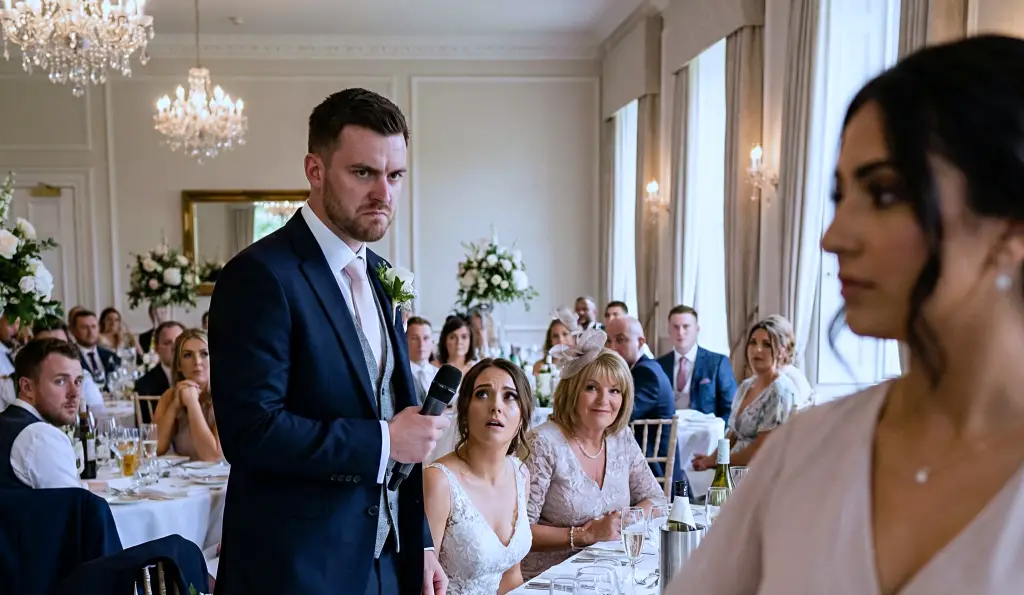
Callum, the groom—Vivienne’s perfect, polished fiancé—stood up slowly.
He didn’t look amused. He didn’t look at Vivienne. He didn’t even glance at the guests. His eyes were locked straight onto me. And something in his expression made the entire room freeze.
In that instant, I knew. Something was about to happen. This wasn’t a rescue, and it wasn’t a fight. It was a reckoning.