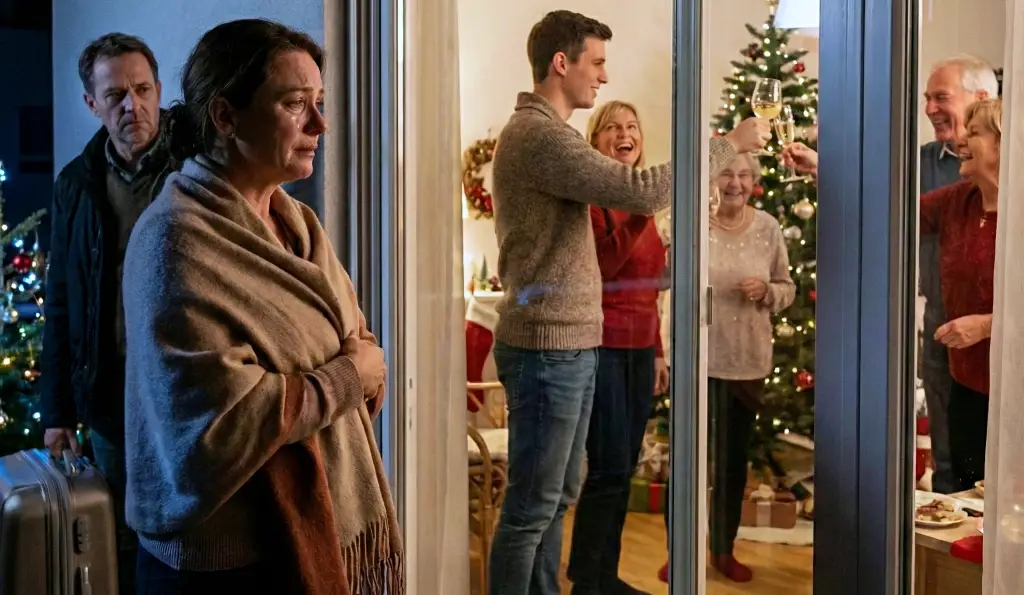
I returned from my trip in total secrecy. I wanted the element of surprise for Christmas, a moment of genuine joy to cap off a long year.
As I approached the driveway, the house was ablaze with festive lights. I could hear the distinct, rhythmic thrum of laughter drifting from the living room—the sound of a party in full swing. I left my suitcase by the front door and moved with slow, deliberate steps toward the side of the house. My gaze was drawn to the balcony; there, bathed in the soft glow of the garden floodlights, my wife was weeping silently.
She stared at the twinkling tree lights with a look of utter desolation. Inside, separated by a pane of glass, my son was laughing with his in-laws, raising a toast as if the world were perfect. No one noticed my return. I simply stood there in the shadows, observing, and in that moment, I understood the entire situation without needing to hear a single word.
But let me back up. Let me tell you from the beginning how a man who built an empire returned home to find his sanctuary invaded, and how retribution, when executed with surgical precision, can be devastatingly silent.
My name is Michael Anderson. I am sixty-two years old.
I own a chain of boutique hotels in the Florida Keys—six properties I clawed out of the sand thirty years ago, back when luxury tourism in Florida was nothing but a gamble nobody wanted to take. Today, those properties generate $40 million in annual revenue. It is a life that many envy, a level of success that few understand the true cost of.
My wife, Claire, is fifty-eight. We married thirty-five years ago when I had nothing to my name but dreams and a terrifying amount of determination. She worked right beside me in those first dilapidated hotels, scrubbing toilets when we couldn’t afford maids, manning the front desk until midnight, believing in a vision that everyone else called insanity.
We have one son, Stephen. He is thirty-two. He is an architect.
Or rather, he possesses the degree. In practice, he has never done an honest day’s work, always armed with excuses about a “tough market,” “impossible clients,” or an “unstable economy.” Four years ago, he married Amanda, a thirty-year-old woman—attractive, educated, and hailing from a family of “old money” in New York City.
Since the wedding, the atmosphere shifted. Subtly at first, then with undeniable clarity. Stephen began to pull away. The visits became rare; the phone calls, scarce.
Amanda always monopolized his time. Her family demanded his attention. Their high-paced life in New York apparently had no room for aging parents in Key West.
“Dad, you understand, right? Amanda needs to be near her family, and the work is there.”
“What work? Stephen, you haven’t touched a blueprint in six months. I’m looking.”
“I’m contacting clients. Building a network.”
Excuses. It was always excuses. Meanwhile, I continued to wire him money every single month. What started as parental support had morphed into his entire livelihood.
Because Amanda had standards. She required an apartment on the Upper East Side, a high-end German sedan, and vacations across Europe. And Stephen, possessing the weak spine he always had, couldn’t bring himself to say no.
Claire suffered in silence. She watched her son drift into the fog, watched her grandchildren—twins, two years old—grow up in social media posts rather than in her arms. Every time she voiced her heartache, Stephen had a rehearsed rebuttal ready.
“Mom, don’t be dramatic. We’re busy. We’ll visit when we can.”
But “when we can” never came. Unless, of course, they needed something. Capital for an investment, a loan for a sudden medical “emergency,” or an advance on his inheritance for a “once-in-a-lifetime” opportunity. And I, playing the fool, always signed the check. Because he was my son.
My only son. And parents are supposed to help their children, aren’t they?
This year, I decided to take a trip to Europe. Alone. Claire had pressing commitments with the charity foundation she managed.
I needed space. I needed time to strategize about the business, about a potential expansion into the Caribbean, and about a future that felt increasingly unstable.
“How long will you be gone?” Claire had asked.
“Three weeks, maybe four. I’ll visit properties, meet with investors, explore options. I’ll miss you.”
“And I’ll miss you.”
“But I’ll be back before Christmas. I promise.”
I left in mid-November. For the first two weeks, the rhythm of life seemed normal. Claire sent daily texts—photos of the garden, updates on the hotels, the trivial banter that kept us tethered. But then, the frequency dropped.
The messages became sparse, brief, carrying a tone I couldn’t quite decipher, but one that sparked worry in my gut. When we spoke, she sounded distracted.
It felt like her mind was elsewhere, like speaking to me was a chore rather than a comfort.
“Are you okay?” I asked during one call.
“Yes, of course. Why?”
“You sound different. Distant.”
“It’s your imagination. I’m just tired.”
But my instincts, honed by decades of high-stakes business, told me otherwise. Something was wrong. The more I ruminated on it, the tighter the knot of anxiety in my chest became. So, I made a decision.
I would return early. I wouldn’t tell a soul. I would surprise Claire for Christmas and see with my own eyes what was unraveling at home.
I touched down in Key West on the afternoon of December 23rd, three days ahead of schedule. I didn’t alert anyone. I hailed a taxi from the airport to our residence, a sprawling estate in an exclusive enclave overlooking the ocean.
It was a house I had built specifically for Claire. For her comfort, for her joy. It was nearly 8:00 PM when I pulled up.
The property was illuminated like a beacon. Christmas lights draped the garden, the tree was clearly visible through the bay windows, and the air was filled with sounds—laughter, music—as if a gala were in full swing. I paid the driver, grabbed my suitcase, and walked up the drive, key in hand, ready for the surprise, for the embrace, for the warmth of home.
But then I heard voices. Many voices. And a laugh I knew instantly. Stephen.
What was Stephen doing here? He was supposed to be in New York with Amanda and her clan.
I bypassed the front door, moving silently along the side of the house toward the patio. Through the large glass sliding doors, the scene unfolded before me like a grotesque play. The living room was packed—Stephen, Amanda, her parents (my in-laws)—all of them toasting, laughing, lounging in my house, in my living room, as if they held the deed.
And then I saw the other scene. On the balcony, Claire. My Claire. Sitting in solitude, a glass of wine loosely held in her hand, staring blankly at the Christmas tree, tears streaming down her face.
No one was looking at her. No one noticed her agony. They were too busy consuming the party, in the house I built, spending the money I earned, completely erasing the woman who had sacrificed everything for this family.
I remained in the shadows, a silent observer, and through the partially open screen door, I heard the fragments of conversation that laid the conspiracy bare.
“Finally, we have the house to ourselves, without Michael here barking orders.”
“Amanda, lower your voice. Your mother-in-law might hear.”
“So what, Stephen? Your father is in Europe, probably with a mistress. You think he cares about us? Does he care about Claire, out there crying? Just leave her.”
“She’ll get used to the new reality.”
“What reality?”
“That this house is perfect for us, for the kids. With your father traveling constantly, we could, you know, convince Claire it’s for the best. She should move into something smaller, more manageable, and we stay here.”
“Amanda, this is my parents’ house. And one day it will be yours.”
“Why wait decades? Stephen, your father is sixty-two. With luck, he’ll live another twenty years. Do you want to wait until you’re fifty to finally have the life you deserve?”
“I don’t know.”
Then Amanda’s father chimed in, a man of sixty-five with the booming, authoritarian voice of someone accustomed to obedience.
“Stephen, Amanda is right. Look at this property. It’s easily worth thirty million, and you’re paying rent in New York City. It’s absurd. Convince your father to transfer the property. Use estate planning as the pretext, tax protection, anything—but secure your future.”
“And if he refuses, then we work on your mother. Claire is more malleable, especially now that she’s alone, vulnerable. With her son visiting more, supporting her, being present, she can influence Michael. Make him see reason.”
“I don’t know if it will work.”
“It will work,” Amanda assured him. “Because Stephen, your father can’t take it all with him when he’s gone. And the sooner you secure what’s yours, the better. This house, the hotels… eventually, everything.”
“But you need to act, not wait.”
Amanda’s mother added the final dagger.
“And Claire, poor thing. She looks so lonely, so abandoned. Maybe she needs a reminder that family is here, that she can depend on us, that she doesn’t need to be in a house this big, this empty, when she could be in something cozier, closer to her grandchildren.”
The fury that surged through me in that moment was unlike anything I had ever felt. It wasn’t a hot, explosive rage. It was cold. Calculated. Lethal.
They were conspiring. Not just Stephen and Amanda, but her entire clan. They were plotting to usurp my home, manipulate Claire, and steal the future I had constructed brick by brick. And Claire—my Claire—was on that balcony weeping because she had likely heard these whispers before. She had probably been pressured and gaslit for weeks while I was away.