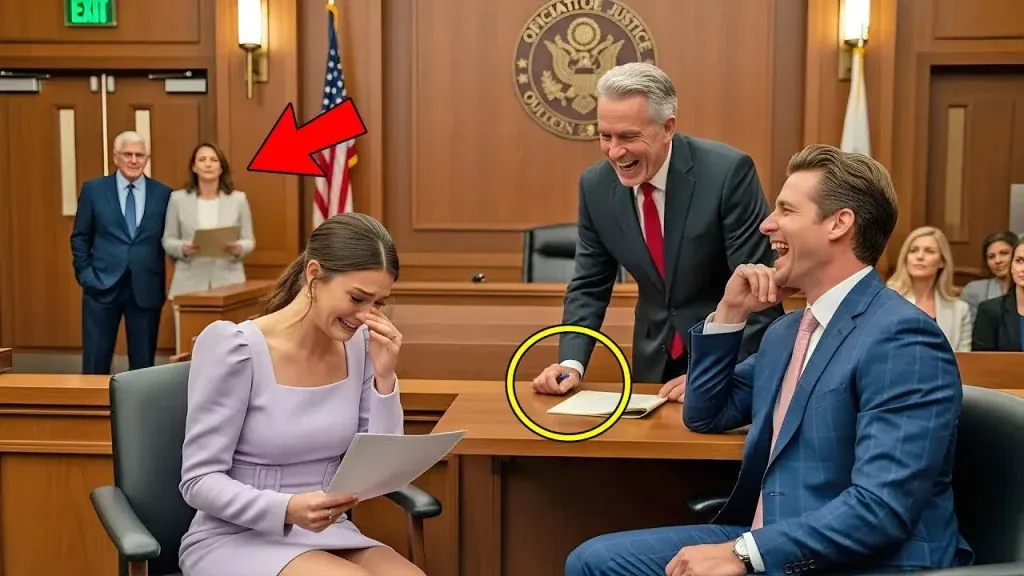
The courtroom hummed with the arrogant laughter of the wealthy. Alexander Hawthorne sat with his high-priced lawyers, a smug grin plastered on his face as he prepared to leave his wife, Sarah, with absolutely nothing. He thought she was just a simple stay-at-home mother from a no-name town, utterly alone in the city.
He thought winning would be easy. He was wrong. The moment the courtroom doors swung open and a fleet of black SUVs pulled up outside, everything changed.
Alexander wasn’t just divorcing a lonely housewife. He was declaring war on a dynasty he never knew existed. And today, they had come to collect.
The divorce proceedings of Hawthorne v. Hawthorne were taking place in the Superior Court of Manhattan, a building that smelled of old mahogany and expensive desperation. To Alexander Hawthorne, the smell was sweet. It smelled like victory.
Alexander adjusted the cuffs of his bespoke Italian suit, glancing at the reflection of his Patek Philippe watch. He was a handsome man, in the way sharks are handsome: sleek, predatory, and devoid of warmth. At thirty-eight, he was the CEO of Hawthorne Tech, a company he had built—admittedly, with the emotional support of his wife, Sarah.
But he conveniently forgot that part. Today, he wasn’t thinking about the late nights she stayed up helping him format business plans or the way she had nursed him through his stress-induced ulcers. He was thinking about Jessica, his twenty-four-year-old PR director, currently waiting for him in a hotel suite at the Ritz.
And he was thinking about how much he enjoyed crushing people.
“Look at her,” Alexander whispered to his lead attorney, Arthur Pendergast. Pendergast was a man who eviscerated the opposition. “She looks like she’s about to faint. This will be over before lunch.”
Arthur Pendergast chuckled, a dry, rattling sound. “Standard procedure, Alex. We crush her spirit. She signs the NDA and the waiver for alimony.”
“And she goes back to whatever cornfield you plucked her from,” Alexander sneered. “She has a public defender, for God’s sake. A public defender against me.”
Across the aisle, Sarah Hawthorne sat alone. She wore a simple grey dress that had seen better days. Her brown hair was pulled back in a severe, practical bun.
She looked tired. Her hands were folded on the empty table in front of her. Next to her sat a young, flustered-looking man named Timothy O’Malley.
He was a court-appointed lawyer who looked like he had graduated law school about fifteen minutes ago. He was shuffling papers nervously, dropping a pen, picking it up, and dropping it again.
“Mrs. Hawthorne,” Timothy whispered, his voice cracking. “I really think we should have taken the initial settlement. Five thousand dollars is better than nothing. Pendergast is a monster.”
“He’s going to argue that you contributed nothing to the marriage, and that you were, well, unfaithful,” Timothy continued anxiously.
Sarah didn’t look at him. She kept her eyes fixed on the judge’s bench. “I wasn’t unfaithful, Timothy. You know that. Alexander knows that.”
“It doesn’t matter what the truth is,” Timothy hissed, panic rising in his chest. “It matters what they can prove or what they can fabricate. They have photos, Sarah.”
“Doctored, maybe, but photos,” he added. “They have witness statements from staff you’ve never met. They are going to destroy you.”
“Let them try,” Sarah said softly.
Timothy stared at her. For a woman about to be thrown into the street without a penny to her name, she was bizarrely calm. It wasn’t the calm of peace. It was the calm of a hurricane’s eye.
Alexander leaned back, stretching his legs. He caught Sarah’s eye and smirked. He mouthed the word goodbye.
She didn’t blink. She just watched him, her eyes dark and unreadable.
Judge Harold C. Bentley entered the room, his black robes billowing. The bailiff called the order. Judge Bentley was a man who had seen it all, and he looked particularly bored today. Another rich husband dumping his starter wife; it was a Tuesday tradition in New York.
“We are here for the matter of Hawthorne versus Hawthorne,” Judge Bentley droned, adjusting his glasses. “Mr. Pendergast, you may begin your opening statement.”
Pendergast stood up, buttoning his jacket. He didn’t walk; he prowled. He approached the jury box, though there was no jury for this hearing, only the judge. He performed for the audience in the gallery.
“Your Honor,” Pendergast began, his voice booming with theatrical outrage. “We are here today to dissolve a marriage that was built on deception. My client, Mr. Alexander Hawthorne, is a titan of industry, a man of integrity, a man who pulled himself up by his bootstraps to build an empire.”
“And who did he drag up with him? This woman.” He pointed a finger at Sarah like a loaded gun. “Sarah Hawthorne, a woman from a small, insignificant town in rural Wyoming. A woman with no education, no background, and no assets.”
“My client, out of the goodness of his heart, married her,” Pendergast continued. “He gave her a life of luxury: penthouses, cars, designer clothes. And how did she repay him?”
Pendergast paused for effect. The courtroom was silent.
“She repaid him with laziness, with incompetence, and ultimately with infidelity,” he declared. A gasp rippled through the few spectators—mostly reporters Alexander had tipped off to humiliate Sarah publicly.
“We have evidence, Your Honor,” Pendergast continued, waving a thick file. “Affidavits from hotel staff, receipts. While my client was working eighteen-hour days to put food on the table, Mrs. Hawthorne was… entertaining guests.”
Alexander put on a mask of pained sorrow, looking down at his hands. It was a performance worthy of an Oscar.
“We are asking for a full annulment,” Pendergast declared. “We are asking that Mrs. Hawthorne be denied all alimony. We are asking that she be removed from the marital residence immediately. And furthermore, we are suing for defamation of character, citing the emotional distress she has caused my client.”
Timothy, the young lawyer, looked like he was about to vomit. He stood up, his knees shaking.
“Objection, Your Honor. This is… this is preposterous. Sarah—Mrs. Hawthorne has been a loyal wife for ten years.”
“Sit down, Mr. O’Malley,” Judge Bentley sighed. “You will have your turn.”
Pendergast smirked at Timothy. “The defense has nothing, Your Honor, because the defendant is nothing. She has no family to vouch for her, no character witnesses, no resources. She is a grifter who got caught.”
Alexander leaned over to Pendergast as he sat down. “Brilliant, Arthur. Truly brilliant. Did you see her face? She’s paralyzed.”
“She’s done,” Pendergast whispered back. “We’ll have the papers signed by noon. Then we go to lunch at Le Bernardin.”
Sarah sat perfectly still. She reached into her cheap purse and pulled out a small vibrating pager, the kind used in hospitals or old restaurants. It buzzed once—a harsh, mechanical sound.
She looked at the pager, then at the clock on the wall. Ten a.m. exactly.
“Sarah,” Timothy whispered. “What is that?”
Sarah finally turned to her terrified lawyer. A small, sad smile touched her lips. “I told Alexander that I came from a small town in Wyoming. That was true. But I never told him who ran the town.”
Timothy blinked. “What?”
“I told him I was estranged from my family because they were difficult,” Sarah continued, her voice gaining a sudden steely strength. “I didn’t tell him I left because I wanted to see if anyone could love me for me, and not for my last name.”
“Sarah, what are you talking about?”
“He failed the test, Timothy.”
Sarah stood up. She didn’t ask for permission. She simply stood, her posture changing instantly.
The slump vanished. Her shoulders squared. She looked taller, sharper, dangerous.
“Your Honor,” Sarah said, her voice cutting through the murmurs of the courtroom. It wasn’t the voice of a beaten housewife. It was the voice of someone used to giving orders that were obeyed instantly.
Judge Bentley looked over his glasses, annoyed. “Mrs. Hawthorne, your counsel will speak for—”
“My counsel has done an admirable job, given the lies he was fed by the opposition,” Sarah interrupted calmly. “But my actual legal team has just arrived. I request a brief recess to allow them to enter the building.”
Alexander laughed out loud. “Legal team? What legal team? The cashier from the grocery store?”
Pendergast rolled his eyes. “Your Honor, this is a delay tactic. She has no resources.”
“The recess is denied,” Judge Bentley said, banging his gavel. “Sit down, Mrs. Hawthorne.”
Boom. The sound wasn’t thunder. It was the heavy double doors at the back of the courtroom being thrown open with enough force to rattle the windows.
Every head in the room turned. The atmosphere in the room shifted instantly. The air grew heavy, charged with a sudden overwhelming pressure.
Standing in the doorway were six men. They were not court security. They were not local police.
They were dressed in black tactical suits, impeccable and terrifying, with earpieces coiling down their necks. They moved with a synchronized fluidity that spoke of elite military training. They stepped aside, forming a corridor.
Alexander frowned, his laughter dying in his throat. “Who the hell are these people?”
Through the corridor of guards walked a man and a woman. The man was older, perhaps in his sixties, but he possessed a vitality that made him seem ageless. He wore a charcoal suit that cost more than Alexander’s car.
He had silver hair, cold blue eyes, and he carried a silver-tipped cane—not because he needed it, but because it looked like a weapon. The woman beside him was younger, stunningly beautiful, with sharp features that mirrored Sarah’s.
She wore a white power suit that looked like armor. She carried a leather briefcase stamped with a gold crest, a crest of a lion holding a sword.
Behind them came a phalanx of lawyers. Not the frantic, sweaty lawyers of the Manhattan lower courts. These were the sharks that ate other sharks. There were twelve of them marching in lockstep, carrying stacks of files.
“What is the meaning of this?” Judge Bentley demanded, though his voice wavered slightly. “You cannot just barge into my courtroom.”
The silver-haired man stopped in the center of the aisle. He looked at the judge, then at Alexander. He didn’t look at Alexander like a person. He looked at him like a stain on the carpet.
“My apologies, Your Honor,” the man said. His voice was deep, smooth, and commanded absolute silence. “We were delayed by your city’s atrocious traffic. I am William Vanderquilt.”
The silence that followed was absolute. It was the kind of silence that happens when a bomb drops but hasn’t detonated yet. Alexander’s face went pale.
He knew that name. Everyone in business knew that name. Vanderquilt.
The Vanderquilts weren’t just rich. They were the bedrock of the American economy. They owned steel. They owned shipping. They owned media. And rumor had it they owned half the Senate.
They were old money—money that had existed before the country had borders.
“William… Vanderquilt?” Arthur Pendergast stuttered, standing up. “The… The industrialist?”
“And I,” the woman in the white suit said, stepping forward, “am Victoria Vanderquilt Sterling. Senior Partner at Sterling Holt and Associates.”
Pendergast choked. Sterling Holt and Associates was the most feared law firm in the western hemisphere. They handled international disputes, treaties, and the divorces of royalty. They didn’t come to Superior Court for a tech CEO.
“We are here representing the defendant,” William Vanderquilt said, turning his gaze to Sarah. His cold eyes softened instantly. “Hello, sweetheart.”
Sarah stepped out from behind her table. She walked past a stunned Timothy O’Malley and embraced the older man. “Hi, Dad.”
“Dad?” Alexander shrieked. He stood up so fast his chair toppled over. “That’s impossible. She’s Sarah Jones. From Wyoming.”
William Vanderquilt released his daughter and turned slowly to face Alexander. The look of affection vanished, replaced by a glacial hatred.