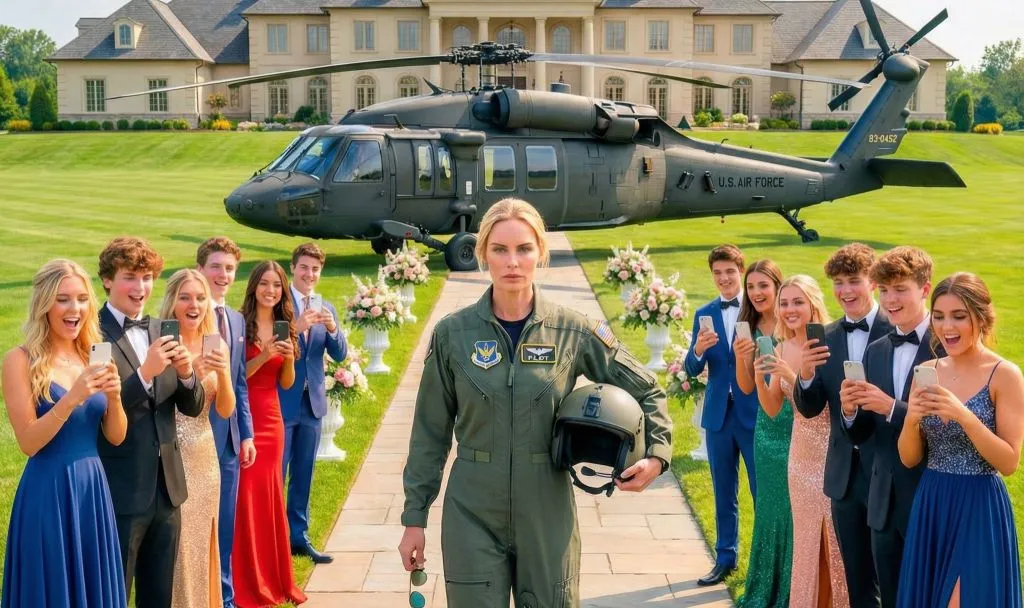
They sent her an invitation to the 10-year reunion, not because they wanted to see her, but because they wanted to humiliate her one last time. The girl they called the class loser, the one they mocked, ignored, and wrote off as invisible.
They laughed as they added her name to the guest list, already imagining her walking in alone, out of place, embarrassed. But when the night arrived and the ground began to shake, no one was laughing anymore. What happened next would leave 200 people speechless.
The rooftop bar overlooked downtown Seattle like a crown perched on glass and steel. Golden hour lights spilled through the floor-to-ceiling windows, catching the edges of wine glasses and casting long shadows across the polished table where four people sat. The city stretched out below them, glittering and distant, as if the world itself existed only to frame this moment.
Bridger Castellan leaned back in his chair, one arm draped casually over the backrest, his other hand scrolling through his tablet with the kind of ease that came from never having to worry about anything. He wore a tailored navy blazer that probably cost more than most people’s monthly rent. His smile was the practiced kind that came from years of closing real estate deals with handshakes and hollow charm.
Beside him, Sloane Devereaux held her phone at arm’s length, angling it to capture the sunset behind her. She tilted her head, lips parted just slightly, and snapped three photos in quick succession before lowering the device to review them. Her hair was styled in loose waves that looked effortless but had likely taken an hour to perfect.
She was the kind of person who curated her life for an audience, every moment filtered and framed, every interaction a potential post. Across from her sat Paxton Rhee, a corporate attorney whose entire presence radiated control. His suit was charcoal gray, his tie perfectly knotted, and his expression held that permanent edge of skepticism that lawyers wore like armor.
He swirled his whiskey glass slowly, watching the ice shift as if even his drink required strategic consideration. Lennox Faust completed the quartet. He was the youngest of the group, lean and sharp-featured, with the kind of restless energy that came from building a tech startup from nothing and watching it explode into something real.
He checked his watch twice in the span of a minute, not because he had somewhere to be, but because his entire identity was built on the idea that time was the only currency that mattered. The four of them had been meeting like this for months, planning the Glenridge Academy class of 2015 reunion with the kind of enthusiasm usually reserved for people who peaked in high school and never quite moved on.
Bridger stopped scrolling and tapped the screen. A smile spread across his face, slow and deliberate, the kind that promised trouble. He turned the tablet toward the others.
“Wait, wait,” he said. “What about Elowen?”
Sloane looked up from her phone, squinting at the screen. Then her eyes widened, and she burst into laughter—the kind that was too loud for the space, drawing glances from nearby tables. She covered her mouth with one hand, but the laughter kept spilling out.
“Oh my god,” she said between gasps. “Elowen Ashby? I completely forgot she even existed.”
Paxton leaned forward, his brow furrowing as he studied the image on the tablet. “The girl who ate lunch alone in the art room every single day?” he asked, his tone halfway between disbelief and mockery. “Are you serious right now?”
Lennox grinned, leaning in closer, his eyes lighting up with the kind of cruel inspiration that came from recognizing an opportunity. “This is perfect,” he said, tapping the table with his knuckles. “We send her an invite, she shows up thinking people actually want to see her, that maybe things have changed, that maybe she matters now.”
Sloane picked up the thread immediately, her laughter subsiding into something sharper, more calculated. “And we get to remind everyone how far we have all come,” she said. “The contrast alone would be…” She paused, searching for the right word, then smiled. “Chef’s kiss.”
Bridger was already typing, adding Elowen’s name to the digital guest list with theatrical flair.
“To the Glenridge Academy class of 2015 reunion,” he narrated aloud as he typed. “At the Cascadia Grand Estate, black tie required.” He looked up, grinning.
“She will show up in something from a thrift store,” Paxton smirked, lifting his glass. “If she even shows up at all.”
Sloane raised her own glass, tilting it toward the others. “Oh, she will,” she said, her voice low and certain. “People like Elowen always show up. They always hope things have changed.”
They clinked their glasses together, the sound sharp and bright in the warm air. The toast felt less like a celebration and more like a pact, a shared understanding that some people existed only to remind others of how much better their own lives had turned out. Bridger tapped a final button on the screen, and a notification appeared in the corner: Invitation delivered.
The camera lingered on the tablet screen, zooming in slowly on the yearbook photo that accompanied Elowen’s name. It was a school portrait from ten years ago, the kind taken in a gymnasium with portable lights and a bland gray backdrop. The girl in the photo was pale, almost ghostly, with oversized glasses that seemed to swallow half her face.
Her hair was thin and pulled back into a tight, unflattering ponytail. She wore a sweater that looked two sizes too big, drowning her already small frame. But it was her eyes that held the camera.
They stared directly forward, unblinking, unreadable, as if she were looking not at the photographer, but through him, past him, into something farther away. There was no smile, no attempt to seem approachable, just that quiet, unsettling stare.
The screen froze on that image, and then the scene shifted. The high school hallways appeared in fragments, quick cuts of memory that felt more like wounds than nostalgia. There was no dialogue, only images.
Elowen sat alone in the corner of the cafeteria, her back against the wall, a book open in front of her. The title was visible if you looked closely: Flight Dynamics and Aeronautical Engineering. Around her, tables full of students laughed and shouted and lived their lives as if she were not even there.
She turned a page, her expression unchanged, her focus absolute. She had learned long ago that invisibility was safer than visibility.
The next image showed her locker, spray-painted in thick, dripping letters with the word Ghost. The paint was still wet, running down the metal in uneven streaks. Elowen stood in front of it, staring at the word, her backpack hanging from one shoulder.
She did not cry. She did not react. She simply opened the locker, retrieved her books, and walked away.
Behind her, a group of students stood watching, Sloane among them, smirking as she whispered something to the girl beside her. They all laughed.
A classroom appeared next. A teacher handed back tests, moving down the rows, placing papers face down on desks. When she reached Elowen, she paused, smiled faintly, and set the paper down with a nod.
Elowen turned it over. 98%.
Behind her, Bridger received his own paper. 72%. He glanced at Elowen’s score over her shoulder, his jaw tightening.
He crumpled the paper into a ball and threw it at the back of her head. It bounced off and landed on the floor. Elowen did not turn around; she simply folded her test neatly and placed it in her binder.
The final fragment was the most painful. It was career day, held in the school gymnasium. Rows of booths lined the space, each representing a different profession or branch of the military.
Students wandered from table to table, asking questions, collecting brochures, imagining futures. In the far corner, near the exit, stood a booth with a banner that read: U.S. Navy Recruitment. Behind the table sat an officer in dress whites, patient and professional, waiting for someone, anyone, to show interest.
Only one person stood there: Elowen. She leaned forward slightly, asking a question the camera could not hear. The officer handed her a pamphlet, and she took it carefully, as if it were something fragile.
Across the gym, a group of students pointed at her and laughed. One of them mimicked a salute, exaggerating the motion, and the others doubled over. Elowen did not look at them.
She simply thanked the officer, tucked the pamphlet into her bag, and walked away. The last image was graduation day. The building stood tall and imposing, red brick and white columns—the kind of architecture meant to suggest tradition and excellence.
Students poured out of the double doors in caps and gowns, surrounded by families taking photos, friends hugging, parents crying with pride. Elowen walked out alone. No family, no friends.
She wore her cap and gown, but there was no one to take her picture. She paused at the bottom of the steps, turning back to look at the building one final time. Her expression was unreadable.
Then she turned and walked away, down the long sidewalk, into the distance, until she was just a small figure disappearing into the afternoon light. The camera held on the empty doorway she had left behind, the space where she had stood, as if the absence itself was louder than any goodbye.
A voiceover drifted over the image, soft and detached: They wrote her off as nothing, a dreamer, a nobody.
The scene shifted forward, snapping back to the present. The Cascadia Grand Estate appeared on screen, a sprawling venue of old-world elegance and new-world excess. Marble columns framed the entrance, wrapped in strings of warm Edison bulbs that glowed like fireflies in the evening air.
A red carpet stretched from the valet stand to the front doors, flanked by carefully manicured hedges and topiary shaped into perfect spirals. A live jazz band played somewhere inside, the music drifting out through open windows, mingling with the sound of laughter and clinking glasses. Luxury cars pulled up one after another, sleek sedans and convertibles, each one more expensive than the last.
Valets in crisp uniforms hurried to open doors, offering hands to guests who stepped out in designer dresses and tailored suits. Bridger, Sloane, Paxton, and Lennox stood near the entrance, positioned like hosts at a coronation. They greeted each arriving guest with wide smiles and enthusiastic hugs, the kind of shallow warmth that looked perfect in photos but felt hollow up close.
Sloane held her phone in one hand, snapping candid shots of arrivals, already planning which ones would make it to her social media feed. Bridger shook hands with a former classmate, clapping him on the shoulder and laughing at a joke that probably was not funny. Paxton accepted a champagne flute from a passing server, lifting it in a silent toast to no one in particular.
Lennox checked his watch again, then glanced toward the driveway as if waiting for something specific. Sloane leaned closer to Lennox, her voice dropping to a conspiratorial whisper.
“She RSVP’d,” she said.
“Yes?” Lennox raised an eyebrow. “No plus one?”
Sloane smiled. “Of course not.”
Bridger checked his own watch, frowning slightly. “She is late,” he said. “Probably could not find anything to wear.”
They laughed, the sound sharp and easy, and moved inside to join the party. The ballroom was spectacular. Crystal chandeliers hung from the vaulted ceiling, casting prismatic light across the polished marble floor.
Round tables draped in white linen filled the space, each one topped with elaborate floral centerpieces that smelled faintly of roses and lavender. At the far end of the room, a massive projection screen displayed a rotating slideshow of yearbook photos, prom pictures, sports victories—candid moments frozen in time. The images cycled slowly, each one accompanied by a ripple of recognition and nostalgia from the crowd.
People pointed at the screen, laughing, groaning, reminiscing about hairstyles and fashion choices that had not aged well. When Elowen’s yearbook photo appeared on the screen, the room erupted. Laughter echoed from every corner, loud and unrestrained.
Someone near the bar shouted, “Oh my god, I forgot about her!”
Another voice chimed in from across the room. “She was so weird. Did she not want to be a pilot or something?”
More laughter. Someone else added, “Yeah, good luck with that.”
The photo lingered on the screen for a few more seconds. That same pale face, those same oversized glasses, that same unreadable stare, and then it cycled to the next image. The laughter faded, replaced by the hum of conversation and the clink of silverware against plates.
Sloane stood near the edge of the dance floor, holding her phone up to film a quick video for her followers. She smiled into the camera, her voice bright and performative.
“Reunion glow-up check,” she said, tilting the phone to capture the room behind her. “Let’s see who shows up tonight.” She winked and ended the recording, already planning the caption.
Paxton stood at a table near the entrance, nursing his second whiskey of the night. He leaned toward Lennox, who had finally stopped checking his watch and was scanning the room with the detached interest of someone who had already decided the event was beneath him.
“Twenty bucks says she shows up in a Honda Civic,” Paxton said, smirking.
Lennox snorted. “I will take that bet. I am thinking she does not show at all.”
They shook on it, sealing the wager with the kind of casual cruelty that came from never having been on the other side of the joke. Inside, the party continued. The jazz band transitioned into a swing number, and a few couples moved onto the dance floor.
Servers circulated with trays of champagne and hors d’oeuvres. The slideshow kept cycling. Each photo was met with cheers or groans or good-natured teasing. It was the kind of night that felt perfect on the surface.
The kind of night people would post about and remember fondly. The kind of night that hid its cruelty beneath layers of nostalgia and expensive wine. And then the music stopped.
It happened mid-song, the band cutting off abruptly as if someone had yanked a plug from the wall. The sudden silence was jarring, disorienting. People froze, drinks halfway to their lips, conversations trailing off into confused murmurs.
A low rhythmic sound began to fill the space, faint at first, almost imperceptible, like a distant heartbeat. Thump, thump, thump.
The sound vibrated through the floor, rattling the glassware on the tables, making the chandeliers sway ever so slightly. Bridger frowned, looking around.
“What the heck is that?”
The sound grew louder, deeper, more insistent. Thump, thump, thump. The vibrations intensified, strong enough now that people could feel them in their chests, in their bones.
A champagne flute tipped over on a nearby table, spilling pale liquid across the white linen. Someone gasped. Another person laughed nervously, unsure whether this was part of the entertainment or something else entirely.
Paxton set his whiskey down, his expression shifting from amusement to concern. “Is that thunder?”
But it was not thunder. Thunder came in bursts, in crashes. This was steady, mechanical, relentless.
The sound continued to build, filling the ballroom, drowning out the murmurs and the nervous laughter. The chandeliers swayed more visibly now, their crystals clinking together in a discordant melody. A crack appeared in one of the tall windows, a hairline fracture that spread slowly outward like a spiderweb.
Someone near the back of the room screamed. The crowd began to move, a collective surge toward the windows and the French doors that opened onto the lawn. People pushed past one another, craning their necks, trying to see what was happening outside.
The sound was deafening now, a deep mechanical roar that seemed to come from everywhere and nowhere at once. The floor shook. The walls trembled. The entire building felt as if it were holding its breath.
Sloane stumbled toward the nearest window, her phone clutched in one hand, her face pale. She pressed her palm against the glass, staring out into the night.
“What is happening?” she whispered, but no one answered. No one knew.
The French doors flew open, blown wide by a sudden gust of wind, and the crowd spilled out onto the lawn. The camera followed them in a single, unbroken shot, weaving through the chaos, capturing the confusion and fear etched into every face. Outside, the night air was thick with dust and noise.
The manicured lawn, which had been pristine just moments before, was now obscured by a swirling cloud of debris. The roar was overwhelming, a physical force that pressed against eardrums and made it impossible to think, to speak, to do anything but stare. And then, through the dust, a shape began to emerge.
It descended from the sky like something out of a dream—or a nightmare, depending on who was watching. The AH-64 Apache attack helicopter was massive, its rotors slicing through the air with brutal precision, kicking up dirt and grass and sending it spiraling outward in waves. The landing lights blazed white-hot, illuminating the stunned faces of 200 guests who stood frozen on the lawn, mouths open, eyes wide, utterly unable to comprehend what they were seeing.
The helicopter descended slowly, deliberately, as if it had all the time in the world. The noise was unbearable, the wind was relentless, and yet no one moved. No one ran. They simply stood there, transfixed.
The Apache touched down with a shudder, the landing gear sinking slightly into the soft earth. The rotors began to slow, the roar diminishing to a low, steady hum. The dust settled, drifting back down to the ground in lazy spirals.
The silence that followed was almost worse than the noise. It was heavy, expectant, as if the entire world were holding its breath. The side door of the helicopter opened.
A gloved hand gripped the edge of the doorframe. A boot touched the ground. The camera held on the silhouette, backlit by the helicopter’s interior lights. A dark figure framed against the glow.
For a moment, no one moved. No one spoke. The entire crowd stood in frozen disbelief, staring at the figure emerging from the machine.
Sloane’s voice broke the silence, barely audible, trembling with disbelief. “Elowen?”
The figure stepped fully into view. Elowen Ashby stood before them, and she was unrecognizable. Gone was the pale, fragile girl from the yearbook photo.
In her place stood a woman forged by discipline, sacrifice, and something far beyond the reach of anyone in that crowd. She wore a full naval aviator flight suit, olive green and perfectly fitted, with patches on her shoulders that read U.S. Navy and HSC-85. A trident insignia gleamed on her chest, the symbol unmistakable.
Her hair was pulled back into a tight, functional bun. Her face was calm, composed, carved by years of training and survival in environments most people could not even imagine. She removed her helmet with one smooth motion and tucked it under her arm.
Her gaze swept across the crowd, steady and unwavering. She did not smile. She did not need to.
Behind her, two crew members stepped out of the helicopter, both in uniform, both standing at attention. One of them, a young petty officer, saluted her.
“Ma’am,” he said, his voice clear despite the residual hum of the rotors. “We will be on standby.”
Elowen returned the salute with precision. “Thank you, Petty Officer.”
She began to walk forward. The crowd parted, not because anyone consciously decided to move, but because something about her presence demanded it. She walked with the kind of confidence that came from knowing exactly who she was and what she had done.
Every step was measured, deliberate, unhurried. She was not here to rush. She was not here to perform. She was simply here.