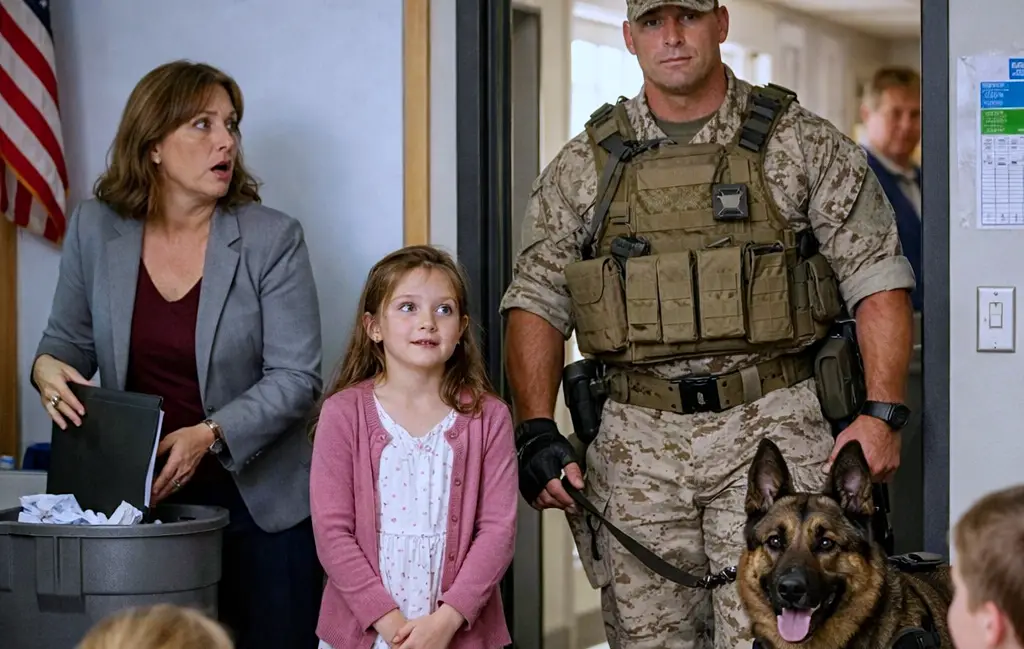
A cool Pacific breeze drifted through the schoolyard as morning fog clung low to the sidewalks around Redwood Creek Middle School, softening the edges of a quiet suburban campus just waking up. Emily Carter arrived early, as she often did, clutching her presentation folder to her chest with both arms as if it might slip away if she loosened her grip.
At eight years old, she was small for her age, narrow-shouldered and light-boned. She had pale skin that flushed easily and a dusting of freckles across her nose that darkened when she was nervous. Her light brown hair, usually brushed neatly by her mother each morning, had already begun to escape its ponytail. Thin strands clung to her cheeks as the coastal air dampened them. Emily walked carefully, eyes down, sneakers scuffing the concrete.
She was rehearsing the words in her head for what felt like the hundredth time. “My hero is my dad.” She whispered it under her breath, testing the sentence again. She had practiced for days, at the kitchen table, on her bed, even quietly in the bathroom mirror. The words themselves were simple, but the courage required to say them out loud felt enormous.
Emily was not a child who enjoyed attention. She was observant and inward, the kind of girl who listened more than she spoke. She felt things deeply but rarely showed them on her face. That quietness had grown sharper over the past year, shaped by long evenings waiting for phone calls that came late or not at all. She had learned early that loving someone in uniform meant living with absence as a constant companion. Her father, Staff Sergeant Daniel Carter, was the center of her story.
Daniel Carter was not a tall man, but he carried himself with the unmistakable posture of a Marine: straight-backed, deliberate, and economical in every movement. In photographs, his face was angular and weathered beyond his years. He had a squared jaw, close-cropped dark hair already threaded with gray at the temples, and eyes that rarely smiled fully even when his mouth did. He wore his beard short when allowed, a rough shadow that never quite disappeared. His skin bore the quiet marks of long days outdoors: sun-worn, slightly scarred, practical rather than polished. To strangers, Daniel could seem reserved, even distant.
To Emily, he was gentle in ways that surprised people. He was patient when explaining homework over video calls and soft-spoken when reading bedtime stories through a screen. He was unfailingly attentive when she spoke, no matter how small the concern. Daniel’s seriousness had not always been there. Years earlier, before deployments and training cycles blurred into one another, he had laughed more easily. Emily’s mother said the change came after a training accident overseas. It was nothing officially recorded, nothing dramatic enough for medals or headlines, but enough to leave Daniel quieter, more watchful.
He had returned home with the habit of scanning rooms instinctively, of standing with his back to walls, and of pausing before speaking, as if weighing every word for risk. Emily did not know these details, not fully. She only knew that when her father looked at her, the tension in his shoulders softened. When he promised something, he kept it. The presentation folder held more than paper. Inside were drawings Emily had made herself: her father in camouflage, a small American flag in one corner, and beside him a large, dark shape with pointed ears.
Rex, the K9 her father worked with. Rex was four years old, according to Daniel. He was a Belgian Malinois with a lean, powerful build, deep amber-brown eyes, and a scar just above one ear from training long before Emily met him. In photos, Rex always sat close to Daniel’s leg, alert but calm, his posture disciplined to the point of stillness. Emily loved Rex instantly, even though she had only seen him in person twice. Her father told her Rex was brave and loyal, but more importantly, he trusted Rex completely. That, to Emily, was the highest form of praise.
Emily reached her classroom early and slipped into her seat near the window. The room smelled faintly of dry-erase markers and cleaning solution. Posters about kindness and teamwork lined the walls in cheerful colors. She placed her folder carefully on her desk and smoothed the edges with small, precise movements, trying to calm the flutter in her chest. Ms. Laura Bennett entered moments later. Laura Bennett was in her early forties with straight blonde hair cut just below her jawline and carefully applied makeup that never appeared rushed.
She dressed in neutral tones—cardigans, pressed slacks, sensible shoes—and carried herself with the confidence of someone who had long believed she understood children better than most. She spoke clearly and crisply, often reminding parents and colleagues alike that she valued structure, honesty, and academic standards. To many, she appeared professional and fair. To students, she could be distant, her approval conditional, and her disappointments sharp. Ms. Bennett noticed Emily’s folder immediately.
Her eyes lingered on the drawings as she circulated the room, pausing just long enough for Emily to feel the weight of that attention settle on her shoulders. Emily looked up briefly, offered a small, hopeful smile, then looked back down when no smile returned. When presentation time arrived, Emily’s hands trembled as she stood. She carried her folder to the front of the room, standing stiffly beside the whiteboard. The classroom felt larger than usual, the faces of her classmates blurring together. She began softly, her voice barely above a whisper at first, then steadier.
She spoke about her father, about how he trained, how he helped people, and how he worked with Rex to keep others safe. Ms. Bennett interrupted with a raised eyebrow.
“And where did you learn all this, Emily?” she asked, her tone light but edged with skepticism.
“My dad told me,” Emily answered, tightening her grip on the folder.
Ms. Bennett glanced at the drawing of Rex. “That’s quite a lot for a Marine, don’t you think?” she said, not unkindly, but not warmly either. “Are you sure you’re not confusing some of this with movies or television?”
Emily shook her head. “No, ma’am.”
There was no accusation, no raised voice, but something shifted in the room. Ms. Bennett took the folder, flipping through it slowly, then reached for her red pen. She wrote two words across the top of the first page: “Not Verified.” She placed the folder on the corner of her desk, separate from the others. Emily’s stomach dropped. Ms. Bennett said nothing more, simply gesturing for Emily to return to her seat.
As Emily walked back, heat flooded her face, and her ears rang with the sound of her own heartbeat. She sat down carefully, folding her hands in her lap, staring at the grain of the desk as if it might offer answers. She did not cry. She did not speak. But inside, something fragile cracked quietly. At recess, Emily sat alone, watching other children run past. The folder was still on the teacher’s desk behind the classroom door.
She wondered, for the first time, whether loving her father so openly had been a mistake. She wondered whether telling the truth could sometimes be the wrong choice. When the final bell rang, Ms. Bennett returned the folder without comment, setting it down rather than handing it back. Emily picked it up, noticing the red ink as if it were a stain that would not wash out. That evening, at home in their small rental near the base, Emily’s mother, Sarah Carter, noticed immediately. Sarah was a slender woman in her mid-thirties, with tired blue eyes and fine lines at the corners that spoke of long hours standing on her feet.
Her light auburn hair was usually tied back in a practical bun, a few strands escaping no matter how carefully she tried to contain them. She worked part-time as a cashier, polite to customers even when they were unkind, determined to keep life stable while Daniel was away. Strength, for Sarah, was quiet persistence. Emily handed her the folder without a word. Sarah read the red ink, then looked at her daughter’s face, too still, too composed.
“What happened?” she asked gently.
Emily swallowed. “She said she didn’t believe me.”
Sarah closed the folder slowly, her jaw tightening just enough for Emily to notice. “I see,” she said, forcing her voice to remain calm.
Later that night, after Emily had gone to bed, Sarah sat alone at the kitchen table. She stared at her phone, Daniel’s name glowing on the screen. She did not call, not yet. She knew her husband well enough to understand that some truths, once spoken, could not be taken back. Somewhere, far from the classroom where doubt had taken root, a Marine prepared to come home. He was unaware that his daughter’s quiet faith in him had just been tested for the very first time.
The classroom felt different the next morning, heavier somehow, as if the air itself remembered what had happened the day before and refused to let it go. Emily Carter took her seat more slowly than usual, her backpack resting at her feet. Her hands were folded carefully on the desk, as though she were afraid that any sudden movement might draw attention she did not want.
At eight years old, she had already learned a small but painful truth: once doubt entered a room, it lingered. Ms. Laura Bennett stood at the front of the class, posture straight, her expression composed in the practiced way of someone who believed firmly in her own judgment. She had not slept poorly. In her mind, the previous day had been a matter of responsibility, of maintaining standards. Children exaggerated. That was what children did. It was a teacher’s role to correct them gently, firmly, before fantasy hardened into dishonesty.
Laura Bennett told herself this as she scanned the room, her gaze passing briefly over Emily without stopping. When she called Emily’s name, it was not loud, not sharp. It was calm, professional, almost kind. That, somehow, made it worse.
“Emily, please bring your project up here.”
Emily’s stomach tightened. She stood, chair legs scraping softly against the floor, and walked to the front with small, careful steps. Her face was pale now, freckles standing out sharply against skin drained of color. She did not look at her classmates. She kept her eyes on the edge of the desk where Ms. Bennett waited. Ms. Bennett took the folder without comment and opened it again, flipping through the pages as if seeing them for the first time.
The drawing of Daniel Carter in uniform lingered under her gaze, then the careful crayon rendering of Rex, the K9, ears alert, body poised. A faint smile touched her lips—not warm, not amused, but skeptical.
“Class,” Ms. Bennett said, holding the folder up slightly, “this is a good opportunity to talk about accuracy.”
Emily’s heart began to pound. Ms. Bennett reached for her red pen again and, with deliberate strokes, underlined the words she had written the day before: Not Verified. Then, she did something new. She closed the folder and placed it, not on her desk this time, but into the small plastic bin beneath it—the one used for scrap paper and outdated worksheets. A soft gasp rippled through the room. Emily froze.