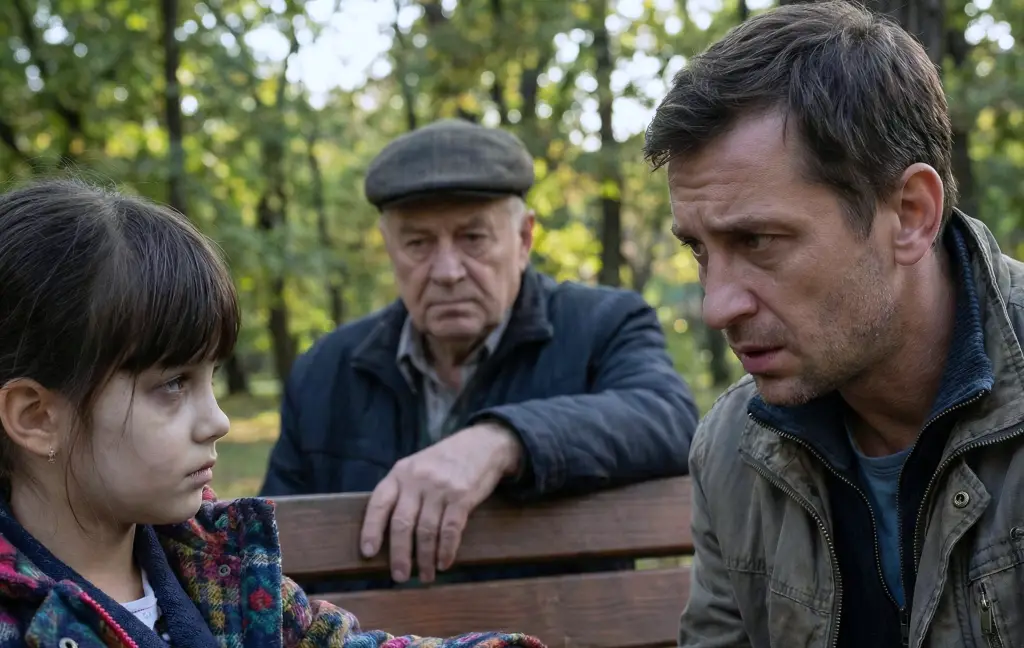
“Take that bracelet off her now.”
I pulled into the clinic parking lot for the sixth time that month, my knuckles white against the steering wheel. In the back seat, my daughter Mia sat quietly, her small hand pressed against her nose with yet another tissue already blooming red.
“It’s okay, sweetheart,” I said, forcing calm into my voice. “Dr. Patterson will figure this out.”
But I didn’t believe my own words anymore. We’d been here five times in three weeks. Blood work, imaging, coagulation panels, allergy tests. Every single result came back normal. Meanwhile, my eight-year-old daughter was bleeding through a box of tissues every other day.
“Daddy, it’s happening again,” Mia whispered.
I twisted around to see fresh blood trickling from her left nostril. The tissue in her hand was already saturated. This was the third one today. It was barely noon.
My ex-wife Claire had called me dramatic when I first raised concerns. “Kids get nosebleeds, Daniel,” she’d said dismissively. “You’re overreacting like always.”
But this wasn’t normal. No child should bleed this much, this often.
Dr. Patterson entered the examination room with the same practiced smile she’d worn at every previous visit. She was thorough, competent, and clearly as frustrated as I was.
“Mr. Chen, I’ve reviewed all of Mia’s test results again,” she said, pulling up screens on her tablet. “Platelet count is normal. Clotting factors are normal. No signs of von Willebrand disease. No hemophilia markers. No vascular abnormalities on the imaging.”
“Then why is she bleeding every single day?” The words came out sharper than I intended.
Dr. Patterson’s expression softened. “I understand your frustration. Sometimes pediatric epistaxis can be idiopathic, meaning we can’t identify a clear cause. The nasal passages are delicate, and in some children…”
“Sixteen nosebleeds in three weeks isn’t delicate nasal passages,” I interrupted. “Something is wrong.”
She nodded slowly. “I’m going to refer you to Dr. Okonkwo, a pediatric hematologist at Children’s Hospital. If there’s something we’re missing, she’ll find it.”
Another referral. Another specialist. Another round of tests, while my daughter kept bleeding.
The following Tuesday, Claire dropped Mia off at my apartment after her week at her mother’s place. Our custody arrangement had Mia alternating weeks between us, a schedule that had worked well enough since the divorce two years ago.
“How was your week, sweetie?” I asked, pulling Mia into a hug.
“Good. Grandma Diane came over lots. She made cookies and we watched movies, and she gave me this.”
Mia held up her wrist, showing off a delicate silver bracelet with small butterfly charms dangling from it. My stomach tightened. Diane was Claire’s mother, and our relationship had been strained since the divorce. She’d made it clear she thought Claire had married “beneath herself” when she’d chosen a high school math teacher over the lawyers and doctors in her social circle.
“That’s pretty,” I said carefully. “When did Grandma give you that?”
“Last Monday. She said it was special, that it belonged to her mother, and now it’s mine. I have to wear it every day to keep the family blessing.”
I examined the bracelet more closely. It was old, probably vintage, with an ornate clasp and delicate filigree work on each butterfly charm. The silver had a slightly tarnished look despite Mia obviously trying to keep it polished.
“Have you been wearing it all week?”
“Uh-huh. Grandma said I should never take it off, not even for bed or bath. She said the blessing only works if I keep it on.”
Something cold settled in my chest. I glanced at the calendar on my fridge. The nosebleeds had started three weeks ago. The first really bad one had been… I pulled out my phone and scrolled through my calendar alerts. Monday, three weeks ago. The day after Claire had mentioned her mother coming to visit.
It was probably nothing. Correlation wasn’t causation. But I couldn’t shake the unease creeping up my spine.
That night, Mia had two nosebleeds before bed. I’d barely gotten the first one stopped before the second started. She fell asleep, exhausted, and I sat in the hallway outside her room, staring at that silver bracelet on her thin wrist and trying to talk myself out of paranoia.
Thursday afternoon, I took Mia to Confederation Park, despite the October chill. She needed normalcy, needed to be a kid instead of a patient. She ran ahead to the playground while I followed, coffee in hand, watching her climb the equipment with the careful attention of a parent who’d spent too many hours in medical waiting rooms.
“Your daughter’s very energetic.”
I turned to find an elderly man on the bench beside mine. He wore a heavy cardigan and wire-rimmed glasses, a paperback folded in his weathered hands. He had the look of a grandfather enjoying retirement in the autumn sun.
“She’s a good kid,” I said, offering a polite smile before returning my attention to Mia.
“That’s a beautiful bracelet she’s wearing. Vintage craftsmanship. You don’t see work like that anymore.”
I glanced at him, surprised he’d noticed such a small detail from this distance. “It was her grandmother’s. Family heirloom.”
The man was quiet for a moment. His eyes were still on Mia as she slid down the slide. Then he leaned forward slightly, his voice dropping.
“Has she been ill lately?”
Every muscle in my body tensed. “Why would you ask that?”
“I’m sorry. I don’t mean to pry. It’s just… I spent 40 years as a research chemist before I retired. Old habits die hard. I couldn’t help but notice that the bracelet’s patina is unusual. Silver tarnishes to black or gray, typically, but that piece has an almost greenish discoloration in places. That can indicate copper contamination. Or…”
He trailed off, seeming to reconsider his words.
“Or what?” My heart was pounding now.
The man met my eyes. “Or deliberate alloying with metals that shouldn’t be worn in prolonged skin contact. Some antique jewelry was made with compounds that we now know to be toxic. Lead, arsenic, even mercury, were sometimes used in decorative metalwork.”
My mouth went dry. “Are you saying that bracelet could be poisoning my daughter?”
“I’m saying it’s possible. If she’s been experiencing unexplained symptoms, particularly anything involving bleeding or bruising, it would be worth having the piece analyzed. Modern testing can identify the elemental composition quite easily.”
I was already standing, calling Mia’s name. She ran over, confusion on her small face.
“Sweetie, I need you to take off the bracelet for a minute.”
“But Grandma said…”
“I know what Grandma said. Just for a minute, please.”
She reluctantly unclasped it and handed it over. I held it up to the light, examining it more closely than I had before. Now that the chemist had mentioned it, I could see the greenish tinge he’d described, particularly around the clasp and the points where the charms connected to the chain.
“There’s a private lab on Bank Street,” the man said, writing something on the corner of his book page and tearing it off. “A colleague of mine runs it. Tell him Gregory sent you. He can do a full spectrometric analysis within a few hours.”
I took the paper, my hand shaking slightly. “Thank you. I don’t know if this is anything, but thank you.”
“I hope I’m wrong,” Gregory said quietly. “But if I’m not, don’t let her wear that again until you know for certain.”