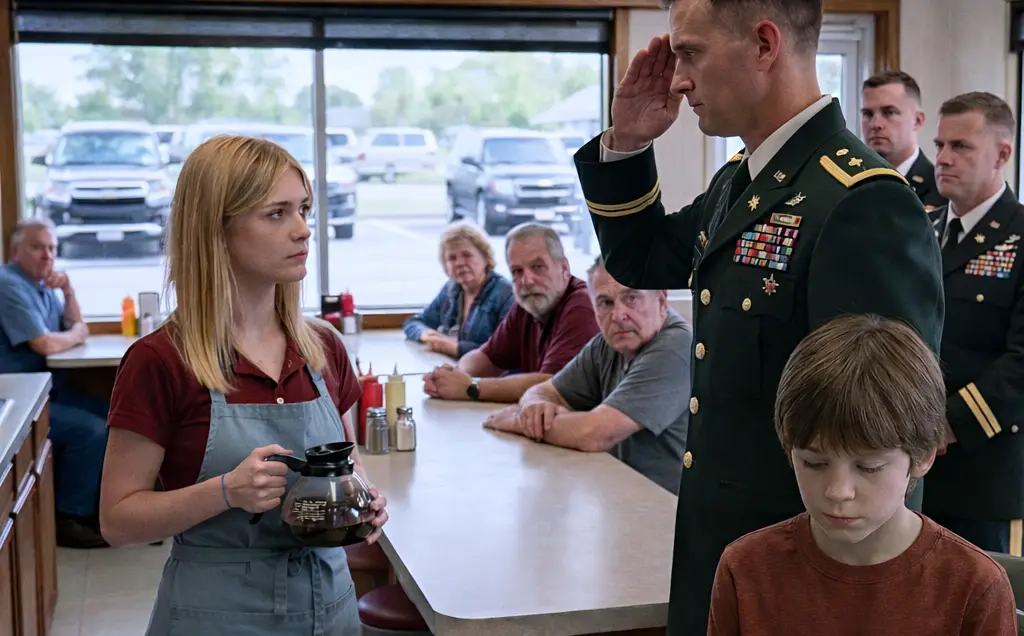
The topography of the ceramic plate was something Olivia Evans had memorized through touch alone. She knew exactly where the cool, smooth glaze gave way to the slightly rougher rim as she slid the dish across the scarred laminate of the counter. Leaning in, she lowered her voice to a conspiratorial whisper, a volume calibrated for an audience of one.
“It’s on the house, sweetie. The usual.”
She never demanded the boy’s name, nor did she fish for gratitude. Her compensation was simply the sight of him eating. However, on this specific morning, the familiar clatter of cutlery and the low, steady murmur of conversation at The Morning Glory Diner were severed by a sudden, oppressive silence. Beyond the plate-glass window, the morning sun glared off the polished black armor of four massive SUVs as they executed a synchronized halt, effectively barricading the entrance.
A man emerged from the lead vehicle. His posture was unyielding, his spine a rod of iron, and he was clad in a pristine military dress uniform that looked jarringly out of place against the dusty, rural street. In one gloved hand, he clutched a single, sharply creased letter. The visual was so startling that the diner’s heartbeat didn’t just skip; it flatlined. Who were these men? And why, the instant Olivia stepped out from the sanctuary of her service station, did every patron in the room instinctively scramble to their feet?
At twenty-nine, Olivia Evans was as permanent a fixture in the diner as the buzzing neon sign in the window. The Morning Glory was a modest establishment, wedged tightly between a hardware store reeking of sawdust and a twenty-four-hour laundromat scented with dryer sheets, situated right in the pulsing heart of rural Kansas. Olivia’s existence was a loop of predictable, quiet moments: the harsh alarm in the pre-dawn dark, the three-block commute through slumbering streets, the ritualistic knotting of her faded blue apron, and the application of a warm, service-industry smile. It was a practiced mask, constructed to conceal a loneliness that felt as vast and empty as the plains surrounding them.
She resided in a minuscule one-bedroom apartment perched directly atop the town pharmacy. It was a space less inhabited by the living and more by the echoes of the departed. Her parents were present there, trapped in photographs that were slowly surrendering to the sepia tones of age. Her father had been claimed by a sudden illness when she was fifteen; her mother, unable to navigate the labyrinth of grief, followed him a mere two years later. The grandmother who had taken in the teenage Olivia had long since retreated to Florida to soothe her arthritic joints, leaving Olivia with a familial tether that had eroded to biannual phone calls and generic birthday cards.
The boy had first materialized on a crisp Tuesday in early October.
He couldn’t have been a day over ten, possessing a fragile, reedy architecture that looked like it was holding its breath for a growth spurt that hadn’t yet arrived. His eyes were his most arresting feature—watchful, cautious, mapping the geography of the room while disclosing absolutely nothing of his own internal terrain. He invariably selected the booth tucked deepest in the corner, a strategic vantage point that offered maximum distance from the main entrance. A backpack, comically oversized for his narrow shoulders, sat beside him like a sentry, and a thick hardcover book was always splayed open on the Formica table.
During that inaugural visit, he ordered a single glass of water. Olivia delivered it with her standard cheerfulness, dropping in a colorful striped paper straw. In return, he offered a nod so microscopic she almost missed it.
The pattern calcified over the subsequent days. By the second week, Olivia had his timeline charted with precision. He would slip through the door at 7:15 a.m., allotting himself exactly forty-five minutes before the first bell rang at the elementary school three blocks away. He would sit, read, and nurse that free water, his eyes occasionally darting toward other patrons as they demolished stacks of pancakes, crispy bacon, and butter-soaked toast. At 7:55 a.m. sharp, the book would snap shut, the silent nod would be offered, and he would vanish without having consumed a single crumb.
On the fifteenth day of this heartbreaking ritual, Olivia staged an intervention disguised as a serendipitous accident. She approached his table, balancing a steaming plate of buttermilk pancakes.
“Oh, goodness, I’m so sorry,” she lied, her voice pitching perfectly between surprise and apology as she set the plate down. “It looks like the kitchen fired an extra order by mistake. I’d hate to see good food go to the trash, so I’ll just leave it here.”
The boy’s head snapped up. His eyes were a battlefield where deep-seated suspicion warred with a visceral, desperate hunger.
“It’s really no problem,” Olivia assured him, her tone gentle and devoid of pressure. “Brenda gets her tickets mixed up sometimes. It’s better that someone enjoys it, right?”
She turned on her heel and walked away before he could construct a refusal. From the safety of the service station, she observed him. He picked up his fork hesitantly, almost reverently. When she returned ten minutes later, the plate had been wiped clean, and his gaze was once again glued to his book—a deliberate shield to avoid eye contact.
“Thank you,” he whispered as she collected the empty dish.
It became their unspoken pact. Every morning, Olivia would arrive at his booth with a “mistaken” order or an “extra” portion the cook had supposedly fumbled. One day it was pancakes; the next, fluffy scrambled eggs with toast. As the autumn chill deepened, she brought him bowls of oatmeal swirled with brown sugar and cream.
The boy never asked for anything. His verbal contribution was limited to those two hushed words of gratitude. But he ate with a focused intensity, sometimes devouring the food with a velocity that suggested a terrifying fear that it might be snatched away before he could swallow.
“Who’s the kid you keep feeding?” asked Frank, a retired mail carrier who practically lived at the counter. “Never see any folks with him.”
“I don’t know,” Olivia admitted, wiping down the counter with rhythmic, circular motions. “But I know he’s hungry.”
After the third week, Brenda, the pragmatic and tough-as-nails grill cook, cornered Olivia in the dry storage room.
“You’re feeding a stray, Liv,” she warned, her tone not malicious, but weary with experience. “I’ve seen it a hundred times. You give handouts, they start to expect it. Then one day, they’re just gone. They always disappear.”
Olivia didn’t argue. She just offered a small shrug and a quiet confession.
“It’s alright. I used to be that hungry, too.”
It was the most vulnerable thing she had shared about herself in the three years she had worked at The Morning Glory.