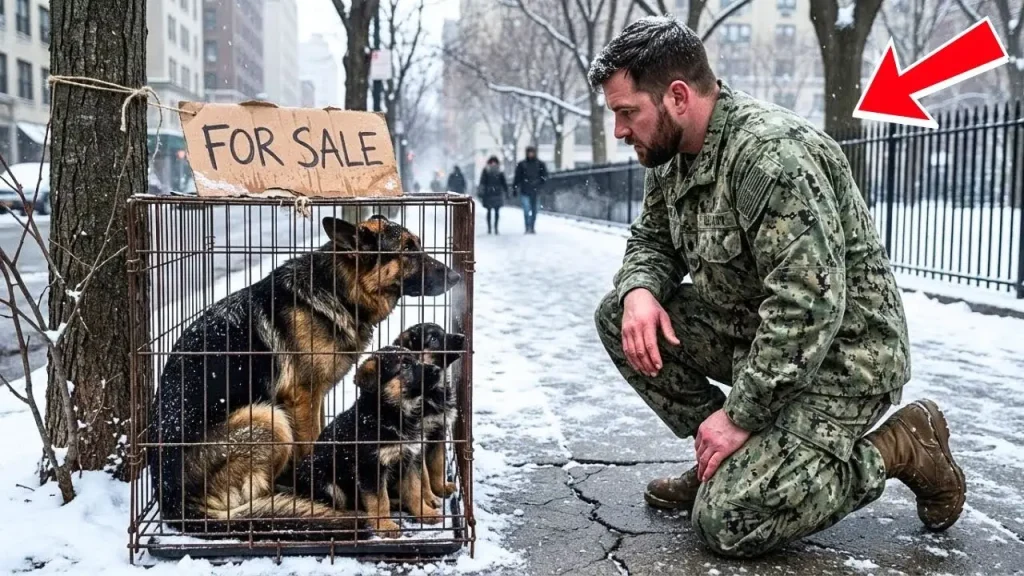
A rusty cage sat forgotten on a snowy city sidewalk. A handwritten sign above it read: FOR SALE. Inside, a German Shepherd mother curled around her two shivering pups, their fur glazed with frost, their eyes too tired to cry.
People walked past without looking twice. But one man stopped. He was a Navy SEAL in a worn uniform. A soldier who had seen too much loss to ignore another.
He knelt in the snow, face to face with the trembling mother, and something in both of them broke open and began to heal. What happened next will melt your heart and remind you that kindness is never for sale.
Winter mornings in New York had a strange kind of beauty. Harsh, brittle, and fragile all at once. The snow that had fallen overnight still clung to rooftops and awnings, softening the hard edges of the city.
Steam rose from the street vents, curling into the gray air, and the sound of distant traffic echoed like a heartbeat beneath the cold. Fifth Avenue was already alive with motion. The click of heels. The rhythm of hurried boots. The shuffle of a city that had no time to look down.
Ethan Walker walked with no particular destination. He moved like a man accustomed to long roads and silence. Tall, broad-shouldered, he was built from years of endurance rather than ease.
His dark brown hair was short, touched faintly with gray, and a trimmed beard lined a jaw that looked carved from habit more than vanity. At thirty-eight, he still carried the posture of a Navy SEAL. Though the uniform he wore—a faded Navy working uniform, Type III, in soft green-gray-brown camouflage—no longer represented command or mission, only memory.
His eyes, a storm gray that caught the light of the city and reflected none of it, watched the world with quiet distance. Ethan had been home for three months, but the word home had lost its meaning.
Every night, he dreamed of sandstorms, broken radios, and the sound of barking that never faded. Every morning, he woke to the hum of refrigerators and traffic instead of rotors and waves. It should have been peace, but peace could feel like another kind of exile.
So he walked through the frost and noise and movement, just to remember that he still could. It was near East 72nd Street that he saw it: a metal cage sitting crookedly beside a lamppost, half-buried in snow.
At first, he thought it was trash, something left behind by a street vendor or careless mover. But as he drew closer, he saw the sign taped across the top, written in thick black marker: FOR SALE. He stopped.
The cage was small, rusted along the corners, the bars frosted white with ice. Inside was a German Shepherd mother, curled tight around two tiny puppies. Her fur, once thick and glossy, was dulled by dirt and weather.
She trembled, though her body remained wrapped protectively around her young. The puppies pressed into her chest, their small bodies barely moving except for the faint rise and fall of breath. For a long moment, Ethan simply stared.
People passed behind him, boots crunching, phones ringing, voices clipped by the cold. No one slowed. No one looked. The city flowed around the small cage as though it were invisible.
A woman in a long red coat muttered, “Poor thing,” but didn’t stop. Ethan felt a hollow ache in his chest. It wasn’t anger, not yet, just recognition.
He had seen that look before—a living creature waiting for help that never came. It was the same expression he’d seen on the faces of stray dogs on deployment. The same one in the mirror after the funerals of friends.
He crouched beside the cage, the movement natural, precise. The dog stiffened, ears twitching, body coiled to protect. Ethan kept his hands visible and his tone calm.
“Hey there,” he murmured, his voice low and steady. “Easy, it’s all right.”
The mother’s eyes lifted to meet his. They were a deep, glassy brown, ringed with red from cold and exhaustion. Her breathing was shallow, fogging the air between them. She didn’t growl, only stared, measuring him with the same cautious patience he once used to clear rooms in silence.
He studied the collar around her neck. It was thin nylon, torn at the edges, and too tight. Whoever left her had done so with purpose. He imagined the moment: the car door slamming, the taillights disappearing, the sound of wind filling the space where loyalty once lived.
Above the street, six stories up, Eleanor Pierce sat by her frost-lined window. Seventy years old, hair silver and soft as dust, she had a small, tidy apartment filled with books and photographs that smelled faintly of tea leaves.
Once, she’d been an English teacher at a neighborhood high school. Now she spent her days watching the street below, her world reduced to the rhythm of strangers’ footsteps. Since her husband Richard, a Vietnam veteran with gentle hands and haunted eyes, had died ten years ago, winter had always felt longer.
From her window, Eleanor saw the man pause at the cage. She watched as he knelt, the movement slow and deliberate, like someone lowering himself into memory. Something about his posture struck her: the straightness of his back, the careful stillness of his hands.
She knew that stillness. She’d seen it in Richard when he came home from war, when words had become something fragile, something easily broken.
On the street, Ethan exhaled softly. “Who left you out here, huh?” he whispered. The words came out as breath, not sound.
The dog tilted her head slightly. He removed one glove and reached toward the cage, not to touch, just to let her smell his hand. His skin stung in the cold.
“It’s okay,” he said again. “I’m not going to hurt you.”
The German Shepherd’s nose twitched. For a moment, nothing happened. Then slowly, she leaned forward and sniffed his fingers through the bars.
The gesture was small, but it broke something inside him. A wall he hadn’t realized was still standing. Her trust was tentative, fragile, undeserved, and yet she gave it anyway.
A bus roared past, shaking the pavement. Snow fluttered from a nearby awning and landed across Ethan’s shoulders, melting into the fabric of his jacket. He didn’t move.
The world went on, but for him, the noise faded to nothing. He looked at her pups. Two tiny shapes pressed beneath their mother’s chest. One whimpered softly, the sound barely audible above the city’s hum.
The mother nudged it with her muzzle, a quiet, instinctive motion. Ethan’s throat tightened. Above, Eleanor leaned closer to the window, her breath fogging the glass. She whispered to herself, without knowing why, “Don’t let her freeze.”
Ethan’s hand rested on the cage, his fingertips brushing cold metal. He could feel the pulse of warmth behind it, the faint promise of life holding on.
“You’ve been fighting too long,” he said under his breath.
The German Shepherd blinked slowly. Their eyes met: gray to brown, human to animal, survivor to survivor. In that instant, the sounds of Fifth Avenue vanished. The horns, the footsteps, the conversations—all fell away.
The snow drifted softly between them like falling ash, and the only thing that existed was that silent exchange of understanding. Ethan felt something stir deep within him. A memory of loyalty, of loss, of the quiet instinct to protect what cannot protect itself.
He didn’t move closer, didn’t speak again. He simply stayed there, kneeling in the snow, his breath mingling with the dog’s, his heart steadying for the first time in months.
And in that quiet, beneath the gray sky of a city too loud to notice, Ethan’s eyes met the wet, trembling eyes of the German Shepherd mother. A single, wordless moment hung between them. Fragile, still, and strangely sacred. A moment of silence in the middle of the noise.
The snow had started falling harder now, the flakes growing heavier and slower as they drifted past the glow of the streetlights. The world looked washed in silver, quiet except for the distant growl of a taxi engine somewhere down Fifth Avenue.
Ethan stayed crouched beside the cage, the wind tugging at his jacket. The German Shepherd mother hadn’t looked away from him once. Her eyes followed his every breath. For a moment, he forgot that there was anyone else in the city but the two of them and the trembling life she shielded with her body.
He straightened and turned, scanning the sidewalk. Just across the street, a man in a thick brown parka was tending to a small cart half-buried under a sheet of snow. The faint smell of roasted chestnuts drifted through the air.
Ethan walked toward him, his boots crunching softly. The vendor, a man perhaps in his late fifties, short, sturdy, with a broad face reddened by the cold, looked up as Ethan approached.
“Hey,” Ethan said, nodding toward the cage. “That cage by the tree. Do you know who left it there?”
The vendor frowned, his breath clouding the air. “What cage?” he asked, wiping his gloved hands on a towel. Then he followed Ethan’s gaze and saw it.
“Ah, that thing’s been there since morning, maybe earlier. I figured somebody’d come back for it.”
“But no one did,” Ethan stated.
“No, just people passing by. Most don’t even look,” the man said. His voice carried the indifference of a man who’d seen too much of the city to be surprised by its cruelty. He shrugged and turned back to his cart. “Happens all the time. You can’t save every stray in New York.”
Ethan’s jaw tightened, but he said nothing. His gloved fingers brushed the snow off the edge of his jacket as he turned back toward the cage. When he reached it again, the snow had nearly covered the sign. The edges of the cardboard curled from moisture, the ink bleeding down the sides.
He crouched once more, brushing away the snow so the mother dog could see his face. Her body was trembling harder now. Her breath was quick and shallow. The smallest puppy made a faint sound, barely a whimper, its tiny paw twitching.
“Easy,” Ethan murmured. “Hang on, girl. I’ve got you.”
He hesitated, then reached into his pocket and pulled out his wallet. It was old, scuffed leather, soft at the edges. Inside were a few folded bills and a military ID. He looked down at the money for a long moment. It was his last cash until his next disability check.
A bitter laugh caught in his throat. “Figures,” he muttered quietly.
He turned toward the vendor again. “Hey,” he called over the wind. “I’ll give you two twenties for that cage.”
The man blinked. “For what?”
“For the cage,” Ethan said simply. “And everything inside it.”
The vendor stared at him for a second, then shrugged. “Buddy, it’s not mine.”
“I know,” Ethan said. “But take it anyway. I just don’t want anyone else touching them.”
The vendor studied him for a moment, his expression softening. There was something about the man’s tone—steady, weary, and absolute—that didn’t invite argument. He nodded. “All right, pal, if it makes you feel better.”