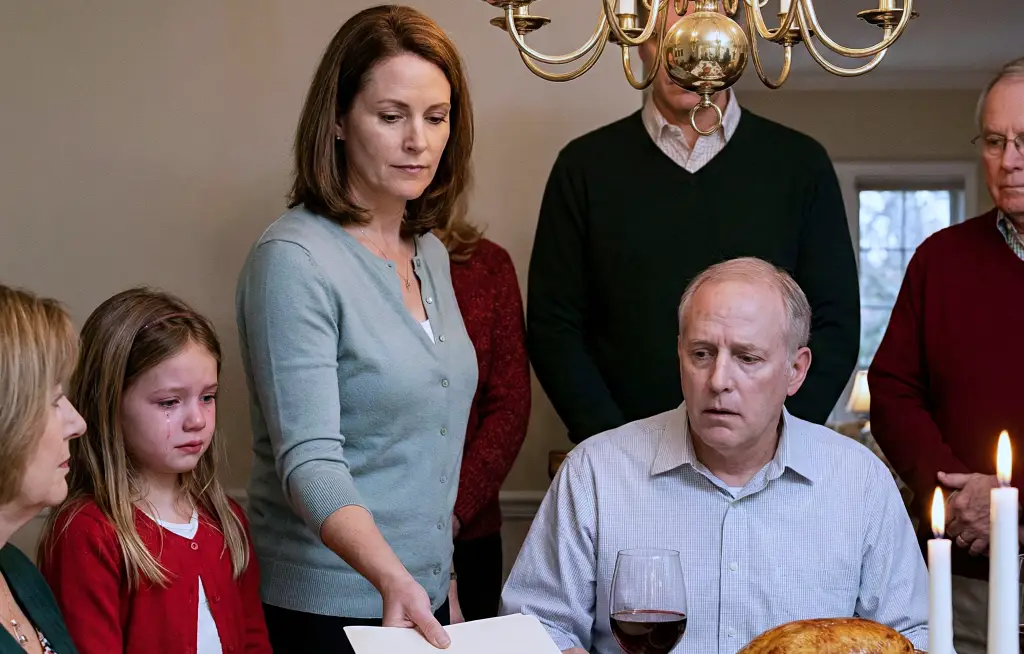
At Christmas dinner, my father pushed my nine-year-old daughter and said, “That seat is for my real grandkid. Get out.”
She hit the floor in front of the whole family. No one moved. I didn’t cry. I said four words, and that was the night my family lost everything.
She fell hard onto the hardwood floor, right in front of twenty adults who all pretended not to see it. No one spoke. No one helped her up. In that silence, I realized something terrifyingly clear: my child was never safe in this family.
So, I didn’t scream. I didn’t argue. I didn’t beg.
I reached into my bag, placed a folder on the table, looked my parents in the eye, and said four words. Four words that would unravel every lie they had built their power on.
The sound my daughter made when she hit the floor wasn’t loud. That was the part that stayed with me. It wasn’t a scream or a cry.
It was a short, hollow thud—bone meeting wood—followed by a sharp intake of breath, like the air had been punched out of her chest. Lily’s hands flew out instinctively, palms skidding on the polished hardwood, her knees folding under her like she’d forgotten how they worked.
For half a second, I thought someone would move. My mother, Margaret, was closest. She’d always claimed she had good instincts when it came to children.
My sister, Olivia, had stood up faster than anyone when her daughter, Emma, once spilled juice on a rug. My father, Richard, was still holding his fork, suspended in the air like he was deciding whether the moment was real enough to deserve a reaction.
No one moved. The table was frozen in a way that felt practiced, like everyone had rehearsed this exact scene their whole lives and finally knew their marks. A napkin slipped off someone’s lap and landed softly near Lily’s shoe. That was the loudest sound in the room.
Lily looked up at me. She wasn’t crying yet; that came later. Right then, her face was blank with confusion, her eyes wide and searching, like she was trying to solve a problem she hadn’t been taught how to name.
Her mouth opened, then closed again. She pulled her hands back into her lap, already apologizing with her body. I stood up.
My chair scraped against the floor, a long, ugly sound that finally broke the spell. My father flinched at that—at the noise, not at what he’d done. That told me everything.
I crossed the room in three steps and knelt in front of my daughter. Up close, I could see her knee starting to bloom red beneath the thin fabric of her tights. Her hands were shaking.
She grabbed my sleeve like she was afraid the ground might give way again.
“I’ve got you,” I whispered, low enough that only she could hear. “I’ve got you.”
I helped her to her feet slowly, one hand under her arm, the other steadying her back. She leaned into me, small and light and unbearably careful, like she was trying not to take up too much space. Nine years old and already an expert at disappearing.
I waited. Not because I needed permission, but because part of me, some leftover foolish piece, still expected an adult in that room to do the right thing. No one did.
My mother stared at the centerpiece like it had suddenly become very interesting. Olivia’s eyes flicked from Lily to Emma and back again, calculating. A few relatives avoided looking at me entirely.
One of my aunts gave a tight, nervous smile, the kind people use when they’re relieved something terrible isn’t happening to them. My father finally cleared his throat.
“She shouldn’t have been in that seat,” he said, as if explaining a minor breach of etiquette. “That place is for family.”
Family. The word landed heavy and ugly in my chest. I felt something settle inside me then. Not rage. Rage would have been loud.
This was quieter, colder. The kind of clarity that arrives when the argument is finally over. I reached down with my free hand and picked up my bag from beside the chair.
The leather strap felt familiar against my fingers. Grounding. Lily’s grip tightened when she saw me move, panic flaring across her face.
“It’s OK,” I murmured, squeezing her hand. “We’re leaving.”
That was when my mother finally looked up. “Hannah,” she said quickly. Too quickly. “Let’s not make a scene.”
I almost laughed. Instead, I walked back to the table and set my bag down carefully, right in front of my parents. I unzipped it, reached inside, and pulled out a thin folder.
Plain. Unmarked. It made a soft sound when I placed it on the table, right between the cranberry sauce and my father’s glass.
I looked at him. Really looked at him. He’d gone pale. Not angry pale. Not indignant pale.
This was something else. Recognition, maybe. Or fear.
“You don’t get to touch her,” I said, my voice steady. “Not ever.”
Then I said the four words I’d practiced only in my head until that moment.
“You’ve been served.”
For a heartbeat, no one reacted. Then my mother’s wine glass slipped from her fingers and hit the table with a sharp clink, red liquid sloshing dangerously close to the folder. My father grabbed the papers like they belonged to him, flipping them open with shaking hands.
I didn’t wait to see what he read. I turned, lifted Lily into my arms, and walked toward the door. Her face was buried in my shoulder now, her breath uneven, hot against my neck.
Behind us, the silence shattered. Not with apologies or concern, but with panicked voices overlapping each other, questions firing too late to matter. The cold night air hit my face as I stepped outside.
I didn’t look back. Because whatever was happening in that house now had nothing left to do with us.
Lily didn’t cry in the car. That scared me more than if she had. She sat in the passenger seat with her hands folded neatly in her lap, staring straight ahead like the windshield was a screen playing something only she could see.
The streetlight slid across her face in quiet bands of yellow and shadow. Her knee was already swelling, the skin tight and shiny, but she didn’t mention it. She didn’t mention anything.
I drove with both hands locked on the steering wheel, jaw clenched so hard my teeth ached. The heater hummed softly, useless against the cold that had settled inside my chest.
“Does it hurt?” I asked gently.
She shrugged, a small movement. “It’s okay.”
It wasn’t. But she’d learned somewhere along the way that saying so didn’t change anything. At a red light, she finally spoke again. Her voice was careful, like she was stepping onto thin ice.
“He doesn’t like me,” she said.
I felt it like a punch to the ribs. “That’s not true,” I said immediately, then stopped myself. Lies, even well-meant ones, had a way of rotting from the inside. “What he said… that was about him, not you.”
She nodded, but she didn’t look convinced. Her fingers worried at the edge of her sleeve. “Is it because I’m not real?” she asked.
I pulled over right there, hazard lights blinking, the world rushing past us like nothing had changed. I turned fully toward her, my heart breaking in a dozen quiet places.
“No,” I said, and I made the words solid. “You are real. You are my child. You belong with me, always.”
She searched my face, weighing the promise the way children do when they’ve been let down before. Then she nodded once, slow and deliberate, like she was filing the answer away for later.
At home, I wrapped her knee in ice, made cocoa with too many marshmallows, and put on her favorite movie. She leaned into me on the couch, her head tucked under my chin, like she was afraid the world might shove her again if she sat up straight.
That night, after she finally fell asleep, I sat alone at the kitchen table and let the memories come. Because what happened at dinner wasn’t new; it was just louder.
Growing up in my parents’ house had been an exercise in contrast. My sister, Olivia, was light. I was static. Olivia was praised for breathing; I was corrected for existing.
“She’s sensitive,” my father used to say about me, smiling like it was a joke everyone should enjoy. “Don’t mind her.”
When Olivia spoke, people listened. When I spoke, my mother’s eyes would flick toward me in warning. Don’t start. Don’t ruin this.
There were little things. Too small to complain about without sounding dramatic. Olivia got the bigger slice. Olivia got called first. Olivia got, “Come sit by me.” I got, “Move, you’re in the way.”
My father’s favorite trick was cruelty dressed up as humor. If he laughed while he said it, it didn’t count. If everyone else laughed too, it became truth.
The suspicion came later. Or maybe it had always been there, humming under the surface. I was a teenager the first time I heard it—not directly, of course.
My aunt’s voice carried down the hallway one Thanksgiving, lowered but not lowered enough. “She doesn’t really look like him,” she said.
My father laughed. “Well, we all have our mysteries.”
Everyone laughed with him. No one asked me how that felt. My mother never defended me, not once. She smoothed things over, changed the subject, poured more wine.
Silence was her skill, and she wielded it expertly. The only person who ever treated me like I belonged was my grandfather, my father’s father. He wasn’t warm. He didn’t hug or talk about feelings.
But he’d pat my shoulder and say, “You’re sharp. Don’t let anyone dull that.”
When he died, something shifted in the house. Not grief. Control. After that, my father handled everything: accounts, papers, decisions.
When I asked, years later, if there had been anything set aside for me—just enough help to move to a safer apartment after a break-in—my mother had looked at the counter and said flatly, “There wasn’t anything.”
I believed her, or I forced myself to, because the alternative was realizing that they could look at me and choose dishonesty without blinking. The folder sat in my bag on the kitchen chair, exactly where I’d put it after dinner.
I hadn’t opened it. I didn’t need to. I already knew what it was: legal service, a demand for truth. I stared at it for a long time, listening to the quiet of my small apartment, to Lily’s steady breathing down the hall.
I told myself I could wait. After the holidays. After one more dinner. Keep the peace. Be the bigger person.
Waiting stopped being an option the moment that happened. I stood, picked up the folder, and slid it deeper into my bag. Tomorrow, I would start the part I’d been avoiding my entire life.
I would stop being small. And whatever came next, I would make sure my daughter never learned that belonging was something she had to earn.
Two weeks before Christmas, my phone buzzed with Olivia’s name. “Can you watch Emma for an hour? I have a work call.”
Olivia said “work call” the way people say, “I’ll just be a minute.” Meaning: don’t ask questions. I stared at the message longer than I should have. Already tired. Already knowing I’d say yes.
Because saying no in my family had always come with consequences. So, I drove over. My parents’ house looked the same as it always had: brick polished by money and habit.
Wreath on the door. Everything exactly where it was supposed to be. Emma greeted me like a tiny queen receiving a subject, already used to being adored. She liked me well enough in the way children like adults who don’t demand performances.
Olivia swept out ten minutes later, phone already at her ear, a distracted kiss blown in Emma’s direction. “She knows the rules,” she said lightly. “No screens.”
Emma nodded solemnly. The house fell quiet after Olivia left. Emma played on the floor with dolls, narrating a dramatic storyline about princesses and betrayals.
I cleaned wrapping paper off the coffee table because old habits die hard. That’s when I noticed Olivia’s laptop. It sat closed on the couch. Sleek and silver, humming faintly like it was still awake.
I didn’t touch it. I didn’t even think about touching it. It wasn’t my business.
Emma thought differently. She climbed onto the couch with the confidence of a child who had never been told “no” and flipped the laptop open like she’d done it a hundred times before.
The screen lit up. A password box appeared. My stomach tightened. Before I could say anything, her fingers danced across the keys.
No hesitation. No guessing. The screen unlocked. Kids don’t know passwords unless someone lets them.
“Hey, sweetheart,” I said gently, stepping closer. “That’s not a toy.”
I reached to close it. The screen refreshed. A document popped up. White background. Black text. Bold headings.
The kind of document you don’t need context to recognize. Legal. Official. Heavy.
Right at the top was my grandfather’s name. I sat down. Not because I wanted to snoop, but because my body had gone cold in a way I recognized. This matters.
I skimmed fast, eyes jumping to the parts that felt like landmines. Trust. Beneficiaries. Distribution.
Then I saw it. My full legal name. Not a nickname. Not “other child.” My name. Printed clean and precise, like it had always belonged there.
I scrolled carefully, afraid the truth might vanish if I moved too fast. A line near the bottom made my chest ache. A distribution date I remembered vividly.
The same month I’d asked my parents for help after my apartment had been broken into. The same month they’d told me they couldn’t. The same month Olivia had shown up with a new SUV and a laugh about being “so blessed.”
The numbers blurred. I didn’t read everything; I didn’t need to. I took one photo. Clear. Legible. The part that mattered.
Then I closed the laptop. Emma tugged at my sleeve. “Can I watch cartoons now?”
“Yes,” I said, smiling like my world hadn’t just tilted. “Pick one.”
That night, Olivia breezed back in, cheerful and careless. “Everything good?” she asked.
“Fine,” I said. Because confronting people like my family without a plan is like walking into a storm with an umbrella.
Two days later, I sat across from a woman named Claire Donovan in a law office that smelled like coffee and competence. I slid my phone across the desk. She studied the photo for five seconds. Then her expression changed.
“If your name is on it,” she said calmly, “trustees don’t get to decide you don’t count.”
I swallowed. “Even if they think…”
“Ink beats opinions,” she interrupted.
That was the moment something in me shifted. I didn’t call my parents. I didn’t ask for explanations. I let Claire do what she did best. Quietly. Thoroughly. Without emotion.
When she handed me the folder a few days later, I didn’t open it. I carried it in my bag like a weight and a promise. I told myself I’d wait until after the holidays.
One more dinner. One more act of pretending. Then my father shoved my daughter. And the paper that didn’t lie finally had a reason to speak.
The folder felt heavier every day. Not physically—there wasn’t much inside it yet—but emotionally. Like it was drawing gravity toward itself.
I carried it everywhere for a week. Tucked into my bag, brushing against my hip when I walked. Sometimes I’d check just to make sure it was still there, like it might vanish if I stopped believing in it.
Claire Donovan didn’t rush me. That was the first thing I noticed about her. She didn’t fill silences. She didn’t soften the truth to make it easier to swallow.
When I sat across from her again in her office, she waited until I was ready to speak. Hands folded neatly on the desk. Eyes sharp, but not unkind.
“Tell me about the trust,” she said.
I laughed. A short, humorless sound. “I don’t know anything about it. That was always the point.”
I told her what I knew. What I’d lived. My grandfather’s death. My father taking over the paperwork. The way questions were shut down with a look or a joke.
The way my mother said, “There wasn’t anything set aside,” like she was talking about leftovers.
Claire listened. Took notes. Didn’t interrupt. When I finished, she slid a legal pad toward me. On it were a few words written in neat block letters.
“Trustees have duties. They’re not owners,” she said. “They’re managers. And managers don’t get to decide who deserves honesty.”
My throat tightened. “They’ll say it was a misunderstanding.”
“They always do,” Claire replied. “That’s not a defense. That’s a habit.”
She explained it slowly, piece by piece, like she was building something solid in front of me. If my name was on the trust—and the photo strongly suggested it was—then I was entitled to a full accounting. Every dollar in. Every dollar out. Every signature that approved it.
“And if they’ve been diverting funds?” I asked.
“Then the court will want to know why,” she said simply.
I thought of Olivia’s SUV. The house renovations. The way money always seemed to appear for everyone but me.
“What do we do?” I asked.
Claire met my eyes. “We ask the court to make them tell the truth.”
The words sent a jolt through me. Fear. Relief. Something like hope all tangled together. She drafted the petition while I sat there, the soft clicking of her keyboard steady and relentless.
Legal language filled the page, precise and unforgiving. It didn’t accuse. It didn’t rant. It requested. It demanded clarity. By the time she printed it out, my hands were shaking.
“This doesn’t mean a trial tomorrow,” she said, noticing. “It means transparency. And if there’s nothing to hide, they’ll be fine.”
We both knew that wasn’t true. I didn’t tell my parents. I didn’t warn Olivia. I didn’t give anyone a chance to get ahead of it. I signed where Claire told me to sign, my name looping across the page with a steadiness I didn’t feel.
When she handed me the final folder, she paused. “Once this is served,” she said carefully, “they’re going to be angry. They may try to make this about something else.”
“Like what?” I asked.
She hesitated just long enough to be honest. “Like whether you belong.”
I thought of Lily’s small voice in the car. Is it because I’m not real?
“I’m ready,” I said. I wasn’t, but it didn’t matter.
For days, the folder lived in my bag untouched. I took it out, put it back, told myself I’d wait. After Christmas. After one more attempt at peace.
Don’t ruin the holidays. Don’t make it awkward. Don’t be dramatic. The words sounded familiar because they were old. They’d been used on me my whole life.
Then came Christmas dinner. The shove, the silence. Lily’s knee hitting the floor. Waiting stopped being a choice.
After that night, the phone calls came fast and sloppy. Missed calls. Voicemails I didn’t listen to. Texts that swung wildly between rage and pleading.
Olivia was first. “What did you do? Are you insane?”
My mother followed. “Hannah, please. Think about what you’re doing.”
My father waited. When his message finally came, it was cold and measured. “You’re not taking anything from this family.”
I stared at the screen, my hands steady now in a way they hadn’t been before. He thought this was about money. He was wrong.
Because once the petition was filed, once the court date was set, something irreversible happened. The story my family had told about me, quietly, casually, over decades, no longer mattered. Ink beats blood. And for the first time in my life, the truth wasn’t something they could laugh away.
The first hearing was scheduled faster than I expected. Claire called me on a Tuesday morning while I was packing Lily’s lunch. Peanut butter sandwich, apple slices, the granola bar she liked because it didn’t crumble. Normal things. Anchors.
“They responded,” Claire said. Her voice was calm, which meant the opposite of calm.
I closed the fridge door slowly. “How bad?”
“They’re not denying the trust,” she said. “They’re denying you.”
I sat down at the kitchen table, my knees suddenly weak. Lily glanced up at me, brows knitting together.
“I’m fine,” I mouthed, forcing a smile. She nodded, unconvinced, but used to adults lying gently.
Claire continued. “They’re asking the court to dismiss the petition and sanction you for bad faith.”
“Sanction?” The word tasted ugly. “Like I did something wrong?”
“Like you’re harassing them,” she said. “And yes, your father is claiming there was always doubt about your parentage.”
There it was. The thing they’d kept sharpened in a drawer for decades, waiting for the moment it would hurt the most. I felt heat rush to my face, then drain away, leaving something cold and solid behind.
“So that’s the play. They want to shift the conversation,” Claire said, “from money to identity, from facts to shame.”
After we hung up, I sat at the table for a long time, staring at the wood grain like it might rearrange itself into something kinder. Lily finished packing her bag and slipped her hand into mine.
“Are we in trouble?” she asked softly.
“No,” I said, and this time I believed it. “We’re safe.”
At the courthouse, everything smelled like old paper and polish. The waiting area buzzed with quiet conversations, lawyers murmuring, people clutching folders like life preservers.
My parents sat across the room from me. They looked smaller than I remembered. My mother’s hands twisted in her lap. My father sat rigid, jaw tight, eyes fixed straight ahead.
Olivia leaned close to him, whispering urgently. When she noticed me looking, she glared like this was my fault.
Claire touched my elbow. “Remember,” she said, “we’re not here to perform. We’re here to preserve.”
The judge didn’t waste time. He listened. He skimmed. He asked pointed questions that didn’t care about family history or holiday dinners.
When my father’s attorney started talking about “real grandchildren” and “family understanding,” the judge raised a hand.
“Is the petitioner’s name on the trust?” he asked.
There was a pause. “Yes,” the attorney admitted.
“Then the trustees have a duty,” the judge said. “We’re not debating biology today. We’re preserving assets.”
He granted the order. Freeze all distributions. Preserve records. Full accounting required.
My father’s face hardened. Olivia’s mouth fell open. My mother stared at the table like it might swallow her whole.
On the way out, my father finally looked at me. Really looked at me. His eyes weren’t angry. They were calculating.
Between hearings, the documents started arriving. Not all at once. Not dramatically. They came the way consequences do: steadily. Without mercy.
Bank statements. Distribution summaries. Approval logs.
Claire called me into her office again a week later. “Sit,” she said, sliding a page across the desk.
I scanned it, not understanding at first. Then my eyes caught on the column labeled Authorized by. The signatures were familiar. Too familiar.
My mother’s handwriting curved across the page. Neat and unmistakable. Not once. Not twice. Over and over.
I felt something inside me go very still. “It wasn’t just him,” I said quietly.
Claire shook her head. “No, she knew.”
I didn’t cry. I didn’t feel surprised. I felt confirmed. Like a puzzle piece had finally clicked into place.
That night, Lily asked me a question while I brushed her hair. “Do I have to say sorry?” she asked.
“For what?”
“For making Grandpa mad.”
I set the brush down and turned her toward me. “No,” I said firmly. “You never apologize for someone else hurting you.” Her shoulders relaxed just a little.
The second hearing was quieter. More procedural. More damning.
The judge reviewed the records. The patterns. The money that left the trust and reappeared as cars. Renovations. Tuition. Categories labeled “family support,” like theft dressed up as generosity.
“This court finds mismanagement,” the judge said.
The word landed with a finality that made my chest ache. My father stared straight ahead. Olivia didn’t look at me. My mother’s hands shook.
When it was over, Claire turned to me. “This isn’t done,” she said. “But the story they told about you? It’s already cracking.”
In the parking lot, my phone buzzed. A text from my father: You’re tearing this family apart.
I stared at it for a long moment before deleting it. Because for the first time, I understood something clearly. I wasn’t tearing anything apart. I was refusing to hold together something that had been breaking me my entire life.
The smear campaign started quietly. Not with shouting or threats, but with whispers. Carefully placed. Plausibly deniable.
I found out about it the way you always do. Sideways. A co-worker pulled me aside after a meeting, her voice hesitant.
“Hey, I just wanted to check in. I heard you’re going through some ‘family stuff’.”
Family stuff. The phrase people use when they don’t want to say “lawsuit” or “inheritance,” or “your parents are telling a very different story.”
That night, my phone buzzed nonstop. Distant relatives. People I hadn’t spoken to in years. Messages that all sounded eerily similar.
Is everything okay?
This seems so unlike you.
I hope you know what you’re doing.
No one asked how Lily’s knee was healing.
Olivia went public first. A vague post on social media, carefully worded, polished just enough to look concerned instead of cruel. Some people will destroy a family for money. It’s heartbreaking to watch.
No names, no details. Just enough for everyone who knew us to connect the dots and feel morally superior for doing so. The comments filled quickly. Heart emojis. Praying hands. So sad. Families should stick together.
I stared at my phone, then set it face down on the counter. Lily was at the table doing homework, her tongue poking out in concentration. She didn’t look up.
“Mom,” she said after a moment. “Why do people lie?”
I took a breath. “Because the truth doesn’t help them.”
She nodded like that made sense, then went back to her math. Claire called the next morning.
“They’ve escalated,” she said. “Your father’s attorney filed a motion.”
I leaned against the kitchen counter. “Let me guess. Paternity.”
“Yes,” she said. “They’re asking the court to consider whether you’re a biological child at all. They want dismissal on standing.”
My stomach dropped. Not because I doubted the truth, but because I knew what they were trying to do. They weren’t defending money. They were defending the right to punish.
“I can take a test,” I said quietly.
Claire paused, just long enough to be deliberate. “Not for court. Not for them. But your name is on the trust,” she cut in gently. “That’s the law. Trustees don’t get to rewrite documents based on suspicion. If we go down this road, we let them turn this into a circus.”
I closed my eyes. Images flashed. My father’s voice. Real grandkid. Lily on the floor. The way doubt had been threaded through my life like a toxin.
“Desperate people throw sand,” Claire continued. “They want to blind you.”
After we hung up, I sat alone for a long time. The idea that this question, this ugly, unresolved thing, could still control my life made my skin crawl.
That afternoon, I opened my mailbox and found it. A small plain box. The return address belonged to my father’s attorney. Inside was a paternity test kit.
No note. No explanation. Just the implication. Heavy and unmistakable.
I didn’t open it. I set it on the highest shelf in the hall closet and shut the door.
That night, Lily crawled into my bed without a word. She curled against my side, warm and solid. After a while, she spoke into the dark.
“I don’t want to go there again,” she said. Not a question. A decision.
“OK,” I said. “You don’t have to.”
Something in her breathing eased. The next hearing was brutal in its restraint. My parents’ attorney argued biology with the confidence of someone used to getting their way through intimidation.
Claire didn’t rise to it. She stayed focused. Names. Dates. Signatures. Transfers. Paper.
The judge listened, expression unreadable. Then he spoke.
“Rumor is not evidence,” he said, “and family suspicion is not a legal defense.” He denied the motion. Just like that.
On the courthouse steps, Olivia hissed as she passed me, “You think you’ve won?”
I didn’t answer. Because this still wasn’t about winning. That evening, as Lily slept, I stood in the hallway and looked at the closet door. The test sat behind it, waiting.
For the first time, I understood the choice clearly. I didn’t owe them proof. But I owed myself peace. And for the first time in my life, I was the one deciding how the story would continue.
The proof didn’t arrive all at once. It came in waves. Thick envelopes. Secure emails. Spreadsheets that looked harmless until you read them closely.
Paperwork has a way of pretending to be neutral. It isn’t. It remembers everything.
Claire texted me one afternoon: Come in now.
I left work early and drove to her office with my heart pounding, Lily’s test kit heavy in my thoughts, even though it stayed untouched at home. Claire didn’t waste time with small talk. She slid a single page across the desk like it was something dangerous.
“Look at the approvals column,” she said.
I did. Rows of numbers. Dates. Categories labeled education, housing, family support. And beside them, initials, signatures, authorizations. My mother’s handwriting. Again. And again.
I stared until the letters stopped looking like letters. “She signed off on this,” I said. It wasn’t a question.
“Yes,” Claire replied. “Multiple times.”
Something loosened in my chest. Not relief. Not pain. Understanding. I’d told myself for years that my mother was trapped. That she didn’t see. That she couldn’t stop him.
It had been easier to believe she was weak than to accept she was willing.
“They told me there was nothing,” I said, my voice steady in a way that surprised me.
“They told you what they needed you to believe,” Claire said. “And they moved money that was earmarked for you as if it were a family slush fund.”
She laid out the highlights. Not every transaction—no one needs a documentary about theft—but enough to tell a story even a judge couldn’t ignore. A down payment that lined up perfectly with Olivia’s first house. A vehicle purchased the same month my parents told me they couldn’t help with rent. Tuition payments labeled “education” that never came near me.
“Trust principal at death,” Claire said, tapping the top line. “Four hundred eighty thousand.”
My ears rang.
“Intended split,” she continued. “Fifty-fifty. You and Olivia.”
I swallowed hard. “So, two hundred forty thousand.”
“Yes,” she said. Then she pointed to the bottom. “Current balance: thirty-eight thousand.”
My brain refused it for a second. Like it was waiting for someone to laugh and say just kidding.
“That’s not possible,” I whispered.
“It is,” Claire said. “Now we show the court how it happened.”
I left her office in a fog. Outside, the day went on. Cars honking. People laughing. The world doing what it does when your life has just been relabeled. I sat in my car and breathed until my hands stopped shaking.
That night, Lily asked me something while I was brushing her hair. “Are Grandma and Grandpa mad at us?” she asked.
“Yes,” I said honestly. “But that’s not our problem to fix.”
She considered that, then nodded.
The next hearing felt different. Heavier. Quieter. Like everyone in the room knew the ending was already written and we were just reading it out loud.
Claire presented the numbers. The patterns. The signatures. She didn’t raise her voice. She didn’t moralize. She let the records speak.
My parents’ attorney tried to frame it as confusion. As generosity misunderstood. As family helping family.
The judge leaned forward. “Helping family requires consent,” he said. “And documentation.”
My father finally looked at my mother. Not with anger. With something like disbelief. She didn’t look back.
The judge ordered restitution calculations and penalties. Interest. Legal costs. A path forward that involved consequences, not conversations.
When it was over, I didn’t feel victorious. I felt empty.
In the hallway, my phone buzzed. A text from my mother: I didn’t know how to stop him.
I stared at it for a long time. Then I typed back: You signed your name.
I blocked her. At home, Lily was at the table coloring. She held up her drawing. A house with two stick figures holding hands.
“That’s us,” she said simply.
I smiled, the kind that comes from somewhere deep and fragile. Because while the records remembered everything my family tried to erase, my daughter was learning something better: that belonging doesn’t come from ink or blood. It comes from who stays.
The final hearing didn’t feel dramatic. There were no gasps. No shouting. No moment where everyone froze like a scene in a movie.
It felt administrative. Almost boring. Which I would later realize was the point. Justice rarely arrives with fireworks. It arrives with paperwork and a judge who has already made up his mind.
The courtroom was smaller than I expected. Neutral walls. Neutral carpet. Neutral everything.
My parents sat at one table. Claire and I sat at the other. Olivia was there too. Stiff-backed. Her hands clenched in her lap like she was bracing for impact. I noticed something strange: no one looked at me with confidence anymore.
The judge entered. We stood. We sat. The rhythm of procedure settled over the room like a lid.
Claire stood first. She didn’t recap the story. She didn’t talk about Christmas dinner or Lily’s knee or the word “real.” She talked about math.
Trust principal. Intended distribution. Actual balance. Unauthorized transfers. Trustee signatures. Each word landed clean and unemotional, like a nail tapped carefully into place.
When she finished, the judge nodded and turned to my parents’ attorney. “Response?”
The attorney rose, smoothed her jacket, and tried one last time to pivot. She spoke about family complexity, about misunderstandings, about how emotions can cloud intent. Then, inevitably, she drifted back to biology.
“There was longstanding uncertainty,” she said carefully, “which informed the trustees’ decisions.”
The judge didn’t react right away. He looked down at the file in front of him, flipped a page, then another. When he finally spoke, his voice was calm and unmistakably tired.
“Trustees do not have discretion to punish,” he said. “They have duties.”
He looked directly at my father. “You don’t get to rewrite legal documents based on suspicion,” he continued, “and you don’t get to spend someone else’s inheritance and call it family support.”
My father opened his mouth, then closed it.
The judge went on. “The court found mismanagement. The court found diversion. The court ordered restitution. $240,000, plus interest, plus legal fees, plus penalties. $368,000 in total.”
The words echoed in the quiet room, heavy and final. Olivia’s face went pale. My mother didn’t move at all.
My father stared straight ahead, his jaw tight, like he was holding back something that no longer mattered. I didn’t feel triumphant. I felt lighter. Like something that had been pressing down on my chest for decades had finally lifted, and my body didn’t quite know how to stand without it.
Outside the courtroom, my father stopped walking. “This isn’t over,” he said quietly, not looking at me.
I met his eyes for the first time that day. “It is,” I replied. Because it was.
That night, I sat at the kitchen table long after Lily had gone to bed. The apartment was quiet in the way it only gets when you know something fundamental has shifted.
On the counter sat the small, plain box. The paternity test. I’d left it unopened for weeks, letting paper beat rumor, letting ink do the work.
But now the case was over, and the question still lived inside me like a splinter. Not because I owed them proof. Because I was tired of carrying doubt.
I opened the box. Everything inside was neat and clinical. Instructions printed in calm, reassuring font. My father’s sample was already included. That part almost made me laugh. The audacity of it. Packaged and prepaid.
I didn’t make a ritual of it. I didn’t cry or hesitate. I swabbed. Sealed. Dropped it into the mail the next morning like I was returning something defective.
The waiting was worse than I expected. Every day I told myself it didn’t matter. Every day it did. Lily hovered close during that time. Not scared, exactly. Just cautious. Like she was watching the world to see if it would behave.
One night, as I tucked her in, she said casually, “I don’t want to go back there ever.”
“OK,” I said. No negotiation, no guilt.
The email arrived on a Tuesday afternoon. I read it once, then again.
Biological match.
I sat down hard in the kitchen chair, my hands shaking. Not with relief, but with fury. Clean, sharp fury. Because it meant the suspicion had been wrong. And the cruelty had been deliberate.
They could have ended this years ago. One test. One conversation. One choice to be decent. They hadn’t wanted clarity. They’d wanted permission.
I forwarded the results to both my parents. No message. No explanation. Just the truth they’d built my entire life around refusing to face. Then I blocked them. And for the first time since Christmas, I slept through the night.
Blocking them didn’t bring silence right away. It brought echoes. Voicemails stacked up like debris after a storm. Messages I didn’t listen to. Numbers I didn’t recognize, but knew anyway.
Olivia tried first, calling from a private number, then from a friend’s phone. My mother followed. Text after text, slipping through before I blocked each new attempt. My father waited.
A week passed. Then my doorbell rang.
I checked the peephole and felt my chest tighten. My mother stood in the hallway, hands clasped together like she was about to ask for forgiveness the way people ask for favors. Carefully. Strategically.
Her eyes were swollen, red-rimmed in a way that looked more exhausted than dramatic. Lily was at school, thank God. I opened the door just enough to make it clear I was listening, not inviting.
“Hannah,” she said softly. “Please, just a minute.”
I didn’t answer. Silence had been her weapon for decades. I let her sit in it.
“Your father’s been different,” she said finally. “He asked about Lily.”
The words hit wrong, like a key jammed into the wrong lock.
“He wants to see her,” she added quickly. “He wants to be a family now that we know.”
Now that we know. As if love were a subscription that activated once a lab confirmed eligibility. I stared at her. Really stared. And waited.
Eventually, the rest came out—messy and too late.
“Before you were born,” she said, voice shaking, “I slept with someone else. Just once. Your father suspected. Or maybe he knew. I don’t even remember which came first anymore.”
I felt very calm.
“From that moment on,” she continued, “he decided you might not be his. And I let him treat you like a question mark because I was guilty. I thought I deserved it.”
The words fell between us, heavy and unfixable.
“And somehow,” she whispered, “you paid for it.” She reached for me.
I stepped back. “It shouldn’t have mattered,” I said quietly. “You were my mother, whether I was his or not. And you chose him anyway.”
Her face crumpled. “We can fix this now.”
“No,” I said. Firm. Clear. “You don’t get to come back because the story is comfortable again.”
I told her the only thing she was leaving with was the knowledge that she’d been wrong. Then I closed the door.
That night, Lily sat beside me on the couch, legs tucked under her, watching a cartoon she wasn’t really paying attention to.
“We’re not going back, right?” she asked.
“No,” I said. “We’re not.” This time, it wasn’t a promise. It was a boundary.
Four months later, the money hit my account. All of it. I stared at the number for a long time. Not because I was excited, but because it felt unreal. Like a language I was just learning to read.
Restitution. Interest. Legal costs. Penalties.
They sold the house to pay it. The house my father used to call his legacy. Turns out legacy doesn’t mean much when a judge orders repayment and there’s nowhere else to pull from.
I paid off what I needed to. Set aside what would keep Lily safe. The rest stayed untouched for a while, like I needed to make sure it was real before deciding what it meant.
They’re broke now. Not “we need to budget” broke. Quiet broke. The kind where relatives stop calling and excuses stop working. Downsized. Borrowed. Smaller.
We are no contact. Not the dramatic kind. The peaceful kind.
Lily laughs more. She sleeps through the night. She doesn’t ask about being real anymore. And I don’t flinch when my phone buzzes. Because the truth didn’t just give me my money back. It gave me my life back.
People expect endings like this to feel loud. They imagine celebration, champagne, a final speech where the villain is humbled and the hero walks away glowing. That’s not how it happened.
The day everything truly ended was quiet. Lily and I were at the grocery store, standing in the cereal aisle, debating whether chocolate counted as breakfast. She was explaining, very seriously, that it absolutely did if you added strawberries.
I was pretending to consider it. And then it hit me. I wasn’t bracing for anything. No tightening in my chest. No scan of the room to see who might hurt us. No mental rehearsal of explanations I didn’t owe.
We were just there, together, safe. That was the victory.
The money changed things, of course. I moved us into a place with better locks, better light. A little backyard Lily immediately claimed as her reading zone.
I set up an account in her name for college, another for emergencies, another just in case life decided to be unfair again. But money wasn’t what healed us. Boundaries were.
No calls. No visits. No updates passed through relatives who just wanted everyone to get along. I didn’t announce it. I didn’t explain it. I simply stopped participating. Silence, it turns out, can be chosen.
Sometimes I still thought about my parents. Not with longing, but with a strange, distant curiosity. Like remembering a house you used to live in and wondering who occupies it now.
I heard things secondhand. How they downsized. How my father avoided gatherings. How my mother looked smaller somehow. None of it reached me.
One evening, months later, Lily asked me a question while we were doing dishes together. She handed me a plate, careful not to drop it.
“Mom,” she said, casual as anything. “What does family mean?”
I dried my hands and thought about it. “Family,” I said slowly, “is who keeps you safe. Even when it’s hard. Especially when it’s hard.”
She nodded, satisfied, and went back to splashing water everywhere like nine-year-olds do.
That night, after she fell asleep, I sat on the edge of her bed for a long time and watched her breathe. I thought about the version of me who would have apologized for existing. Who would have swallowed the shove and called it peace.
Who would have taught her daughter that belonging was something fragile and conditional. That woman felt very far away now.
I didn’t save my family. I saved my child. And in doing that, I saved myself.
Holidays are different now. Smaller, quieter. We make our own traditions. Pancakes for dinner. Movies we’ve already seen. A tree that’s a little crooked, but perfectly ours.
Lily laughs without checking the room first. She takes up space. So do I.
They lost their money. They lost their story. They lost control.
We kept our names. We kept our future. We kept each other. And that was more than enough.