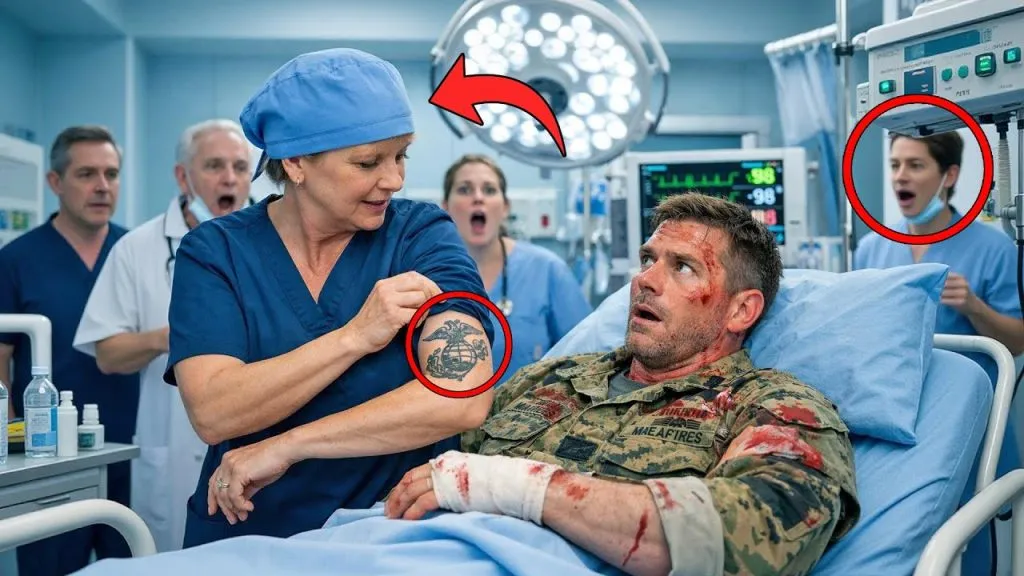
Lieutenant Colonel Mike “Iron Man” Sterling thought he was looking at a timid, middle-aged civilian nurse. To him, she was just a barrier between him and the medical care he demanded. He saw the graying hair and the soft voice, and he saw weakness.
He didn’t see the woman who had once held a dying Marine’s artery closed with her bare fingers for two hours in the dusty heat of Sangin. He didn’t see the legend whispered about in the barracks of the First Marine Division.
He refused her help, barking for a “real” corpsman. He had no idea that the woman standing before him didn’t just serve the Corps. She had saved it. And when she finally rolled up her sleeve, the ink on her skin would bring the entire hospital to a standstill.
The automatic doors of the Naval Medical Center San Diego, affectionately known as Balboa, slid open with a sharp hiss. They admitted a gust of unseasonably warm November air and a man who looked like he was carved from granite and regret. Lieutenant Colonel Mike Sterling did not walk; he marched.
However, the hitch in his left stride betrayed the agony radiating from his hip. He was a man of the old breed, a Marine’s Marine, with a jawline that could cut glass and eyes the color of a stormy Atlantic Ocean. Even in civilian clothes—a tight-fitting polo that strained against his biceps and tactical cargo pants—he radiated authority.
He was the commanding officer of the 3rd Battalion, 5th Marines, the legendary “Dark Horse” Battalion, and he was not accustomed to waiting. He gripped the reception counter with knuckles that turned white.
The young Petty Officer behind the desk, a Hospitalman Apprentice barely out of high school, looked up and swallowed hard.
“Sir?” the young man squeaked.
“I need a consult. Orthopedics. Now,” Sterling growled. His voice was a low rumble, like a tank idling in a garage. “My hip feels like someone replaced the joint with broken glass.”
“Do… do you have an appointment, Colonel?”
Sterling leaned in. “Son, I have a battalion deploying in three weeks. I don’t have time for appointments. I have shrapnel shifting in my hip from Fallujah, and it’s deciding to migrate south today. Get me a doctor.”
He paused for emphasis. “Preferably one who knows the difference between a femur and a fibula.”
The lobby was bustling. It was Friday afternoon, the “witching hour” for military hospitals. Training accidents, weekend warriors, and old veterans converged in a chaotic symphony of pain.
“I’ll… I’ll see who is available, sir. Please, take a seat.”
Sterling didn’t sit. He paced. Every step sent a jolt of electricity up his spine, but he refused to show it. Pain was just weakness leaving the body, or so the saying went.
But this pain felt less like weakness leaving and more like a hot poker twisting in his marrow. Ten minutes passed. Then twenty. Sterling’s patience, never his strong suit, was fraying like an old rope.
Finally, a side door opened. Out stepped a woman. She was short, perhaps five foot four, with a figure that had softened with age. Her scrubs were a generic, faded blue, devoid of the sharp creases Sterling admired in his Marines.
Her hair was pulled back in a messy bun, strands of silver fighting a losing battle against the dark brown. She wore comfortable, worn-out clogs, and reading glasses perched precariously on the end of her nose.
To Sterling’s discerning and prejudiced eye, she looked like a substitute teacher or a grandmother who baked cookies. She did not look like a warrior, nor someone capable of handling the damaged machinery of a Marine Commander.
“Lieutenant Colonel Sterling?” she called out. Her voice was calm, almost melodic, cutting through the din of the waiting room.
Sterling stopped pacing and turned. He looked over her shoulder, expecting a doctor or at least a Chief Petty Officer.
“I’m Sterling.”
“I’m Nurse Sarah Jenkins,” she said, offering a small, polite smile. “I’ll be doing your intake and initial assessment before the surgeon sees you. If you’ll follow me to triage room three.”
Sterling didn’t move. He looked at her outstretched hand, then back at her face, his expression hardening.
“Nurse Jenkins,” Sterling said, testing the name like it was a questionable piece of meat. “Are you active duty?”
Sarah blinked, surprised by the question. “I am a civilian nurse, Colonel. I’ve been with Balboa for fifteen years. Now, if you…”
“Civilian,” Sterling interrupted, the word tasting like ash in his mouth. He let out a sharp, derisive exhale. “I specifically requested a military provider. I need someone who understands combat trauma, not someone who’s used to putting Band-Aids on dependents’ scraped knees.”
The lobby went quiet. A few heads turned. Sarah lowered her hand slowly. Her expression didn’t change, but her eyes, hazel and sharp, seemed to assess him with a new intensity.
“Colonel, your status indicates urgent pain. The orthopedic surgeon, Commander Halloway, is in surgery. I am the senior triage nurse. I am fully qualified to assess your injury and administer pain management protocols until he is out.”
“Pain management?” Sterling scoffed, stepping closer, towering over her. “I don’t need pills, and I don’t need a civilian guessing game. I have metal fragments lodged in my iliac crest.”
He leaned closer. “Do you even know what an IED blast does to bone density over twenty years?”
“I am quite familiar with blast injuries, Colonel,” Sarah said softly.
“I doubt that,” Sterling snapped, “unless you picked that up watching Grey’s Anatomy.”
He turned back to the terrified young corpsman at the desk. “Get me a corpsman. A Chief. Someone who has actually worn the uniform. I’m not letting a civilian touch me.”
Sarah stood her ground. She didn’t flinch. She didn’t retreat. She simply clasped her hands in front of her.
“Colonel Sterling, refusing care is your right, but I am the only one available to help you right now. You are sweating, your pupils are dilated, and you are favoring your left side to the point of causing secondary strain on your lumbar spine. You are in agony. Let me help you.”
“I said no,” Sterling barked, his voice echoing off the linoleum floors. “I’ll wait for Halloway. And while I wait, get me someone with a rank on their collar, not a union card in their pocket.”
He turned his back on her and limped aggressively toward a row of chairs, sitting down with a grimace that laid bare his suffering. Sarah watched him for a long moment. A younger nurse might have run off to cry in the break room. A prouder nurse might have argued back.
Sarah did neither. She simply adjusted her glasses, picked up her clipboard, and walked over to him.
“I’m not going anywhere, Colonel,” she said, her voice dropping to a register that was steel wrapped in velvet. “Because in about ten minutes, that hip is going to lock up completely, and you’re going to need help just to stand up. I’ll be right here.”
Sterling glared at her, his eyes narrowing. “You’re dismissed, nurse.”
“This is a hospital, Colonel, not a parade deck,” she replied smoothly. “And until you check out, you’re my patient.”
She took a seat directly across from him, crossed her legs, and waited. The battle lines were drawn. The standoff in the waiting room of the Naval Medical Center lasted for forty-five minutes.
To the casual observer, it was just a man sitting in a chair and a nurse sitting opposite him, reviewing charts. But the tension in the air was thick enough to choke on. Mike Sterling was deteriorating.
He knew it, and he hated that she knew it, too. The adrenaline that had carried him through the front doors was fading, replaced by a throbbing, white-hot nausea.
The shrapnel, a souvenir from a roadside bomb in Ramadi back in ’06, had likely shifted millimeters. But inside the tight architecture of the hip joint, millimeters felt like miles. He tried to shift his weight, and a gasp escaped his lips before he could suppress it.
Sarah didn’t look up from her clipboard. “Seven out of ten?” she asked casually.
“Mind your business,” Sterling gritted out, sweat beading on his forehead.
“Looks like an eight, maybe a nine,” she continued, turning a page. “You’re going rigid. Muscle spasms are setting in. If we don’t get you a muscle relaxant and an anti-inflammatory soon, we’re going to have to cut your pants off because you won’t be able to stand to take them off.”
“I have survived worse than a stiff leg,” Sterling snarled. “I took a round through the shoulder in Garmsir and walked three klicks to the evac point. I think I can handle a chair in San Diego.”
“Garmsir,” Sarah repeated, the word rolling off her tongue with a strange familiarity. She finally looked up. “2008. That was a bad summer. The heat alone was killing people.”
Sterling paused, his eyes locking onto hers. “You read my file that quickly?”
“I didn’t read your file, Colonel. I know the history.”
“History Channel fan?” he mocked, though his voice was weaker now.
“Something like that.” She stood up. “Colonel, please. Put aside the ego. You are the commander of the Dark Horse. Your men need you functional. Right now, you are a liability to yourself.”
She gestured toward the hallway. “Let me take you back. Get an IV started and prep you for Halloway. He’s scrubbing out of a knee replacement now. He’ll be here in twenty minutes.”
Sterling looked at the clock. The pain was becoming blinding. His vision was blurring at the edges. He hated civilians; he found them soft, uncommitted, lacking the discipline that defined his existence.
But he was a pragmatist. He couldn’t command a battalion from a hospital floor if he passed out.
“Fine,” he spat. “But you do the basics. You stick the vein, you hang the bag. If you miss the vein once, you’re done. I get a corpsman. Deal?”
Sarah’s face remained impassive. “I won’t miss.”
She gestured for the orderly to bring a wheelchair.
“I walk,” Sterling commanded, gripping the armrests.
“Colonel…”
“I said I walk.”
He surged upward, using pure willpower to force his legs to straighten. He made it two steps before his left leg buckled. He didn’t hit the floor, though.
Before the orderly could even react, Sarah had moved with a speed that belied her appearance. She stepped into his falling weight, bracing her shoulder under his good arm, locking her stance wide. She caught a two-hundred-and-twenty-pound Marine deadweight without a grunt.
“I’ve got you,” she whispered, her voice right at his ear. It wasn’t the voice of a civilian nurse. It was the command voice of someone who had hauled bodies before. “Pivot on the right. Lean on me. Do not fight me, Sterling.”