For six months, the rhythm of Aaliyah Cooper’s life was set to the beat of a singular, quiet act of kindness. Every morning, without fail, she delivered breakfast to an elderly man she barely knew. The menu never changed: a peanut butter sandwich, a ripe banana, and hot coffee in a battered thermos. At exactly 6:15 a.m., she would find him at the same bus stop where he spent his nights.
She was twenty-two years old, a Black woman working two grueling jobs just to keep a roof over her head. He was sixty-eight, White, homeless, and full of stories that no one believed. They were an unlikely pair, bound together by the early morning chill and a shared few minutes of humanity. Then, one morning, the delicate balance of their world was shattered.
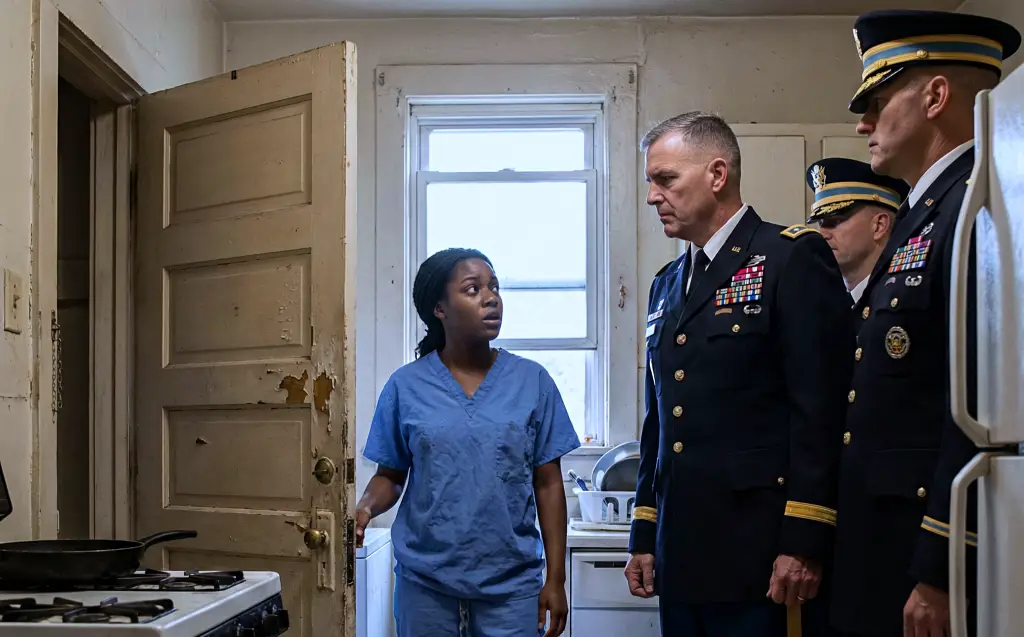
Dawn had just broken when three military officers knocked on her apartment door. They stood in dress uniforms, stiff and imposing in the dim hallway light. A colonel stood at attention on her cracked doorstep. When Aaliyah opened the door, she was still wearing her hospital scrubs, her body aching with exhaustion from a double shift. Her heart plummeted into her stomach.
– Miss Cooper, – the colonel said, his voice deep and authoritative.
– We are here regarding George Fletcher. George, the elderly man from the bus stop.
Aaliyah’s voice trembled, her hands instinctively clutching the doorframe.
– Did something happen to him?
The colonel’s expression remained grave, his eyes unreadable.
– Ma’am, we need to speak with you about what you did for him.
Six months earlier, Aaliyah had noticed him for the first time. She took the number 47 bus every morning at 6:30. The stop was located three blocks from her apartment, directly in front of a laundromat that had been shuttered for years. That was where George slept, curled up on a flattened cardboard box with a wool blanket pulled up to his chin, his few worldly possessions stuffed into a black trash bag beside him. Most people walked past him without a second glance.
Some pedestrians would even cross the street specifically to avoid walking near him. For the first two weeks, Aaliyah had done the same thing, telling herself that she didn’t have enough resources to help anyone. She barely had enough to survive herself.
But one morning in late March, she had packed an extra sandwich for her lunch and realized she wouldn’t have time to eat it. Her shift at the hospital cafeteria ran until three in the afternoon, and then she had to be at the grocery store by four to stock shelves until midnight. The sandwich would just spoil in her locker.
George was awake when she approached him that day. His eyes were sharp, clearer than she had anticipated. He watched her carefully, his posture defensive, as if he were accustomed to people either ignoring his existence or yelling at him to move along.
– Excuse me, – Aaliyah said, holding out the wrapped sandwich. – I made too much food. Do you want this?
He stared at the sandwich, then lifted his gaze to her face. For a long moment, he didn’t move.
– You need that more than I do, – he said quietly.
– That’s debatable, – Aaliyah replied with a faint smile. – But I’m offering.
He reached out and took it with both hands, handling it as if it were something precious.
– Thank you, miss.
– Aaliyah.
– George, – he nodded once. – George Fletcher.
She almost walked away then, almost retreated back into her routine of not seeing him, of not getting involved. But something about the way he had said thank you—with dignity, not desperation—made her pause.
– Do you take your coffee black or with sugar? – she asked.
His eyebrows lifted in surprise.
– Black is fine.
The next morning, she brought coffee in a thermos. And a banana. The morning after that, she brought another sandwich and an apple. By the end of the first week, it had become a ritual she couldn’t imagine breaking.
6:15 a.m., every single day. George was always awake, always waiting at the same spot. They would talk for five, maybe ten minutes before her bus arrived. He would ask about her classes; she was taking nursing courses at the community college two nights a week when she could afford the tuition. She would ask about his day, and he would tell her stories.
They were strange stories.
– Back in my helicopter days, – he would say, his gaze drifting past her to look at nothing in particular. – We flew senators out to places that don’t exist on any maps.
Or he would whisper:
– I worked for a three-letter agency once. Can’t tell you which one. But I can tell you this: those folks don’t forget faces.
Aaliyah figured he was confused. Maybe mentally ill. Maybe just old and lonely, constructing a past for himself that felt more important than sleeping on cardboard. She never corrected him. She just listened.
Other people were not so kind. One morning in April, a businessman in an expensive, tailored suit walked past and deliberately kicked George’s blanket into the gutter. Aaliyah was ten feet away, about to cross the street.
– Hey! – she spun around, her voice sharp with shock. – What is wrong with you?
The businessman didn’t even slow down.
– He is blocking the sidewalk!
– That is somebody’s grandfather! – Aaliyah shot back.
The man kept walking, indifferent. George sat quietly, pulling his blanket back from the dirty water pooling at the curb. His hands shook. Whether from the morning cold or suppressed anger, Aaliyah couldn’t tell. She helped him wring out the blanket. It smelled pungent, a mix of mildew and exhaust fumes.
– You didn’t have to do that, – George said softly.
– Yeah, I did.
He looked at her for a long time. Then he smiled, a sad, knowing smile that reached his eyes.
– You’ve got a fight in you. That’s good.
He folded the damp blanket across his lap.
– You’re going to need it.
Aaliyah didn’t understand what he meant. Not then. She just handed him his coffee, same as always, and waited for her bus.
By May, the routine was as automatic as breathing. Wake up at five, make two sandwiches—one for George, one for herself. Pack a banana, pour coffee into the thermos, walk three blocks, sit with George for ten minutes, catch the 6:30 bus. It didn’t feel like charity. It felt like the only thing in her chaotic life that made sense.
Aaliyah’s apartment was a studio on the fourth floor of a building that should have been condemned years ago. It was three hundred square feet, featuring a hotplate instead of a stove, and a bathroom where the shower only worked if you kicked the pipes first. Rent was $650 a month, and she was perpetually two weeks behind.
The eviction notice had been taped to her door in March. She had talked the landlord into a payment plan—an extra $40 a week until she caught up. She had been paying it off ever since, which meant every other bill got pushed to the jagged edge of default.
Her kitchen counter told the story of her struggle. The electric bill was past due. Medical debt from an emergency room visit two years ago was in collections. Student loan payments were deferred again. Her cell phone was one month away from disconnection. And in the middle of all that paper, sat a loaf of bread and a jar of peanut butter.
Aaliyah stood at the counter on a Tuesday night in late May, doing the math in her head. She had gotten paid that morning: $280 from the hospital, and another $160 from the grocery store.
Subtract rent. Subtract the payment plan. Subtract bus fare for two weeks. There was exactly $90 left. For everything else.
She opened the fridge. A carton of eggs with three left inside. Half a jug of milk. Some wilted lettuce she should have thrown out days ago. That was it. Her stomach had been empty since lunch, but she had learned to ignore that gnawing feeling. She would eat tomorrow. Or the day after. It didn’t matter.
What mattered was the bread and peanut butter. It was enough for another week of sandwiches for George. Maybe two weeks if she stretched it thin. Aaliyah closed the fridge and leaned against it, pressing her forehead to the cold metal door.
She could stop. She could keep the sandwiches for herself, save the coffee money, and catch up on the electric bill before they shut the power off. George would understand. He would probably tell her to stop anyway if he knew how tight things were. But the thought of walking past that bus stop, seeing him there and not stopping… She couldn’t do it.