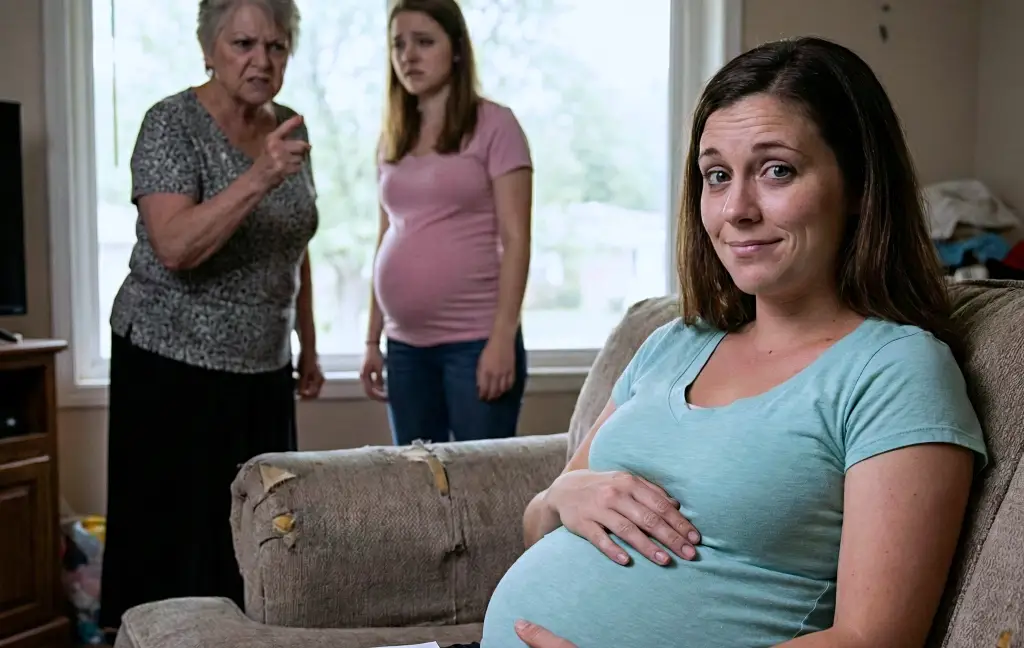
My name is Emerson Foster.
They thought $100,000 and a one-way ticket would make me disappear quietly, leaving them free to build their perfect legacy with triplets on the way. They were wrong. The moment that test result landed in their hands, the color drained from their faces.
Secrets they thought were buried forever came roaring back. Blood doesn’t lie, and money can’t silence what nature has already written. I never wanted it to come to this.
I never asked to be the one left standing in the wreckage while they celebrated their new beginning. But when the truth hit them, when they realized the child they tried to claim wasn’t just any child, everything they built started to crumble. Now they are the ones scrambling, calling lawyers at midnight, watching their perfect plan fall apart piece by piece.
If you’ve ever been pushed aside, dismissed, or told your worth is measured by what you can produce, this story is for you. If you’ve ever watched people who claim to love you choose convenience over loyalty, then listen closely.
That evening started like any other Tuesday in our Santa Barbara home. I was in the kitchen heating up the roast chicken Brandon always said was better than any restaurant. His phone buzzed on the counter while he was in the shower.
I didn’t mean to look, but the screen lit up with a name that wasn’t in my contacts: Jessica. It rang again. And again.
Three calls in a row. From the bathroom, Brandon called out casually, “Emerson, can you grab that for me?”
I picked it up. Before I could even say hello, a woman’s voice came through, shaky and urgent.
“Babe, I just left the doctor. It’s triplets. Three little heartbeats.”
She paused, breathless. “Can you believe it? We’re having triplets.”
The phone slipped from my hand and clattered on the granite. The spoon I was holding fell too, ringing against the tile like a tiny alarm bell. Brandon burst out of the bathroom in a towel, snatched the phone, and turned his back to me.
His voice dropped to that soft, soothing tone he used to use on me. “Hey, hey, calm down, sweetheart. I’m here. We’ll figure this out. Don’t cry.”
I stood frozen in the middle of our kitchen, the one I’d remodeled myself two years ago, staring at the back of the man I’d married. He didn’t even glance at me. He just kept murmuring into the phone like I wasn’t there.
From that moment, the house changed. Brandon still came home most nights, but he might as well have been a guest. His shirts carried a different perfume, something sweet and young.
I told myself it was nothing—colleagues, clients. I repeated it until it sounded ridiculous even to me. Two weeks later, my phone rang with an unknown number.
I answered, and Vivian Reed’s voice came through. No hello, no warmth—just ice.
“Emerson, be at the estate tomorrow at three. Sharp. If you’re late, don’t bother coming.”
She hung up before I could respond. I stood in the living room looking out at the Pacific, the view we used to love watching together. Suddenly, it felt like someone else’s house.
The next day, I drove up the winding road to the Reed family estate in the hills above Santa Barbara. Mr. Thompson opened the gate. He gave me the same quiet look he always did: part sympathy, part resignation.
“Mrs. Reed is in the study, ma’am.”
I walked the long hallway, heels clicking on marble. Vivian sat behind the big oak desk, ramrod straight. Richard was beside her, silent as usual.
On the table between us lay a neat stack of papers and a pen.
“Sit,” Richard said. One word.
I sat. Vivian didn’t waste time.
“You already know about Brandon and Jessica. She’s pregnant. Triplets. This family needs heirs. You’ve had two years and nothing. We’re not going to wait another two.”
I let out a short, dry chuckle. Not because it was funny, but because the absurdity hit me all at once. Two years of doctor visits, tests, supplements, hope after hope, and now triplets on the first try with someone else.
“So this is it?” I asked. “You’re trading me in?”
Vivian’s expression didn’t change. “We’re offering you $100,000. Sign the papers today. The money transfers immediately.”
She pushed the papers closer. “You have seven days to leave the United States. You may not return for three years. No press, no interviews, no using the Reed name for anything.”
I flipped through the pages. Restrictive clauses were everywhere: Non-disclosure. No contact with media. And that exile clause—seven days to vanish.
“And if I don’t sign?” I asked.
Richard finally spoke. “Court. You know how that goes. We have the resources. You’d walk away with nothing, and the narrative would be… unflattering.”
He leaned back. “A woman who couldn’t give her husband children. The public loves a sad story, but they love a winner more.”
Vivian leaned forward. “Take the money, Emerson. Start over. It’s generous. You’ll be comfortable. Don’t make this difficult for everyone.”
Difficult for everyone. Not for me, apparently. For them.
For their reputation. For their perfect picture of triplets and a new Mrs. Reed. I looked at the two of them—people I’d called Mom and Dad for two years.
People who had welcomed me with hugs and promises of family were now negotiating my exit like I was a lease expiring.
“I need three days to think,” I said.
Vivian’s eyes narrowed. “Three days. Not one more.”
I stood up. “Goodbye, Vivian. Goodbye, Richard.”
I didn’t call them Mom and Dad. Not anymore. I walked out of that study past Mr. Thompson, who looked like he wanted to say something but didn’t.
The gate closed behind me with a soft click that felt final. Driving back down the hill, the ocean glittering on my left, I gripped the wheel until my knuckles turned white. They thought $100,000 could buy silence.
They thought I’d disappear quietly. They had no idea what was coming.
Three days later, I drove back up that same winding road to the Reed Estate. The ocean was calm that morning, almost mocking me with its peace. Mr. Thompson opened the gate without a word, just a small nod.
Vivian and Richard were already in the study, in the same positions as before. The papers waited on the table like they’d never been touched. Vivian didn’t smile.
Richard didn’t speak. I sat down and picked up the pen. I read every line again slowly.
$100,000 wired within 24 hours. Seven days to leave the country. Three years before I could return.
No contact with media. No using the Reed name for profit or publicity. It was all there, cold and precise.
Vivian watched me. “Changed your mind?”
“No,” I said. “I haven’t.”
I signed. The pen scratched across the paper like it was carving something permanent. I pushed the stack toward her.
She scanned my signature, gave a single nod, and slid a copy back to me. Richard made a quick call.
“It’s done. Transfer initiated.”
I stood up. “Goodbye, Vivian. Goodbye, Richard.”
This time, they didn’t respond. I walked out alone. The money hit my account that afternoon: clean, instant, impersonal.
I stared at the number on my phone for a long minute. $100,000. Enough to disappear.
Enough to start over. Enough to remind me exactly how much two years of marriage had been worth to them. I packed light: clothes, a few books, my laptop.
I also packed the small wooden box of medical records I’d kept from all those doctor visits. I left the wedding photo on the mantle. I left the kitchen gadgets I’d bought.
I left the house that had once felt like home. Brandon wasn’t there when I left. He texted once: I’m sorry.
I didn’t reply. The flight to Boise was short, under two hours. I landed in the late afternoon, rented a small one-bedroom apartment near the Boise River, and bought groceries at the first supermarket I saw.
The cashier smiled and asked if I was new in town. I said yes. She said welcome. It felt strange, yet normal.
The first few weeks were calm. I found freelance work editing marketing copy for small businesses. Nothing glamorous, but steady.
I walked along the greenbelt every morning, breathing air that didn’t smell like the ocean or betrayal. Megan called almost daily.
“You okay?” she’d ask.
“Getting there,” I’d say.
She didn’t push; she just listened. One morning, about six weeks after I arrived, I woke up feeling off. Nausea hit hard.
I thought it was stress, or the new water, or maybe just bad coffee. But it kept happening. Mornings became a routine of dry heaves, then forcing down toast.
I ignored it for days. Then the fatigue set in—bone deep, the kind that makes you sit on the couch and stare at the wall for an hour. I missed my period again.
But this time, something felt different. I bought a test at the pharmacy down the street. The cashier didn’t ask questions.
I walked home, locked the door, and sat on the edge of the bathtub. Two lines appeared almost immediately. Positive.
I stared at the stick for a long time. Six weeks. The math lined up right around the last time Brandon and I had been together before everything fell apart.
Before the phone call. Before the triplets announcement. Before the papers.
I chuckled—short, sharp, a little hysterical. After two years of trying, of tests, of hoping, of being told my body wasn’t cooperating, life decided to hand me this now.
Now, when I was alone in a strange city with $100,000 and no one to share the news with. I rested a hand on my stomach. No bump yet.
Just the faintest promise of something real. Megan was the only one I told. I called her that night.
“I’m pregnant.”
She went silent for a second, then screamed so loud I had to pull the phone away. “Oh my god, Emerson! That’s incredible. Wait, does Brandon know?”
“No,” I said. “And he’s not going to. Not yet. Not ever, if I can help it.”
She didn’t argue. She just said, “Whatever you need, I’m here. Even if it means flying to Boise and bringing you soup.”
I smiled for the first time in weeks. Soup would be nice. The days after that felt different.
I started eating better: more greens, less coffee. I found a small OBGYN clinic downtown. The doctor was kind and no-nonsense.
She confirmed everything: healthy heartbeat, good levels, about 7 weeks along. I walked out of that office with a printout ultrasound—a tiny blob of flickering light—and suddenly, Boise didn’t feel so empty.
I had a secret. A good one. One that no amount of money or papers could take away.
But secrets have a way of getting heavier. I knew deep down that Vivian and Richard weren’t the type to let go so easily. Months passed in Boise faster than I expected.
The little apartment started feeling like mine. I bought a secondhand desk, set up a corner for work, and landed two steady clients who needed marketing copy edited every week. The pay wasn’t huge, but it was honest money—money I earned myself.
Every time the deposit hit my account, I felt a small, stubborn sense of pride. Megan kept her promise. She flew out once every couple of months, bringing ridiculous amounts of snacks and baby clothes she swore were on sale and too cute to pass up.
We’d sit on my tiny balcony overlooking the river, drinking decaf, and she’d tease me about becoming the coolest single mom in Idaho. I laughed more than I had in years.
“You know,” she said one afternoon, holding up a tiny pair of socks, “these are so small, I’m scared I’ll lose them in my purse. How is something this tiny going to become a whole person?”
I rubbed my growing belly. “I have no idea, but I’m starting to think it’s going to be the best surprise of my life.”
My OB appointments became routine. The doctor was a calm woman in her 50s who never rushed. She always asked how I was sleeping, eating, feeling.
When I told her I felt good—really good—she smiled like she’d heard it before but still appreciated it. At the 20-week ultrasound, I saw my baby clearly for the first time. A perfect profile, tiny hands, a strong heartbeat.
The tech pointed out arms, legs, spine. Everything looked exactly as it should. Then she paused.
“There’s something interesting here,” she said, zooming in on a small area. “Nothing to worry about right now, but I’d like to send this to a genetic counselor. Just routine.”
I nodded, my heart suddenly loud in my ears. Two weeks later, I sat in a quiet office downtown. The genetic counselor was gentle and matter-of-fact.
She explained that during the routine scan, they’d noticed a very rare marker, a gene variation that runs strongly in certain families. It wasn’t dangerous on its own, but it was unusual enough that they recommended confirming paternity.
I didn’t hesitate. I already knew who the father was, but I needed proof. Solid, legal, undeniable proof.
They drew blood from me and sent it to the lab along with a sample Brandon had left behind on an old toothbrush I’d kept in a Ziploc bag. Yes, I’m that petty, and that prepared. Ten days later, the envelope arrived.
I opened it alone in my kitchen at seven in the morning. The words hit like a freight train.
Paternity probability: 99.9998 percent. The child is biologically related to Brandon Reed.
Additionally, the fetal DNA shows the same rare autosomal dominant variant identified in the Reed family lineage, confirmed through public genetic databases and family medical records previously submitted.
I had to sit down. Not only was this baby Brandon’s, but it also carried the exact genetic marker the Reed family had been quietly worried about for years.
It was the one Vivian had mentioned once in passing during a dinner, saying it was “why we need strong, healthy heirs.” The one that, if passed on, could eventually mean serious money in research grants, medical patents, or family prestige.
I stared at the paper and chuckled—quiet at first, then louder. After everything they did to get rid of me, life had decided to hand them the one thing they wanted most, through me. The irony was so perfect it was almost beautiful.
I called Megan immediately.
“They’re going to lose their minds when they find out,” she said, half chuckling, half horrified. “You have the golden ticket, and they threw you away like yesterday’s trash.”
“I’m not giving them anything,” I told her. “Not the baby, not the gene, not even the satisfaction of knowing.”
But secrets like this don’t stay buried forever. A few weeks later, Megan called me in the middle of the night, her voice low and urgent.
“Emerson? I think Vivian’s starting to suspect something. Mr. Thompson called me yesterday. Said Vivian asked if I’d heard from you lately. She sounded… different. Not angry. Curious.”
Too curious. I felt the first real chill since I’d left Santa Barbara. Vivian Reed didn’t do “curious” unless she already had a theory.
And if she had a theory, she wouldn’t stop until she turned it into evidence. I looked down at my belly, now impossible to hide under loose sweaters. The baby moved—a firm little kick right under my hand.
I murmured to the calm room, “Don’t worry, little one. Mommy’s got you.”
For the first time since I signed those papers, I felt something stronger than fear. I felt ready.
A thick envelope arrived in my mailbox on a crisp October morning. No return address, just a Boise postmark and the name of a high-end law firm from Santa Barbara. I knew before I opened it.
My stomach tightened as I slid the letter out. It was formal, polite, and ruthless.
The letterhead read: Reed Family Legal Counsel. The subject line: Request for Paternity Confirmation and Discussion of Custody Arrangements.
They wanted a court-ordered paternity test. They wanted to establish Brandon’s parental rights. They wanted to discuss the “best interests of the child,” which in their words may include “placement with the paternal family, given the child’s unique genetic heritage and the resources available.”
I read it twice. The tone was calm, professional, almost kind if you ignored the threat underneath every sentence. Megan was at my apartment within an hour.
She read it silently, then looked up. “They’re not even pretending anymore. They want the baby.”
“They want the gene,” I corrected. “The baby is just the delivery system.”
We sat on the couch for a long time. Megan finally broke the silence. “You need a lawyer. A good one. Right now.”
I already had one. A local family law attorney recommended by a co-worker. Her name was Karen Ellis: mid-fifties, sharp eyes, and a reputation for never backing down when kids were involved.
I’d met her the week before, just in case. I called her that afternoon. She listened to the letter over the phone, then said simply, “Send me a scan. We’ll talk tomorrow.”
The next day, she laid it out plain.
“In Idaho, custody defaults to the mother unless there’s clear evidence of unfitness. They can request paternity, but they can’t force you to hand over the child without a fight. The ‘best interests’ standard is what matters.”
She continued, listing the facts. “You have a stable home, a job, no criminal record, and good prenatal care. They have money and a big house, but they also have a history of pressuring you out of the marriage. Courts don’t like that.”
She paused. “The genetic marker… It’s interesting, but it’s not a trump card. It doesn’t make them better parents. It just makes them greedy.”
I asked the question I’d been dreading. “How dirty will they get?”
Karen didn’t sugarcoat it. “They’ll hire investigators. They’ll watch your apartment. They’ll dig into your finances, your work, your daily routine. They want leverage—anything to paint you as unstable or unfit.”
I thought of the peaceful street outside my window, the neighbor who waved every morning, the library where I borrowed books on pregnancy and parenting. It felt like my life was about to become a surveillance project.
Sure enough, the watchers appeared within a week. First, it was a man in a gray SUV who parked across the street too often. Then a woman with a laptop at the coffee shop down the block, always glancing up when I walked by.
They weren’t subtle. They wanted me to know they were there. Megan spotted one during a visit.
“That guy in the black coat,” she said. “He’s been sitting on the bench for two hours. He’s not reading the newspaper. He’s watching your building.”
I looked out the window. “Let them watch. I’m not hiding anything.”
But it wore on me. Every walk to the grocery store felt like a performance. Every trip to the doctor felt exposed.
I started varying my routes, changing my schedule slightly—not out of fear, but out of stubbornness. If they wanted to play this game, I’d play it better.
Karen filed a response within 10 days: a motion to dismiss their request for immediate custody evaluation, citing lack of jurisdiction (the child was born and resided in Idaho), and a counter-request for a temporary protective order against harassment. She attached photos of the watchers taken by Megan with her phone and affidavits from neighbors confirming the unusual activity.
The Reed lawyers fired back quickly. More letters, more requests. They offered generous financial support if I agreed to shared custody.
They suggested I relocate back to California for “the child’s benefit.” I chuckled when I read that one. Relocate back to the people who paid me to disappear?
I told Karen, “They can offer me the moon. I’m not moving.”
She smiled for the first time. “Good. Let’s make them come to us.”
Meanwhile, my belly grew. The baby kicked harder every day. Sometimes at night, I’d lie awake feeling those little thumps and murmur, “We’re okay. We’ve got this.”
Megan started staying longer on her visits. She’d cook dinner, fold tiny onesies, and talk about anything except the Reeds. One evening, she said, “You know what’s funny? They spent all that money to get rid of you, and now they’re spending even more trying to get back what they threw away.”
I smiled. “Karma’s expensive.”
The pressure built steadily. More letters, more “concerned inquiries” about my health, my finances, my support system. They even sent a private investigator’s report claiming I’d been seen looking “fatigued” at the grocery store.
Karen called it fishing for dirt. One afternoon, I came home to find a bouquet of white lilies on my doorstep. No card.
White lilies were Vivian’s favorite flower for condolences and new beginnings. A not-so-subtle message. I threw them in the trash.
That night, I sat on the couch with my laptop, researching Idaho family law for the hundredth time. The baby moved—a strong kick right under my ribs. I rested my hand there and felt another.
“You’re a fighter,” I murmured. “Just like Mommy.”
Karen called the next morning. “They’ve scheduled a mediation session in Boise next month. They’re coming here. Vivian, Victor, and Brandon. They want to meet face to face.”
I took a slow breath. “Fine. Let them come.”
She paused. “You ready for this?”
I looked down at my belly, felt the next kick, and smiled. “I’ve been ready since the day they handed me those papers.”
The mediation was set for a Thursday afternoon in a plain conference room downtown. I arrived 15 minutes early, belly leading the way, Karen walking beside me. She carried the folder of documents like a shield.
I wore a simple navy dress—comfortable, professional, nothing flashy. No need to look like I was trying too hard. They were already there when we walked in.
Vivian sat at the head of the table, posture perfect, coat folded neatly beside her. Victor, Richard’s older brother—the one who always spoke for the family when Richard stayed quiet—was next to her. Brandon sat at the far end, looking thinner, eyes down.
He glanced up when I entered, then quickly looked away. Karen spoke first.
“Let’s keep this civil and efficient. My client is here in good faith.”
Vivian didn’t waste time on pleasantries. “We’re not here for small talk. We’re here because that child carries Reed blood, a very specific genetic marker. We have the means to provide the best possible life: education, healthcare, stability. You’re alone in a rented apartment working freelance. Be reasonable.”
I met her gaze. “‘Reasonable’ means giving up my son because you have more money,” I said. “That’s not how Idaho courts see ‘best interests.'”
Victor leaned forward, his voice softer than Vivian’s, but no less firm. “Emerson, we’re not trying to take him away completely. We’re offering shared custody. Summers with us in Santa Barbara. Holidays. You’d have financial support—generous support. You wouldn’t have to worry about anything.”
Brandon finally spoke, his voice low. “It’s a good offer, Emerson. For the baby.”
I turned to him. “You mean for the gene. Let’s not pretend this is about anything else.”
Vivian’s lips thinned. “That gene is important. It’s been in our family for generations. The research potential alone…”
Karen cut in smoothly. “We’re not here to discuss medical patents. We’re here about custody of a child who hasn’t even been born yet. My client is the mother. She’s healthy, employed, stable. There’s no evidence of unfitness. Your surveillance attempts have been documented. They don’t help your case.”
Victor tried again. “We only want what’s best. You’re young. Raising a child alone is hard. We can give him opportunities you can’t.”
I placed both hands on my belly. The baby kicked hard, right on cue. I smiled despite myself.
“He’s already telling you what he thinks.”
Vivian’s eyes narrowed. “This isn’t a joke.”
“No,” I said quietly. “It’s not. But you’ve treated it like one from the beginning. You paid me to disappear. Now you want to buy your way back in because the child has your precious gene. You don’t get to rewrite the rules when it suits you.”
Brandon shifted in his seat. “Emerson… I never wanted things to go this far.”
“I thought you thought I’d just fade away,” I finished. “And I did, for a while. But this baby changed everything. He’s mine. I carried him. I feel him every day. You don’t get to decide his life because your family has a big house and a family tree full of money.”
Vivian’s voice sharpened. “You’re being selfish. A child needs a father. Needs family.”
“He has family,” I said. “Me. And Megan. And the people in Boise who wave hello when I walk by. That’s more than I ever got from you.”
Victor tried one last time, softer. “We’re willing to compromise. Supervised visitation. We’ll pay for everything: school, college, medical. You’d never have to work another day if you don’t want to.”
I looked at Brandon. “And you? You’re okay with this? Handing our son over like a business deal?”
Brandon swallowed. His eyes flicked to Vivian, then back to me. “I—I want what’s best for him.”
I waited. He didn’t add anything else. Karen spoke again.
“No deal. No shared custody. No relocation. If you force this to court, we’ll present everything: the payoff to leave, the surveillance, the pressure. Idaho judges don’t look kindly on wealthy families trying to buy children from their mothers.”
Vivian stood up slowly. “You’ll regret this.”
I stood too, slower because of the weight. “I regretted staying quiet once. I won’t make that mistake again.”
Victor looked almost apologetic. “We’ll see you in court then.”
They filed out: Vivian first, Victor next, Brandon last. He paused at the door, looking back at me for a long second. His mouth opened, then closed.
He left without a word. Karen touched my arm. “You did good.”
I exhaled. “Did I? Or did I just start a war?”
Outside, the October air was sharp. I rested a hand on my belly. Another kick, stronger this time. I murmured, “We’re not backing down.”
The last weeks of pregnancy arrived like a quiet storm. My blood pressure started climbing. Nothing dramatic at first, just numbers the doctor didn’t like.
She scheduled extra monitoring. Then, one afternoon, she said, “We’re admitting you. Better safe than sorry.”
I packed a small bag and went to the hospital in Boise. The room was bright and clean, with a view of snow-dusted hills. Nurses came and went, checking monitors, asking how I felt.
I told them I felt heavy and tired, but okay. They smiled and said that was normal. Megan arrived the next day with a suitcase and a bag of takeout.
“I’m not leaving until he’s here,” she announced. She set up camp in the recliner, read me funny headlines from her phone, and complained about hospital coffee like it was a personal betrayal.
“You know,” she said one evening while peeling an orange, “if this kid inherits your stubborn streak, the Reed family is going to have a very long lawsuit on their hands.”
I chuckled, soft and tired. “They already do.”
Karen visited twice a week. She brought updates: the Reeds had filed another motion, this time asking for an emergency custody evaluation once the baby was born. They claimed my hospitalization proved I was unstable.
Karen rolled her eyes. “They’re grasping. Courts see high-risk pregnancy all the time. It doesn’t make you unfit; it makes you careful.”
I asked her the question that kept me awake at night. “What if they win?”
She looked me straight in the eye. “They won’t. Not here. Not with your record. You’ve done everything right.”
The days blurred. Monitors beeped. Nurses checked. Megan told stories about her crazy aunts and uncles.
One night, she fell asleep in the chair with her mouth open, and I covered her with a blanket. It was the first time since Santa Barbara that I didn’t feel completely alone.
Then the contractions started—real ones, not the practice kind. The doctor came in fast.
“We’re moving to delivery. It’s time.”
The room filled with people. Lights brightened. Monitors sped up. I gripped the bed rails and breathed through the pain.
Megan held my hand so tight I thought she’d break it. “You’ve got this,” she kept saying. “You’ve got this.”
The pain built wave after wave. I pushed when they told me to push. I cried when I needed to cry. And then, suddenly, there was a cry.
Small, fierce, perfect. The nurse placed him on my chest. Noah.
Tiny face, dark hair, eyes squeezed shut. He stopped crying the moment he felt my skin. I touched his cheek and whispered his name.
Megan was sobbing openly. “He’s beautiful. He’s so beautiful.”
I couldn’t stop looking at him. Every finger. Every eyelash. He was real. He was mine.
The next morning, Karen came in with news. Vivian had called the hospital. She wanted to see the baby. She claimed grandparent rights.
The hospital administrator had already spoken to Karen. “They’re not getting past the front desk,” Karen said. “You’re the mother. You decide visitors. And right now, you’ve decided no.”
I looked at Noah sleeping in the bassinet. “They can wait.”
Vivian tried again the next day, through lawyers this time. A formal request for immediate visitation. Karen filed a response in hours: a temporary restraining order citing prior harassment, surveillance, and emotional pressure.
The judge granted it within 48 hours. Vivian lost that round fast.
When I was discharged, I carried Noah out in his car seat, Megan walking beside me. The air was cold and clean. Snowflakes drifted down.
I buckled him into the car and drove home, gradually and carefully. The apartment felt different with him in it. Smaller. Brighter.
It was full of tiny sounds: his breathing, his little sighs, the soft creak of the rocker when I held him at night. Megan stayed another week, then had to go back.
Before she left, she hugged me tight. “You did it. You really did it.”
I hugged her back. “We did it.”
The Reeds didn’t give up easily. More letters arrived. More requests. But each time, Karen pushed back harder and faster.
The court in Boise made it clear: jurisdiction was here. The mother had custody. The father could file for visitation, but only after proving consistent, respectful intent.
No emergency motions. No threats. Vivian’s last attempt was a phone call. Karen put it on speaker so I could hear.
“Emerson,” Vivian said, her voice controlled. “This is unnecessary. Let us see our grandson. We can make this easy.”
I took the phone. “You made it hard from the beginning. You paid me to leave. You watched me. You threatened me. Now you want easy?”
Silence on the line.
I continued. “If Brandon wants to be a father, he can start by respecting boundaries. Until then, Noah stays with me. Only me.”
She hung up. After that, the letters slowed. The watchers disappeared. The pressure eased.
Noah grew. He smiled. He grabbed my finger. He slept on my chest while I read books aloud. Every day felt like a small victory.
I looked at him one peaceful afternoon, sunlight streaming through the window, and realized something simple. They could have all the money in the world. They could have their estate, their name, their legacy.
But they would never have this. They would never have him. And that finally felt like justice.
Months turned into a peaceful rhythm in Boise. Noah grew fast. He rolled over, sat up, and grabbed at everything within reach.
His first laugh came one morning when I made silly faces over his changing table: loud, joyful, unstoppable. I recorded it on my phone and played it back whenever I needed reminding why every hard day had been worth it.
The court case wrapped up faster than anyone expected. Karen filed motion after motion. The Reeds pushed back with expensive lawyers, but Idaho judges don’t bend easily.
The judge, a woman in her 60s with a no-nonsense reputation, read the history: the payoff agreement, the surveillance reports, the repeated attempts to pressure a pregnant woman into giving up her child. She called it a “pattern of coercion” and ruled in my favor.
Sole physical and legal custody to me. Brandon was granted supervised visitation only after completing parenting classes and proving consistent, respectful contact. No relocation allowed without my consent. No financial leverage permitted to influence custody.
Vivian sat in the courtroom the day the ruling came down. She didn’t speak. She just stared straight ahead, lips pressed into a thin line.
When the judge finished, she stood up slowly and walked out without looking back. That was the last time I saw her in person.
The fallout hit the Reed family harder than any of us predicted. A local Santa Barbara paper picked up the story, quietly at first: Wealthy Family’s Custody Battle Ends in Defeat.
Then a bigger outlet ran it: Reed Real Estate Empire Faces Scrutiny After Failed Bid to Take Grandchild.
Photos of the estate appeared online. Old interviews with Vivian praising “family values” resurfaced. Clients started pulling contracts.
A major hotel development deal—the one Richard had been negotiating for two years—fell through when the investors cited reputational concerns. Vivian’s name, once synonymous with power in Santa Barbara circles, became something people whispered about. Invitations to charity galas stopped coming.
Old friends grew distant. She didn’t lose everything overnight, but she lost the one thing she valued most: control of the narrative.
Brandon fared worse. Jessica left him six months after Noah was born. The triplets were demanding—three babies at once—and the constant drama with me didn’t help. She filed for divorce citing irreconcilable differences.
Brandon didn’t fight it. He moved into a smaller house near the coast, away from the family estate. Richard quietly rewrote the trust documents.
Brandon’s share of the inheritance was reduced. He wasn’t cut out, but he was no longer the golden heir. He worked a regular job now, managing a small property portfolio.
When he visited Noah, he came alone, on time, and left quietly. He never mentioned Vivian or the past. He just held his son and tried to be present.
I allowed supervised visits once a month. Always in Boise. Always with a neutral third party. Brandon never asked for more. I think he knew he didn’t deserve it.
Megan moved to Boise permanently a year later. She bought a little house two streets over. She became Noah’s “Auntie Meg,” the one who taught him to ride a tricycle, the one who sang off-key lullabies, the one who made me laugh when I was exhausted.
Life wasn’t perfect. There were sleepless nights, tantrums, doctor visits, and bills. But it was ours.
One afternoon, when Noah was two, we sat on the porch watching snow fall. He pointed at the flakes and said his first full sentence.
“Pretty, Mama.”
I pulled him into my lap. “Yeah, buddy. Pretty.”
Looking back now, I realize the real victory wasn’t just winning in court. It was choosing myself when everyone else told me I should disappear. I used to think family meant swallowing your pride, staying quiet, and accepting whatever scraps of respect they threw your way.
I was wrong. Real family doesn’t demand your silence. It doesn’t measure your worth by how many children you can produce, or how much money you cost. Real family protects you even when it’s hard—even when it means walking away.
Your worth isn’t negotiable. Your child isn’t a bargaining chip. And when someone tries to make you believe otherwise, they’re not protecting family; they’re protecting their own ego.
Choose yourself. Choose your child. Choose the life where you can look in the mirror and know you didn’t sell your soul for someone else’s approval. Because on the other side of that choice is freedom.
Real freedom. The kind that lets you chuckle at silly faces, watch snow fall, and feel your heart full in a way money could never buy.