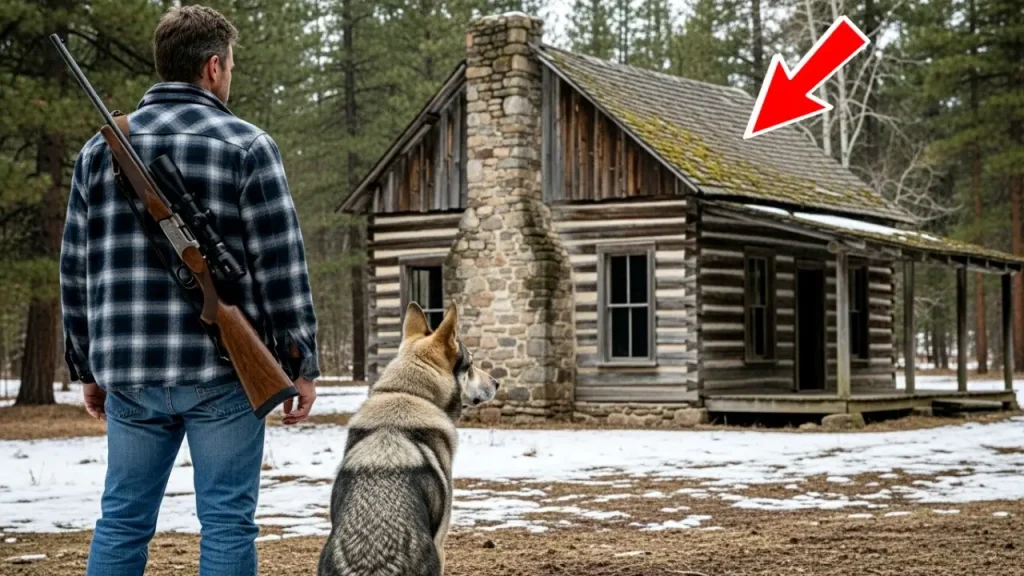
Isolated by a fierce snowstorm, veteran Jack Callahan thought nature was his greatest enemy. He was wrong. Inside the cabin, his ever-calm service dog, Ghost, began to act strangely.
He wasn’t afraid of the storm but was obsessed with the stone fireplace, scratching and whining with an unusual urgency. Jack understood immediately. This wasn’t fear, but a warning.
What could be hidden beneath solid stone that only his dog could sense? A secret buried for fifteen years. He knew he had to trust his only companion and uncover the truth that someone was willing to kill to hide.
The air in the Flathead County Courthouse Annex was stale, smelling of old paper, damp wool coats, and the faint bitter aroma of lukewarm coffee. It was the smell of bureaucracy, a scent Jack Callahan had hoped to leave behind forever. He sat on a hard wooden bench near the back, a solitary figure in a room of familiar neighbors and sharp-eyed speculators.
His back was straight, a posture drilled into him over twenty years in the United States Army. However, his gaze was distant, fixed on the rain-streaked window rather than the auctioneer at the front. At his feet, lying with a quiet dignity that seemed almost out of place, was Ghost.
The dog was a German Shepherd, though his coloring was a rarity that always drew questions. Instead of the typical black and tan, Ghost’s thick double coat was a stunning mix of silver, gray, and pale cream. It was a wolf-like sable that had grown softer and lighter with age.
At nine years old, he was retired from a life of service Jack rarely spoke of. His muzzle was frosted with white, and the amber of his intelligent eyes held a deep, knowing calm. He was more than a dog; he was an anchor, the silent keeper of Jack’s peace.
Jack himself was a man carved from the same quiet resilience. In his late forties, he was tall and lean, with a strength that was wiry rather than bulky. His brown hair, cut short and practical, was threaded with silver at the temples.
His face was a map of his life, lines of concentration etched around his kind, blue eyes. A faint pale scar bisected his left eyebrow, a memento from a long-forgotten firefight in a place he’d rather forget. He wore what had become his uniform in civilian life: a simple gray t-shirt under a worn but clean plaid flannel shirt, faded blue jeans, and sturdy work boots.
He sought not comfort, but function. He sought not conversation, but solitude. The auctioneer, a portly man with a droning voice, moved through the list of foreclosed properties and seized assets with a practiced monotony.
A pickup truck from 2015, a set of woodworking tools, a small bungalow on the edge of town. For each item, a flurry of hands would shoot up, a brief competitive dance that Jack ignored. He was waiting for one thing, a ghost on the county ledger that he’d discovered weeks ago.
“All right, next up,” the auctioneer sighed, adjusting his glasses. “We have parcel 7-B, known locally as the Old Miller Place.”
A subtle shift occurred in the room. It was not a sound but a feeling, a collective intake of breath, a sudden stillness. The low hum of whispered conversations ceased.
The auctioneer cleared his throat, his voice now completely devoid of its already minimal enthusiasm. “Property consists of one hundred and sixty acres, a single cabin, condition listed as poor, one well, status unknown. This property is sold as is, where is.”
He paused before continuing. “It comes to the county by way of tax delinquency. Fifteen years of unpaid property taxes.”
Fifteen years. The number hung in the stale air. It was an eternity for a piece of land to sit in limbo. Jack felt the stares of the other attendees pivot from the auctioneer to him, the only stranger in the room.
They knew why he was here. He had asked about the parcel at the county clerk’s office last week. “We’ll open the bidding at five hundred dollars,” the auctioneer said, his tone suggesting he didn’t expect to get even that.
Jack raised his hand, a calm, steady gesture. “Five hundred.”
The auctioneer’s eyes found him. “I have five hundred dollars from the gentleman in the back. Do I hear six?”
Silence. It was a profound, heavy silence, unlike the competitive pauses from the earlier lots. Ghost lifted his head, his ears twitching slightly, as he sensed the change in the room’s emotional atmosphere.
Jack rested a hand on his dog’s broad head, the familiar feel of thick fur offering comfort. He looked around the room. Farmers in worn overalls and speculators in crisp shirts stared back at him, their expressions a strange cocktail of pity and fear.
No one looked envious. No one looked angry that they might be losing a bargain. They looked at him as if he were a man walking willingly toward a cliff’s edge.
“Going once,” the auctioneer called out, his voice rushing to finish the inevitable. “Going twice.”
Jack held the gaze of a rancher in the front row, a man whose weathered face spoke of a hard life. The rancher gave a barely perceptible shake of his head, a final, silent warning.
“Sold!”
The gavel came down with a crack that echoed like a gunshot in the silent room. “To the gentleman in the back for five hundred dollars.”
As Jack walked to the front to sign the papers and hand over the cash, the room broke into a low murmur. The dam of silence had broken, and whispers followed him like a shadow. He caught fragments of their talk.
“Doesn’t know what he’s just bought.”
“The Miller place? Cursed, I tell you!”
The clerk who processed his payment, a young woman with nervous eyes, refused to meet his gaze. She pushed the deed toward him as if it were contaminated. The whole experience left a sour taste in his mouth, but it did not deter him.
He had faced down men with rifles. Whispers and strange looks were a currency he no longer valued. With the deed to his new life folded in his pocket, Jack led Ghost out into the crisp Montana air.
He needed a few basic supplies before heading out to his new property. The sign on the town’s main street read Abernathy’s General Store. Its paint was peeling from decades of harsh winters and bright summers.
The bell above the door chimed as he entered. Inside, the store smelled of sawdust, leather, and freshly ground coffee. An elderly man stood behind the counter, his face a friendly landscape of wrinkles.
He was the only other person in the store. “Afternoon,” the man said, his voice warm. “What can I get for you?”
Jack nodded, grabbing a short list from his pocket. “Just need a few things. A good padlock, some lamp oil, coffee, and a new axe handle if you have one.”
As the proprietor gathered the items, he studied Jack with open curiosity. “You’re the fella who just bought the Miller Place, aren’t you? News travels fast in a town this size.”
“I am,” Jack said simply.
The old man, Abernathy, according to the name stitched on his apron, leaned against the counter. His friendly expression turned serious. “Son, I hope you don’t mind an old man’s meddling, but you should know what you’ve walked into.”
Jack paused, his hand hovering over a bag of coffee beans. He had expected this. “I’m listening.”
“That land,” Abernathy began, his voice dropping low, “it belonged to a journalist, Arthur Miller. Sharp fella, moved here from back east about sixteen years ago. Always asking questions, poking his nose into things.”
He paused for effect. “Then one day, he just vanished. His truck was still at the cabin, but he was gone.”
He let the words sink in. “Because he had no family here, the property got tangled up in all sorts of legal nonsense with the county. Tax bills piled up. For over a decade, it was a mess nobody could touch.”
Abernathy leaned closer. “A funny thing, though. Blackwoods Corporation, the big mining outfit, tried to get their hands on it a few times through some fancy legal tricks, but they never could. The county laws are strict.”
“If it’s a tax foreclosure, it has to go to a public auction. No exceptions.” Abernathy wiped the counter with a clean cloth, though it was already spotless. “So it just sat there, and folks started talking.”
“They say it’s haunted, that Miller’s ghost still walks the woods looking for justice. They say the land is just plain unlucky. That’s why nobody bid against you. They don’t see a bargain, son. They see a whole lot of trouble.”
Jack listened patiently, absorbing every word. He paid for his items, his movements calm and deliberate. He looked at the old shopkeeper whose eyes held genuine concern.
“I appreciate the warning, sir,” Jack said, his voice sincere. “I truly do.”
He turned and walked out of the store, Ghost trotting silently by his side. The bell chimed his departure. Out on the street, the sky was beginning to clear.
Jack looked down the long, empty road that would eventually lead him to his new home. Haunted, cursed, tangled up with a missing journalist and a powerful corporation. For another man, it might have been a reason to turn back.
For Jack Callahan, a man who had come to Montana seeking nothing but quiet, it felt strangely like he was finally heading in the right direction. He had bought more than land. He had bought a purpose.
The drive out of town was a steady unwinding of civilization. Jack’s old 1998 pickup truck, its engine a familiar and reliable rumble, left the paved streets behind. The road turned to gravel, spitting small stones against the undercarriage.
Then, just as the county map had indicated, it devolved into a dirt track that was little more than two deep ruts carved into the earth. The vast Montana landscape opened up around them. It was a breathtaking panorama of rolling hills giving way to the jagged blue shadows of distant mountains.
This was the quiet he had been searching for. Ghost sat in the passenger seat, his head held high. His nose twitched as he cataloged the new world of scents rushing in through the half-open window.
He was a perfect traveler, calm and observant, his presence a silent conversation that filled the cab of the truck. They found the turnoff for the property, marked only by two rotting fence posts, the wire between them long since rusted away. The entrance looked like a simple product of neglect.
However, as Jack carefully navigated the overgrown path, his eyes, trained to see things that were out of place, began to notice inconsistencies. The fence was down, which suggested an open invitation, yet a massive fallen pine log lay across the trail, forcing a sharp and difficult turn. It was weathered and old, but its position seemed too perfect, too convenient a barrier.
A hundred yards later, a thicket of thorny bushes crowded the path on one side, forcing the truck dangerously close to a deep ditch. It felt less like random wilderness and more like a deliberately constructed obstacle course designed to discourage the casual visitor. After another ten minutes of careful driving, the trail opened into a small clearing.
There it stood: the cabin. It was smaller than he’d imagined, built of thick, dark logs chinked with what was now crumbling gray mortar. A wide porch sagged on one side, and the windows were dark, opaque squares of grime.
The stone chimney that rose from the steep roof was coated in moss. It looked weary, a forgotten relic surrendering to the slow, relentless siege of nature. Jack killed the engine, and the sudden silence was immense, broken only by the whisper of wind through the tall pines that surrounded the clearing.
He and Ghost stepped out of the truck. The air was clean and sharp, scented with pine needles and damp earth. “Well, old friend,” Jack said softly, his voice the first human sound to touch this place in likely a very long time. “This is it—home.”
Ghost gave a low woof in response, his tail giving a slow, steady wag. He stayed close to Jack’s leg as they approached the cabin. The porch groaned under Jack’s weight, but the main logs felt solid.
The front door was unlocked. With a push, it swung inward on protesting hinges, opening into a single large room shrouded in gloom. Sunlight struggled through the filthy windows, illuminating columns of dust that danced in the still air.
The inside smelled of cold ashes, mice, and the deep, earthy scent of decaying wood. A simple wooden table and two chairs stood in the center of the room. Against the far wall, a cast-iron bed frame was bare to its springs.
Dominating the left wall was the fireplace, a massive construction of river stones that reached all the way to the ceiling. It was a scene of perfect abandonment except for the small details that felt jarringly out of place. On the simple wooden table sat a ceramic coffee mug, a faded blue ring painted around its rim.
Next to it, a book lay face-down, its pages slightly curled, as if its reader had just stepped away for a moment. On a peg near the door, a heavy wool coat still hung, one of its pockets bulging slightly. These were the relics of a life interrupted.
A man doesn’t flee in a hurry and leave his coat behind in the middle of a Montana autumn. A man doesn’t vanish forever and leave his book waiting to be finished. Jack ran a hand over the dusty table, a profound sense of melancholy settling over him.
He was not just in an empty house. He was in a place still holding the echo of a person: Arthur Miller, the journalist who asked too many questions. While Jack was lost in thought, Ghost began to act strangely.
He had been conducting his own quiet inspection of the cabin, sniffing at the corners and the cold bed frame with a calm curiosity. But now he stood frozen in the middle of the room, his entire body rigid. His attention was fixed solely on the stone fireplace.
A low whine, a sound of deep unease, rumbled in his chest. His ears were flat against his skull, and the fur along his spine bristled slightly. “What is it, boy?” Jack asked, his voice low.
Ghost ignored him. He took a few stiff steps closer to the hearth, his nose working frantically, sniffing at the gaps between the large flat stones that formed its base. He didn’t bark or show aggression.
This was something different. It was a deep instinctual disturbance, a canine sixth sense screaming that something was fundamentally wrong with that part of the room. Jack had seen him like this only twice before; both times were in a war zone, and both times Ghost’s unease had preceded the discovery of something dangerous and hidden.
Jack knelt beside his dog, placing a calming hand on his back. Ghost’s muscles were tense. Jack trusted this dog’s instincts more than he trusted his own eyes.
He looked at the fireplace, seeing nothing but cold stone and old soot. But Ghost saw or sensed something more. As the afternoon sun began to dip below the mountains, painting the sky in shades of orange and purple, Jack stood on the sagging front porch, the new padlock secured on the door.
He had decided to sleep in the truck for the first night until he could air the place out. He leaned against a post, the pieces of the puzzle clicking into place in his mind. The auction where locals treated the property deed like a death warrant.
The stories Abernathy had told him, a carefully curated legend of a haunting. The subtle, almost professional obstacles on the trail designed to make access just a little too difficult. And now, Ghost’s unwavering, anxious focus on the hearth.
It was all too deliberate. This wasn’t a place that was haunted by a ghost. This was a place that was being guarded by a story.
The rumors, the isolation, the neglect: it was all a wall, a form of camouflage built over years to keep people away. To ensure no one ever looked too closely. Arthur Miller hadn’t just vanished.
He had left something behind, something important enough that for fifteen years, powerful people had orchestrated a lie to keep it hidden. And now that lie had been breached. Ghost came to sit at his feet, pressing against his leg.
He looked up at Jack, his amber eyes seeming to hold the weight of the cabin’s secrets. He was still unsettled, but his place was here, with his person. Jack looked out at the vast, darkening wilderness.
He had come here seeking solitude, an escape from the ghosts of his own past. Instead, he had purchased someone else’s. For the first time in a long time, he felt the stirrings of a purpose beyond his own survival.
Jack woke to a world of gray. The oppressive, steel-colored sky pressed down on the landscape, and the wind, which had been a mere whisper the day before, now howled with a mournful, hungry voice. He sat up in the driver’s seat of his truck.
The wool blanket he’d used for warmth did little against the invasive cold. The first snowflakes, thick and heavy as wet ash, spiraled down from the clouds. It was not the gentle snow of a picturesque winter, but the vanguard of a blizzard, an early-season storm arriving with brutal force.
Ghost, who had been sleeping in the passenger seat, was already awake and alert. His ears pricked as he listened to the rising fury of the wind. “Looks like the world decided to shut its doors on us, boy,” Jack murmured, rubbing the sleep from his eyes.
Staying in the truck was no longer an option. The cabin, for all its dust and decay, offered solid walls against the coming storm. They spent the next hour moving essentials from the truck to the house—a heavy-duty sleeping bag, a crate of nonperishable food, the tools he had just purchased, and a large container of fresh water.
Each trip was a battle against the strengthening wind. The snow was now driving down in a thick, blinding curtain that reduced the world to a swirling vortex of white. Inside, the cabin felt like a tomb, but it was a sanctuary from the storm’s rage.
Jack’s first priority was a fire. He carefully inspected the fireplace, the same one that had so disturbed Ghost the day before. The flue was clear, and the stone structure, despite its age, was solid.
He laid a small, cautious fire, and soon a welcome warmth began to push back against the cabin’s deep chill. The firelight danced across the log walls, casting flickering, distorted shadows that seemed to move with a life of their own. But the warmth did nothing to soothe Ghost.
As the fire grew, so did the dog’s anxiety. He refused to settle on the blanket Jack had laid out for him. Instead, he began to pace, his claws making soft clicking sounds on the wooden floorboards.
His route was always the same: a tight, agitated circle in front of the stone hearth. A low, persistent whine vibrated in his chest. “Easy, boy. It’s just a fire. You’re safe,” Jack said, trying to reassure him.
He reached out and stroked Ghost’s back, but the dog’s muscles remained coiled tight as a spring. Ghost obeyed the calming hand for a moment, pressing against Jack’s leg, but his amber eyes never left the base of the fireplace. Then he pulled away and returned to his vigil.
This time, his agitation escalated. He lowered his head and began to paw at the large, flat stones of the hearth, his claws scraping uselessly against the hard surface. He let out a short, frustrated bark, a sound that was sharp and demanding.
“Ghost, stop.” Jack’s voice was firm, but the dog only barked again, looking back at Jack with an expression of desperate urgency. Jack sighed, his own unease growing.
This was beyond simple anxiety. He had spent years learning to read this dog, to understand the subtle language of his posture, his breathing, the flick of his ears. This was the same intensity Ghost had shown when he had located a hidden cache of weapons buried beneath a dirt floor in Kandahar province back in 2009.
It was a signal. It was a call to action. Trust your partner.
It was the first rule of survival, and Ghost was the most reliable partner he’d ever had. The storm howled outside, cocooning them in a world of roaring wind and snow. Jack stood up, his decision made.
He was going to listen to his dog. He grabbed a lantern and lit it, its steady, golden glow providing a clearer light than the frantic fire. “All right, show me,” he said to Ghost. “What is it? What have you found?”
Ghost seemed to understand immediately. He stopped barking and sniffed intently at one specific stone at the base of the hearth, right in the center. It was a large, rectangular slab of slate, its surface smoother than the rounded river stones that made up the rest of the structure.
Jack knelt, running his gloved hands over the surface. At first, it seemed like all the others sat firmly in place. But as he examined the edges, he saw what Ghost’s superior senses had already detected.
The mortar in the groove around this specific stone was different. It wasn’t the same crumbling, sandy mixture as the rest. It was darker, with a slightly rubbery texture, and in some places, it had been cleverly disguised with a layer of dirt.
It was a seal, not a bond. He took out his utility knife and carefully scraped at the edge. The blade sank in slightly.
It was pitch, hardened over years, but still distinct from the solid mortar. This stone was meant to be removed. It was a door disguised as a floor. The keystone.
A surge of adrenaline, cold and sharp, cut through him. His heart hammered against his ribs. “Good boy, Ghost,” he whispered, his voice thick with a mix of awe and trepidation.
Getting the stone out was another matter. It was heavy and set perfectly flush. He returned to his pile of supplies and retrieved the crowbar, its steel cold and heavy in his hands.
He wedged the flat end of the bar into the seam he had scraped clean and put his weight into it. For a moment, nothing happened. He repositioned, getting better leverage, his muscles straining against the unyielding stone.
Then, with a low groan, the seal began to break. He worked the crowbar around the edges, chipping away at the hardened pitch. Finally, with a loud scraping screech that set Jack’s teeth on edge, one side of the stone lifted a few inches.
He dropped the crowbar and gripped the edge with his fingers, pulling with all his strength. The slab was immensely heavy, but it moved, sliding out of its place and onto the wooden floor with a heavy thud that shook the cabin. Ghost fell silent.
His pacing ceased. He stood beside Jack, peering down into the dark rectangular hole that had been revealed. Jack held the lantern over the opening.
Below was not earth, but a small man-made cavity about four feet deep and lined with stone. It was a cleverly constructed cellar, a secret hiding place. Nestled at the bottom, resting on the dry ground, were two objects.
One was a heavy dark green metal box, the kind used by the crew to store ammunition or sensitive documents. The other was a neat stack of leather-bound notebooks tied together with a faded piece of twine. He looked from the hidden cache to his dog.
Ghost was now calm, his tail giving a slow, satisfied wag. The source of his frantic persistent call had finally been answered. Jack took a deep breath, the cold air filling his lungs, and prepared to climb down into the darkness.
The storm was a living thing, a feral beast throwing itself against the thin log walls of the cabin. Jack hauled the last of his essential gear inside before the snow became too deep, then bolted the door, shutting out the roaring chaos. The world was reduced to the four walls of this room and the flickering circle of firelight.
Ghost stayed close, his earlier anxiety about the hearth replaced by a watchful calm now that the secret was uncovered. Jack placed the heavy metal box and the stack of notebooks on the simple wooden table. He handled the journals with a reverence for the man who had written them.
They were bound in dark, supple leather, the pages filled with a neat, dense script. He poured himself a mug of black coffee from the percolator he’d set on the edge of the hearth, the bitter aroma a small comfort against the cabin’s chill. Then he opened the first notebook, dated 2008.
The words of Arthur Miller flowed across the page, telling a story of a man who had come to Montana seeking the same thing Jack had: quiet truth. The early entries were observations of the natural world, but the tone quickly shifted. Miller began to document his investigation into the Geocorp mining company, detailing their questionable land acquisition practices and rumors of environmental shortcuts.
Then, the entries turned personal. Miller wrote of the pressure. It started subtly.
A county inspector arrived unannounced, citing a complaint about his septic system, for which there was no record. He was issued a fine. A few weeks later, another inspector claimed his chimney was not up to code, despite it having stood for fifty years.
Then came the disputes over property lines, with official-looking documents suddenly appearing that seemed to shrink his land. Miller’s neat script grew slightly more agitated, as he wrote: They are trying to bleed me dry, to bury me in fines and legal paperwork. This is not random harassment. It is a coordinated campaign to force me off my own land.
They want this place, but not enough to pay for it honestly. They want to take it, to make it seem as if I abandoned it under a mountain of debt and violations. It is a quieter, cleaner way of getting what they want. But I will not break.
Jack read for what felt like hours, a deep respect for the long-dead journalist growing within him. Miller had been a fighter. He had seen the web being woven around him and had refused to be trapped.
The notebooks were not just a diary. They were a meticulous record of a war, fought not with bullets, but with bureaucracy. He was so absorbed that he didn’t hear the approaching vehicle.
Ghost did. A low growl, like the rumble of distant thunder, vibrated from the dog’s chest. He rose from his spot by the fire, every muscle tensed, his gaze fixed on the cabin door.
“What is it?” Jack whispered, immediately alert. Ghost’s growl deepened. And then Jack heard it: a faint, struggling sound beneath the howl of the wind.
It was the grinding whine of an engine fighting its way through deep snow. No one should be out in this. No one came this far down a forgotten trail during a blizzard for a friendly visit.
Quickly, Jack gathered the notebooks and the metal box, and stored them back in the hidden cellar. He slid the heavy stone slab most of the way back into place, leaving just enough of a gap to pull it out again later. He kicked some dirt and ash over the seam to disguise it.
By the time he stood up, the sound of the engine was much closer. It stopped directly in front of the cabin. Jack moved to the grimy window, rubbing a small circle clean with his sleeve.
A heavy-duty, county-issued SUV, its emergency lights off, sat idling in the swirling snow. A large figure emerged from the driver’s side. A moment later, a heavy fist pounded on the door.
Jack took a steadying breath, schooling his features into a neutral expression. He placed a hand on Ghost’s head, a silent command for the dog to remain quiet, but ready. Ghost obeyed, the growl subsiding into a tense, watchful silence.
Jack unbolted the door and opened it a few inches. The man standing on his porch was large and imposing, broad-shouldered and thick-set in his sheriff’s department winter coat. He was perhaps in his mid-fifties, his face weathered and ruddy from the cold with a thick mustache that hid his upper lip.
But his eyes, small and dark, were what held Jack’s attention. They were cold, flat, and devoid of any real warmth, scanning the inside of the cabin over Jack’s shoulder. It was Sheriff Riggs.
“Afternoon,” Riggs said, his voice a gravelly baritone that seemed overly loud. “Quite a storm we’re having. I was in the area, and my dispatcher mentioned the deed on this place finally went through. Figured I’d check to make sure the new owner hadn’t gotten himself into trouble.”
The excuse was so thin it was transparent. “In the area?” Jack asked, his tone level. “This is a long way from any other area, Sheriff.”
Riggs gave a dismissive shrug, a politician’s gesture. “Just doing my job. You must be Jack Callahan. Mind if I come in for a second? Get out of this wind?”
It was not a request. Jack opened the door wider, and Riggs stepped inside, bringing a blast of cold air with him. He stomped the snow from his boots, his eyes continuously sweeping the room, taking in the meager fire, the sleeping bag, the sparse supplies.
Ghost stood his ground, a silent gray statue of distrust. His body was rigid, his head low, and his eyes never left the Sheriff. “That’s quite a guard dog you’ve got there,” Riggs commented, giving Ghost a wide berth as he moved toward the fire to warm his hands.
“He’s a good judge of character,” Jack replied evenly.
Riggs’s eyes narrowed for a fraction of a second. He turned from the fire. “So, finding everything all right out here? Place is in pretty rough shape. Find anything unusual?”
He was fishing, his casual tone betrayed by the intensity of his gaze. “Nothing but dust and drafts,” Jack said, leaning against the doorframe. “It’s what I paid for.”
Riggs chuckled, a hollow sound. “Yeah, I suppose you did. You know, this place has been a thorn in the county’s side for over a decade because of those back taxes. A real headache. I’m surprised anyone was foolish enough to buy it.”
The words, dripping with condescension, landed exactly as intended. It was a confirmation, a subtle boast, and a test all at once. He was confirming the story the shopkeeper had told, letting Jack know that he was part of the system that had controlled this land for years.
“One man’s foolishness is another’s peace and quiet, I guess,” Jack said, letting the insult slide.
Riggs nodded slowly. “I suppose. Well, you seem to have things under control. Just be careful out here. Storm’s supposed to last another day, at least. And this land? It’s got a history. Best not to go digging around in it.”
The veiled threat was unmistakable. “I’ll keep that in mind, Sheriff,” Jack said. “Thanks for checking in.”
Riggs gave a curt nod and let himself out. Jack bolted the door behind him and watched through the window as the SUV’s taillights vanished into the white maelstrom. The sheriff hadn’t come to check on him.
He had come to assess him, to see if he was a threat. A sudden, urgent feeling seized Jack. He looked at the fire, then at his truck, barely visible through the thick snowfall.
Acting on pure instinct, he pulled on his heaviest coat and boots and plunged back out into the storm. The wind tore at him, and the snow was already halfway up to his knees. He fought his way to the truck, his boots sinking deep with every step.
He circled the vehicle, brushing the thick layer of snow off the tires. The front two were fine. The rear passenger side was fine.
Then he got to the driver’s side rear tire. There, nestled in the thick tread of the sidewall, was a deep, clean slice. It was not a tear from a rock or a nail from the road.
It was a puncture, a deliberate stab made with a sharp, thin blade, placed perfectly to cause a slow but irreversible leak. Jack stood motionless, the wind and snow whipping around him, the cold forgotten. The sheriff’s visit hadn’t just been an assessment. It had been a delivery.
The punctured tire was a message, clearer than any spoken words: You are not welcome here. You are isolated, and we can get to you whenever we want.
The first warning had been given. The silence in the cabin after Sheriff Riggs’s departure was heavier than the snow piling up outside. The punctured tire was not just a warning; it was a declaration.
They knew he was here, and they had drawn a line in the snow, marking him as an intruder in their secret world. Jack knew then that he could not afford to be ignorant. He needed to understand exactly what Arthur Miller had died to protect.
Leaving the howling storm outside, he returned to the hearth. With practiced effort, he levered the heavy keystone out of place and lowered himself into the small, cold cellar. He retrieved the dark green metal box, its weight a solid, tangible thing in his hands.
Back at the table, he took the crowbar and wedged it under the box’s main latch. With a sharp, metallic screech, the seal broke, and he lifted the lid. The contents were not what he expected.
There was no gold, no cash, no obvious treasure. It was something far more dangerous. The box was meticulously organized, the work of a precise and methodical mind.
On top lay a sheaf of papers. Jack picked them up. They were official-looking lab reports from an independent laboratory in Bozeman, dated from 2008.
He scanned the columns of numbers, his blood running cold despite the warmth from the fire. The reports showed dangerously high levels of arsenic, lead, and industrial solvents in a series of water samples. Beneath the reports were dozens of small glass vials, each filled with a dark, oily liquid and sealed with a wax stopper.
A tiny, handwritten label was affixed to each one, bearing a date and a set of coordinates. There were also small canvas bags filled with soil samples, labeled in the same neat script. At the very bottom of the box was a large, rolled-up topographical map of the county.
Jack spread it out on the table, its corners curling in the dry air. All across the map, Miller had circled specific locations in red ink. They were not random.
They followed a clear pattern, clustering around remote creeks, high mountain springs, and marshlands—the sources of the water that fed the entire valley. These were the locations that corresponded to the labels on the vials. It was a comprehensive and damning chart of systematic poisoning.
Arthur Miller had not just found a single illegal dump site. He had uncovered a web of contamination that threatened the entire region. The blizzard raged for another day and a half before finally exhausting itself.
Jack awoke on the third morning to a world transformed, buried under a thick blanket of pristine, silent white. The sun, when it finally appeared, was a brilliant, blinding glare against the snow. He spent the morning digging out his truck and meticulously patching the tire.
The work was slow and cold, but the physical labor focused his mind. He was no longer just a man seeking solitude. He was the custodian of a terrible truth.
Ghost stayed close, a gray wolf in a world of white. He did not relax, instead taking up a post on the porch, his gaze constantly sweeping the silent, snow-laden woods that surrounded them. It was just after noon when a new sound broke the profound silence.
It was not the struggling whine of the sheriff’s SUV, but the deep, powerful roar of a high-performance engine. A moment later, a vehicle appeared, parting the deep snow with arrogant ease. It was a massive, brand-new pickup truck, its black paint gleaming against the snow.
It pulled to a stop beside Jack’s own mud-splattered vehicle, a stark contrast between wealth and simple function. The man who stepped out of the driver’s seat was tall and impeccably dressed in an expensive winter jacket and clean, high-end boots. He looked to be in his late fifties, his thick hair a distinguished silver, his beard neatly trimmed.
He had the soft, uncalloused hands of a man who commanded others to do his work, and his face held the easy, confident smile of someone for whom the world presented no obstacles. This was Silas Blackwood. He moved with an air of ownership, as if this land and everything on it already belonged to him.
“Mr. Callahan,” Blackwood said, his voice smooth and pleasant. “I’m Silas Blackwood. I apologize for dropping in unannounced, but the storm had us all pinned down. I wanted to come by and introduce myself properly.”
Ghost, standing at the top of the porch steps, let out a low, guttural growl. “Easy, boy,” Jack said calmly, though he made no move to restrain the dog. He wiped his greasy hands on a rag and faced the man.
“You’ve introduced yourself. Is there something I can do for you, Mr. Blackwood?”
Blackwood’s smile never wavered, but his eyes, the color of cold steel, were calculating. “Straight to business. I can appreciate that. I’ll be direct as well. I want to buy this property from you.”
He gestured to the surrounding woods. “My company, Geocorp, has been acquiring land in this valley for a new development project, and this parcel is a key piece of the puzzle.”
“It’s not for sale,” Jack said flatly.
Blackwood chuckled as if Jack had told a charming joke. “Everything is for sale, Mr. Callahan, for the right price. I am prepared to offer you fifty thousand dollars. Cash. That’s a hundred times what you paid for it.”
A remarkable profit for a few days’ work. The offer was obscene, a clear sign of desperation. “The answer is no,” Jack repeated.
Blackwood’s smile finally tightened. The pleasant mask slipped, revealing the predator beneath. “Perhaps you don’t understand. This isn’t a negotiation.”
He took a step closer. “That land is part of a project that has been in the works for a very long time. It would be a shame if unforeseen complications were to arise for someone who chose to stand in the way of progress.”
The threat was as clear as the pristine mountain air. “Some people don’t know when to walk away from a bad investment. You seem like a smart man. I’d hate for you to make a foolish mistake.”
“I’d hate for you to waste any more of your time,” Jack replied, his voice quiet but unyielding. “I’m not selling.”
For a long moment, the two men stood in silence, the only sound the soft drip of melting snow from the cabin’s roof. The confrontation was official. The lines had been drawn.
Blackwood’s face hardened into a mask of cold fury. “You will regret this,” he said, his voice a low hiss. He turned without another word, climbed back into his throne of a truck, and sped away, leaving deep, angry ruts in the snow.
A few miles down the trail, safely out of sight of the cabin, Silas Blackwood pulled his truck to a stop. He took out a satellite phone and dialed a number. “He knows,” Blackwood said, dispensing with any greeting.
“I don’t know how, but he knows something is here. No, he refused the offer. Yes, of course, I was clear.”
He listened for a moment, his knuckles white as he gripped the phone. His voice rose in frustration. “Damn it! Look, I told you we underestimated the bureaucracy.”
“Fifteen years of keeping that place quiet, and it all falls apart because of a damn tax notice none of us saw. I warned you this could happen. Now I have to clean up this mess. I’ll handle it. Just be ready.”
He ended the call, slamming the phone down on the passenger seat. For the first time in a very long time, Silas Blackwood was not in control, and he did not like it one bit.
The departure of Silas Blackwood was not an end, but a new beginning. Jack felt it in the prickle of unease that settled between his shoulder blades and in the heightened awareness Ghost exhibited, his senses constantly scanning the perimeter. The brief truce imposed by the blizzard was over.
Now, the real game began. Jack spent the next few days in a state of hyper-alertness, a familiar condition from his years in uniform. He patched his tire, ensuring his truck was ready, but he knew leaving wasn’t an option. Not yet.
He had to honor Arthur Miller’s sacrifice. He spent hours poring over the remaining journals, piecing together the full scope of Geocorp’s activities, the names of local officials implicated, and the chilling extent of the environmental damage. He began making copies of the most damning documents, tucking them into waterproof bags, preparing for the day he could get them out.
Ghost was his shadow, his silent sentinel. The dog’s behavior was a constant barometer of their safety. When Jack walked the boundaries of his property, surveying the damage from the storm and gathering firewood, Ghost would lead.
His nose was to the ground, his ears swiveling, reading the subtle signs of the wild. Any deviation in his relaxed gait, any sudden stiffening, and Jack would instantly be on guard, scanning the treeline, listening for sounds that didn’t belong. The first incident came on a cold, clear afternoon.
Jack was splitting logs near the cabin, the rhythmic thud of the axe against wood a hypnotic sound. Ghost, usually lying nearby, had instead moved to the edge of the clearing. His body was low to the ground, his gray and silver fur blending almost perfectly with the snow-dusted undergrowth.
He was utterly still, a hunter frozen mid-stalk, his eyes fixed on a distant point in the dense pine forest. Jack stopped, axe held aloft. “What is it, boy?” he whispered, knowing Ghost wouldn’t answer with words.
The dog didn’t move. He just stared, his tail a motionless rudder. Jack followed his gaze, seeing nothing but the endless green of the pines and the white of the snow.
But he trusted Ghost. He slipped back into the cabin, grabbed his binoculars, and returned, pressing himself against the rough logs of the porch. He found Ghost, still unwavering in his focus, and scanned the same area.
It took him several minutes, his eyes aching from the effort, before he saw it. A faint glint, a momentary flash of something metallic deep within the shadows of the trees. It was too regular to be natural.
A lens? This was followed by a darker shape that quickly disappeared behind the thick trunk of a fir. Someone was out there, watching.
Jack returned to his wood-splitting, maintaining a deliberately slow, casual pace. He worked for another hour, all the while acutely aware of the unseen eyes in the forest. Ghost remained vigilant until the light began to fade, only then returning to Jack’s side, a low, satisfied growl rumbling in his chest.
The watcher, for now, had retreated. The next escalation happened three nights later. The cabin was bathed in the dim glow of a single lantern.
Jack was hunched over the table, organizing Miller’s research notes, while Ghost dozed fitfully by the fire, his ears occasionally twitching at the wind. Suddenly, Ghost was on his feet, his hackles raised, a fierce, guttural bark ripping from his throat. He lunged at the door, scratching frantically, his powerful body vibrating with aggressive intent.
“Whoa, Ghost, what is it?” Jack was already moving, his hand instinctively going to the old hunting rifle he kept leaning against the wall. Another sound, clearer this time, a distinct scraping and groaning came from the front of the cabin, near the door.
Not the wind. It was the sound of someone trying to force the lock. Jack moved with the silent, efficient precision of a soldier.
He doused the lantern, plunging the cabin into near-total darkness, broken only by the faint glow of the dying embers in the fireplace. Ghost, a dark, swift shadow, took up a position in the far corner of the room, near the single window, ready to intercept any intruder. The scraping stopped.
A moment of chilling silence followed. Then, a faint click. The old padlock, which Jack had painstakingly installed just days ago, had been picked.
The front door creaked open, just a hair’s breadth, allowing a sliver of darkness even deeper than the cabin’s interior to slip in. Jack stood motionless, rifle raised, his finger light on the trigger. He could hear the faint, ragged breathing of the intruder, masked by the wind but audible to his trained ears.
He saw a shape, a tall silhouette, pause on the threshold, clearly hesitant, sensing the unexpected silence. Then, a low, menacing growl filled the air, emanating from Ghost’s corner. It wasn’t a bark, but a deep, vibrating warning that spoke of raw, untamed power.
The silhouette flinched. Jack seized the moment. He had no intention of killing anyone—not yet.
He just needed to send a message. He aimed carefully, not at the figure, but at the doorframe just beside it. The rifle cracked, a deafening explosion in the confined space of the cabin.
A splintering sound followed as the bullet tore into the wood. The muzzle flash briefly illuminated the terrified face of a man, lean and wiry, wearing a dark ski mask pulled up to reveal his shocked eyes. He staggered back, startled by the shot, his gloved hand fumbling for something at his belt.
Ghost, sensing the retreat, launched himself from the corner with astonishing speed, a gray streak in the darkness. He didn’t try to bite, but slammed his powerful body into the intruder’s legs, a practiced move designed to destabilize and disorient. The man yelped, losing his footing, and stumbled backward onto the porch.
Before he could recover, Jack let out a guttural roar, a battle cry honed in distant lands, and charged towards the door, rifle held ready. The intruder, caught between a growling, powerful dog and a charging, screaming man, chose discretion over valor. He scrambled off the porch and vanished into the swirling darkness of the blizzard, his panicked footsteps crunching faintly in the snow.
Jack stopped at the threshold, scanning the night. Nothing. He waited, listening, but only the howl of the wind answered.
Ghost returned to his side, his breath coming in short, excited pants, his tail now wagging cautiously. “Good boy, Ghost, very good boy,” Jack murmured, scratching the dog behind his ears. Ghost leaned into the touch, his body vibrating with the aftershocks of adrenaline.
Jack carefully re-secured the door, reinforcing it with a sturdy chair jammed under the handle. He relit the lantern, the warm glow a stark contrast to the violence that had just erupted. He knew this wasn’t an isolated incident.
The intruder hadn’t been a random opportunist. He’d been sent. The ease with which the lock was picked, the calculated approach—these were signs of professionalism, of an organized threat.
He looked at the scattered notes of Arthur Miller, then at the sturdy metal box, now hidden once more beneath the hearthstone. They wanted what was in that box, and they would stop at nothing to get it. He had sent his message, proving he wouldn’t be an easy target, but he also knew that their next move would be far more aggressive.
Time was running out. He needed to get these documents into the right hands, and fast. The aftermath of the attack left no room for doubt.
The night’s silence was a fragile thing, and Jack knew it would be shattered again, this time with more force, more finality. He was no longer just a landowner protecting his property. He was a witness, and they would not stop until he was silenced.
Waiting for them to return was not a strategy. It was a death sentence. He needed to get the story out.
He needed an ally. In the cold pre-dawn hours, as the first hint of gray light touched the snow-covered landscape, a name solidified in his mind: Mark Jensen. They had served together in the same Ranger Battalion, two young men navigating the dust and chaos of places half a world away.
After the Army, Jack had sought isolation, while Mark had chased a different kind of fight, trading his rifle for a pen. He was now a respected investigative journalist based in Denver, known for his tenacity and his refusal to back down from powerful interests. If there was one person on Earth Jack could trust with this, it was Mark.
Preparation was a quiet, methodical ritual. He packed a small, durable bag with the essentials: a water bottle, a high-energy bar, a first-aid kit, and a small pouch for Ghost. Most importantly, he placed a carefully curated selection of Arthur Miller’s evidence inside a waterproof sleeve.
This included copies of the most damning lab reports, the topographical map, and several pages from the journals detailing the campaign of harassment. The original evidence went back into the cellar, the heavy keystone sealed back in its place. The secret would remain here, but its echo would travel.
Before leaving, he checked the weather forecast on a small hand-crank radio. The announcer’s voice was grim. Another, more powerful storm system was moving in from the north, projected to hit the mountains by nightfall and bring with it heavy snow and gale-force winds.
The approaching blizzard was both a threat and an opportunity. It would provide cover, but it also created a deadline. He didn’t head toward the familiar small town; that would be the first place they’d look.
Instead, he turned his truck east, driving away from his property, deeper into the remote backcountry. This was a tactic from another lifetime, a routine for ensuring he was not being followed. He drove for an hour on winding, empty roads, his eyes constantly scanning the rearview mirror.
He took a turn onto a gravel logging road that led nowhere, drove for a few miles, then pulled over, pretending to check his engine while he watched the road behind him. Nothing. He doubled back on his route, then took another series of seemingly random turns before finally heading south toward the interstate.
Only when he was absolutely certain that he was not being tailed did he drive toward the city of Kalispell, a larger, more anonymous town over an hour away. Ghost seemed to understand the gravity of their mission. He sat silently in the passenger seat, his usual curiosity replaced by a quiet, watchful alertness, his gaze following Jack’s in the mirror.
In Kalispell, Jack was a ghost. He parked the truck in a public lot several blocks from the town center. His first stop was a large electronics store.
He paid cash for a cheap, prepaid mobile phone, the kind that came in a sealed plastic package and left no paper trail. His next stop was the public library. The library was warm and quiet, a sanctuary of orderly knowledge that felt like another world.
He found an empty computer terminal in a secluded corner. Using a public network offered a crucial layer of anonymity. He logged into an encrypted email service he had maintained for years for just such an emergency.
With swift, practiced movements, he used the library scanner to digitize the documents he had brought. He compressed the files, encrypted them with a password he and Mark had established years ago, and attached them to a new email. The recipient was Mark’s secure private account.
He hit send, watched the progress bar fill, and then logged out, meticulously clearing the computer’s history. The entire process took less than fifteen minutes. The seeds of Arthur Miller’s truth were now planted beyond the confines of the isolated cabin.
He left the library and walked into a cold, narrow alleyway between two brick buildings. The wind whistled around him. He activated the new phone, its electronic chirp sounding unnaturally loud.
He dialed Mark’s number from memory. It rang twice before it was answered. “Jensen!” The voice on the other end was sharp, clipped, and instantly familiar.
“Mark, it’s Jack.”
There was a brief pause, then Mark’s tone shifted, a note of concern cutting through his professional demeanor. “Jack, it’s been a while. Where are you? This isn’t your number.”
“It’s a temporary one. I don’t have much time,” Jack said, his voice low. “I’ve stumbled into something big out here in Montana. It involves Geocorp and a journalist who disappeared about fifteen years ago. I’ve sent the preliminary evidence to your secure inbox.”
“The password is the name of the mountain we got pinned down on back in 2003.”
He could hear the faint sound of typing on the other end. “Got it. I see the file. Jack, what kind of trouble are you in?”
“The kind that sends professionals to your door in the middle of the night,” Jack replied grimly. “Listen, this is why I’m calling. Another big storm is rolling in. It’s going to hit my location by tonight, and it’ll be bad.”
“I’m heading back there now. I need to be there to protect the original evidence.” He gave Mark the precise GPS coordinates of the cabin. “Here’s the plan.”
“If you do not get a call from me on this specific phone by 0600 tomorrow morning—six o’clock, mountain time—you assume the worst. You take everything I sent you and anything else you can dig up, and you give it to the FBI. Not the state police, not the local sheriff, the feds.”
“You give them the files, and you give them these coordinates. Tell them to come heavy. Do you understand?”
The line was silent for a beat, the weight of the instructions hanging in the air. Mark was not a man who panicked. He processed, analyzed, and acted.
“Understood, Jack. 0600. If I don’t hear from you, I raise hell. Is there anything else?”
“No, that’s it.”
“All right,” Mark said, his voice firm, the voice of a soldier and a friend. “Watch your back, Jack.”
“Always,” Jack replied, and ended the call. He removed the battery from the burner phone and tossed the two pieces into separate trash cans.
His mission was complete. The contingency was in place. A weight lifted from his shoulders, replaced by the cold, clear focus of a man heading into a fight.
He walked back to the truck where Ghost was waiting patiently. Together, they drove out of the city, heading back toward the mountains, toward the isolated cabin, and toward the dark, bruised clouds of the coming storm. The drive back to the cabin was a race against the encroaching darkness and the fury of the brewing storm.
The sky, which had been merely bruised earlier, now resembled a gigantic bruise, swollen and purple, pressing down on the peaks of the Rockies. Snow began to fall in earnest just as Jack’s truck rumbled back onto his property. It was heavier than before, fat, wet flakes that stuck to the windshield wipers faster than they could clear.
By the time he pulled up to the cabin, the world was already blurring. The wind howled like a banshee, tearing through the pines, and visibility was dropping by the minute. He barely had time to wrestle a tarp over his truck and grab the last few things from the bed before the storm truly broke.
Inside the cabin, the logs groaned and shuddered against the gale. The fire Jack had built earlier was struggling, the chimney acting like a wind tunnel, but it cast enough warmth to hold back the bitter cold that seeped through the cracks. Ghost, sensing the shift in the weather and the mood, moved with a quiet urgency.
His ears were constantly swiveling, picking up the nuances of the storm’s roar. He didn’t seem anxious in the way he had been with the hidden cellar, but rather intensely focused, a hunter preparing for a difficult night. Jack secured the cabin as best he could.
He braced the windows with heavy planks, jammed a stout length of firewood under the door handle, and even pulled the heavy wooden table closer to the door. He placed the two chairs on top of it, creating a makeshift barricade. He checked his rifle, loading it with precision, its familiar weight a grim comfort in his hands.
He set out his meager supplies: a thermos of hot coffee, a flashlight, and a small bag of dried meat for himself and Ghost. He knew what was coming. Blackwood and his people had received the report that Jack had reached out, that the evidence had been sent.
For them, this was the moment of no return. The blizzard, while a natural phenomenon, was also their opportune window. It would trap Jack, cut him off from any potential escape or immediate rescue.
It would provide perfect cover for their final, desperate move. They couldn’t let the evidence, or Jack himself, live to see the morning. The cabin transformed from a simple dwelling into a fortress.
Jack moved through it with a quiet efficiency, born of years in combat zones, his senses heightened. Every creak of the logs, every shift in the wind’s pitch, was analyzed. Ghost, his silver-gray coat blending eerily with the shadows cast by the fire, mirrored his intensity.
He moved silently, his steps light, checking each window, sniffing at the door, establishing his own perimeter. Hours passed. The blizzard reached its crescendo, an unimaginable maelstrom of wind and snow that shook the very foundations of the cabin.
The world outside was an impenetrable wall of white, a roaring, howling void. Jack sat by the fire, rifle across his lap, Ghost curled tightly at his feet, but not truly sleeping. They were waiting.
It was just past midnight when Ghost rose, silently, without a sound. His head snapped towards the back of the cabin, away from the door Jack had barricaded. A low, barely audible growl began to vibrate in his chest, a sound of deep, primal warning.
His fur bristled, and his eyes, amber in the firelight, glowed with fierce intensity. Jack felt a cold dread snake down his spine. The back of the cabin had a single, small window, set high, looking out over a dense thicket of spruce trees.
It was the most vulnerable point, the one he had thought least likely to be attacked, given the sheer depth of snow and dense foliage. “Where, boy?” Jack whispered, his voice barely audible above the storm.
Ghost moved with a predator’s stealth, pressing himself against the far wall, then pivoting slowly. His nose raised, sniffing the air with urgent concentration. He stopped at the back window, his attention fixed.
Jack grabbed his flashlight, clicked it on, then immediately clicked it off, plunging the room back into darkness. The quick flash was enough. He saw it, not through the window but from the window itself.
A faint, almost imperceptible gleam of a light source, briefly visible, then gone. It was a careful, controlled beam, scanning, not a random explorer’s light. This was a professional.
They weren’t coming through the door. They were coming from the hidden side, the deep, snow-choked woods. They had learned from the first attempt.
Jack pulled the heavy sleeping bag off the floor and quickly moved the wooden table, using it as a shield to block the window. He needed to buy time. He grabbed a roll of duct tape and a thick woolen blanket, taping the blanket over the window, sealing out any light from within and hiding any movement from outside.
Ghost continued to emit a low, rumbling growl, a steady thrum of warning that vibrated through the floorboards. The dog was acutely aware of the unseen presences moving through the blizzard-swept forest. Jack felt a deep sense of gratitude for his companion.
Without Ghost, he would have been caught completely off guard. A new sound began to filter through the roar of the wind, faint at first, then growing steadily louder. It was a rhythmic, crunching sound, heavy and methodical, like footsteps pushing through deep, unbroken snow.
It was not one set of footsteps. It was several. They were coming.
Jack moved to the center of the room, taking up a defensive position behind the sturdy wooden table. He held his rifle at the ready, the cold metal a familiar weight in his hands. Ghost, his eyes fixed on the makeshift barricade at the back window, positioned himself slightly in front of Jack, a living shield of fur and muscle.
He was ready to meet whatever stepped out of the white, howling chaos. The air in the cabin grew thick with anticipation, a heavy mix of fear and adrenaline. The fight had found them.
The siege had begun. Jack looked down at Ghost, whose silver-gray fur was now almost imperceptible in the dim light, a ghost against the backdrop of the blizzard. He placed a hand on the dog’s firm shoulder, a silent promise.
They would face this together. The night was a symphony of violence, conducted by the howling wind. Inside the cabin, Jack and Ghost moved as one entity, a seamless fusion of human strategy and animal instinct.
The first assault had come from the front, a brute force attempt to breach the door. Jack, anticipating this, had used the back window as misdirection, tossing a log against the wall to draw their attention before firing a single, calculated shot from the doorway, crippling the first man who rushed in and sending him screaming back into the snow. After that, the attackers grew smarter.
The battle became one of attrition, a test of nerves played out in the swirling darkness of the blizzard. They probed his defenses: a shot fired through one window, a shadow moving past another. But they underestimated his partner.
Ghost was his early warning system, a living radar that was impervious to the storm’s white noise. A low growl directed at the west wall would tell Jack where the next threat was moving. A soft, anxious whine would draw his attention to the east.
They communicated without words, in a language forged in the crucible of shared danger, a silent dance of survival. Hours bled into one another. The fire in the hearth died down to a bed of glowing red embers, casting the room in a deep, menacing gloom.
Jack conserved his ammunition, firing only when absolutely necessary, making each shot count. He moved constantly, a ghost in his own home, never giving them a stationary target. He was tired, the gnawing ache of old wounds flaring up in the cold, but his mind was sharp, honed to a razor’s edge by the adrenaline and the absolute necessity of staying alive until six in the morning.
The lull came around 4:00 AM. The storm’s fury had lessened slightly, and the probing attacks had ceased. It was a classic tactic: lull the defender into a false sense of security before the final push.
Jack knew it, but the silence was still unnerving. He was focused on the front of the cabin, where the initial assault had come from, his eyes scanning the area through a small crack in the barricade. It was in this moment of focused distraction that the real threat came.
One of the attackers, moving with the silence of a mountain cat, had circled around to the back. He had painstakingly worked at the boards covering the small window, prying one loose without a sound. Now he was slithering through the opening, a dark shape detaching itself from the deeper darkness outside.
He landed on the floor with a soft thud, a pistol held ready in his gloved hand. Jack’s back was to him, but he had not gone unnoticed. Ghost, who had been lying silently near the hearth, exploded into action.
He had been tracking the man’s scent, his approach, every subtle sound the storm had not masked. Before the intruder could even raise his weapon, before Jack could register the new presence in the room, Ghost launched himself across the floor. He was not a flurry of barks and snapping teeth; he was a projectile of focused intent.
He slammed his ninety pounds of muscle and bone into the back of the man’s legs, a move designed to destroy balance. The attacker cried out in shock as his feet were swept from under him. He stumbled forward, his arms flailing, and it was then that Ghost struck with precision.
He bypassed the man’s flailing limbs and clamped his powerful jaws onto the attacker’s right forearm, the one holding the pistol. The sound was a sharp tear of fabric and a cry of pain as the man’s fingers spasmed open, causing the gun to clatter uselessly onto the floorboards. Ghost did not tear or shake.
He held his grip, his entire body locked, pinning the man’s arm to the ground, effectively disarming and neutralizing him. Jack spun around, his rifle snapping up, the scene unfolding before him in a terrifying instant. He kicked the fallen pistol away and dragged the groaning man toward the center of the room, Ghost only releasing his grip on command.
“How many more?” Jack demanded, his voice a low growl that mirrored his dog’s. The man, cradling his injured arm, only whimpered in response.
Suddenly, a new voice, amplified and distorted by the wind, roared from the darkness outside. It was a voice Jack recognized, raw with fury and frustration. It was Silas Blackwood.
“Enough of this. We’re running out of time. If we can’t get it, no one will. Burn it. Burn it all down.”
The desperate command changed the nature of the fight entirely. A moment later, the main window shattered, and a splash of clear liquid followed. The pungent, oily smell of lantern oil instantly filled the cabin.
Jack scrambled back, dragging the injured man with him as another splash came through the broken opening. He had seconds. Before he could even formulate a plan, a flickering object sailed through the window: a torch made from a branch wrapped in a burning rag.
It landed in the pool of accelerant. The world erupted in a whoosh of orange flame. The old, dry logs of the cabin, seasoned by a hundred years of Montana winters, caught fire with terrifying speed.
A wall of heat and fire roared to life, devouring the table, the chairs, the very air itself. Thick, black smoke billowed toward the ceiling, instantly making it impossible to breathe. The choice was gone.
Staying inside meant a fiery death. “Ghost, to me!” Jack yelled over the roar of the inferno. The dog was already at his side, his eyes wide, but his body pressed loyally against Jack’s leg.
The heat was unbearable, the smoke a choking poison. Jack kicked the injured man towards the fire, away from the door. “A gift for your boss!” he yelled into the chaos, trusting the man would scramble out the window he entered.
Then, with his rifle in one hand and his other gripping the thick fur on Ghost’s back, he turned to the front door. It was their only way out. He took one last, desperate breath of the rapidly thinning air.
There was no more cover, no more strategy. There was only the fire behind them and the guns of their enemies in front. With a final, desperate roar, Jack kicked the front door open and plunged out into the gray, pre-dawn light, into the deep snow, and into the face of his final, most desperate trial.
Jack and Ghost burst from the cabin into a world of gray dawn and orange fire. The inferno behind them roared, a hungry beast devouring the log walls, sending a column of thick, black smoke into the snow-filled sky. In front of them, silhouetted against the flames, stood Silas Blackwood and his two remaining men.
Their faces were grim, their weapons raised, forming a semicircle of death. The air was a shocking mix of bitter cold and searing heat. Ghost didn’t hesitate.
He planted his feet firmly in the snow, positioning himself slightly in front of Jack, a low, continuous growl vibrating in his chest. He was a silver-gray shield, a living embodiment of loyalty, ready to meet the final threat. Blackwood’s face was a mask of pure fury, his handsome features twisted by rage and the flickering firelight.
The confident, controlled man from the day before was gone, replaced by a cornered animal. “You should have taken the money, Callahan!” he screamed over the roar of the flames. “I gave you an easy way out. Now look what you’ve done.”
“The evidence is gone, the cabin is gone, and in a few minutes, you’ll be gone too. No one will ever know.”
He raised his pistol, the dark metal aimed squarely at Jack’s chest. The moment seemed to stretch into an eternity. This was it.
The end of the line. Jack tightened his grip on his rifle, preparing to take at least one of them with him. It was then that a new sound cut through the chaos.
It was not the crackle of fire or the howl of the wind. It was a rhythmic, percussive thump-thump-thump that grew louder with every passing second, a sound that vibrated not just in the air but deep in Jack’s chest. Everyone looked up.
Through the low, gray clouds and the swirling snow, two shapes emerged. The first was a smaller, nimble helicopter marked with the bold insignia of the Montana State Police. The second was larger, darker, a sleek and powerful machine with no official markings, the unmistakable profile of a federal aircraft.
A voice, amplified and impossibly loud, boomed from above, seeming to come from the heavens themselves. “This is the FBI. Drop your weapons. Put your hands in the air. You are surrounded.”
Blackwood froze, his pistol still aimed at Jack, his face a canvas of disbelief that quickly curdled into the cold, stark horror of a man whose world had just ended. His two hired guns, men motivated by money, not loyalty, understood the new math immediately. With looks of disgust, they dropped their rifles into the snow and raised their hands.
The game was over. Blackwood stood for a moment longer, a statue of defiance against the backdrop of the burning cabin. Then, with a final guttural cry of pure rage, he threw his pistol down and raised his hands in surrender.
The next hour was a whirlwind of controlled professional chaos. Agents in tactical gear repelled from the larger helicopter while state troopers secured the perimeter. The two injured men Jack had disabled were found and given medical attention before being placed in custody.
The conspiracy, held together for fifteen years by fear and power, had unraveled in a matter of minutes. A tall, calm man in an FBI jacket approached Jack as the fire department, having finally cleared a path, began to battle the last of the cabin fire.
“Agent Thompson,” he said, extending a hand. “You must be Mr. Callahan. Your friend in Denver, Mark Jensen, was very persuasive.”
“It was six o’clock,” Jack said, the exhaustion finally hitting him, making his legs feel weak. “That was the deadline.”
“He called us at six o’clock on the dot,” Thompson confirmed. “Told us a story that was too detailed to be anything but the truth. Now, about the evidence Mr. Jensen mentioned. Blackwood seems to think it was destroyed in the fire.”
Jack looked at the smoldering, blackened ruins of his short-lived home. A slow smile touched his lips for the first time in days. “Blackwood was always a step behind,” he said, pointing to the intact stone chimney that now stood like a lonely tombstone. “The real evidence is under the hearth. It’s safe.”
Weeks later, the snow had begun to melt under a stronger spring sun, revealing the first hints of green on the forest floor. The yellow crime scene tape was gone. The burned-out shell of the cabin remained, a dark scar on the landscape, but the air was clean again.
The story had exploded across the national news. Armed with Arthur Miller’s meticulous research, the FBI had dismantled the entire Geocorp conspiracy. Sheriff Riggs was arrested, along with a dozen county officials.
Silas Blackwood, facing a mountain of charges, had begun to talk, implicating the man at the very top, Senator Peter Coleman. The indictments were sealed, and the legal battle, as Jack knew, would be long and arduous. Mark Jensen’s rental car pulled up the now-cleared trail.
He stepped out, looking older than Jack remembered, more tired, but with the same sharp, intelligent fire in his eyes. “They’re calling you a hero, you know,” Mark said, as he and Jack looked at the ruins.
“I’m not a hero,” Jack replied quietly. “I just listen to my dog.”
Ghost, who had been sitting at Jack’s feet, looked up and nudged his hand, as if understanding the praise. He was healthy, save for a few singed patches of fur, his spirit as resilient as his owner’s.
“The evidence from the cellar was the key,” Mark continued. “It’s going to put them all away for a very long time. More importantly, it’s going to force a full-scale cleanup of this entire valley. You gave hundreds of families their future back, Jack.”
“Arthur Miller did,” Jack corrected. “We just finished his work.”
They stood in comfortable silence for a while, two old soldiers surveying a different kind of battlefield. “So what’s next for you?” Mark finally asked. “You can go anywhere you want now. Write a book. They’d pay you a fortune for the rights to this story.”
Jack looked around. He looked at the vast, silent mountains, at the tall pines whispering in the gentle breeze, at the clear, cold creek that ran along the edge of his property. He looked at the charred remains of the cabin, but he didn’t see a ruin.
He saw a foundation. He saw a place where he had been tested and had not broken. He looked down at Ghost, who was watching him with unwavering, amber eyes.
The dog was home, and so, Jack realized, was he. “I’m staying,” Jack said, a sense of profound peace settling over him, a feeling he had been chasing for years. “I’m going to rebuild.”
He had come to this place seeking an escape from the ghosts of his past. He had found danger, conspiracy, and a fight he hadn’t been looking for. But in the midst of it all, standing on the ashes of what was, he had also found a purpose, a future, and a bond with a loyal gray and silver dog that had proven unbreakable.
This wasn’t just a piece of land anymore. It was home.
Sometimes, the home we seek is not a place on a map, but a bond of unwavering trust. The story of Jack and Ghost reminds us that the deepest loyalty often comes without words, a silent promise to stand together against any storm.