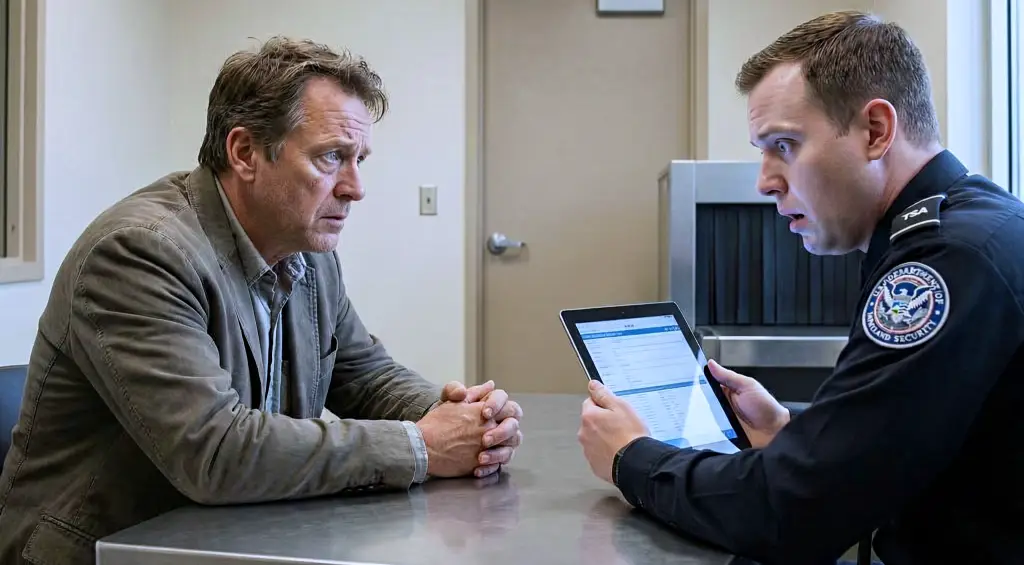
I was at the airport waiting to board a flight to attend the inheritance hearing for my late father’s estate. Everything felt quiet and normal until an airport security officer walked straight up to me.
“Sir, please come with us,” he said.
They told me there had been a report. I was considered a potential threat. Someone believed I might do something dangerous at the courthouse. I immediately explained, calmly and clearly. I told them I was simply traveling to honor my father’s final plans and that I hadn’t threatened anyone. I insisted this had to be a misunderstanding.
The officer studied my face for a long moment without saying a word. Then he turned the screen toward me.
“This is the person who reported you,” he said.
I froze when I saw the name.
I need to tell you why I was standing at Portland Airport security at 6:15 in the morning on October 15, 2024, with my hands shaking from three cups of coffee and zero hours of sleep. My father, Arthur Fletcher, died three weeks ago from a heart attack in his sleep on September 24.
He was 82 years old and had spent 60 years building Fletcher Ranch in Montana. It was 500 acres of cattle land that he worked with his own two hands. No loans, no shortcuts—just decades of sunrise-to-sunset labor that turned raw Montana earth into something worth fighting for.
The funeral was small. My son, Benjamin, showed up, stood in the back, and left without saying a word to me. That was fine; we hadn’t been close in years. But yesterday, he finally called.
“We need to talk about Grandpa’s will.” That was it.
No “I’m sorry for your loss.” No “How are you holding up?” Just business. Cold and transactional.
Here is what Benjamin didn’t know: I knew that six months before he died, my father changed his will. The old one split everything 50-50 between me and Benjamin. The new one left everything to me—100%. The ranch, the house, the cattle, all of it.
So, this morning, I had a flight to Montana. There was a probate hearing at Park County Courthouse at 10:00 sharp. Benjamin’s lawyer had filed a motion to contest the will. My father’s attorney, Philip Garrett, told me I needed to be there in person. No exceptions.
I’d done the math a hundred times: wheels up at 7:00, land at 9:15, drive 45 minutes to the courthouse. Tight, but possible. That’s why I was at airport security at 6:15 a.m., placing my bag on the conveyor belt. Inside were my father’s letters—30 years of correspondence carefully organized—along with his medical records, personal journals, and everything I needed to prove he was sound of mind when he made that final decision.
I walked through the metal detector. No beep. Clean. I reached for my bag on the other side, already calculating my next moves. Gate C7. Maybe grab coffee. Review Philip’s notes one more time.
“Excuse me, sir.”
The voice came from my left. A TSA officer, mid-30s, with the kind of neutral expression that comes from years of dealing with difficult passengers. Officer Collins, according to his badge. His partner, Officer Parker, stood a few feet behind him.
“Yes?” I kept my voice even. Thirty years of teaching high school had trained me for moments like this. Stay calm. Don’t react.
“We need you to come with us, please.”
My stomach dropped, but I kept my face neutral. “Is there a problem?”
“Just some routine questions. This way.”
Collins gestured toward a door marked Security Office: Authorized Personnel Only. Parker picked up my carry-on without asking. The message was clear: this wasn’t optional. Stay calm. This is just like dealing with a student who’s lying to your face. Don’t react. Listen first.
They led me down a narrow corridor into a small office. No windows. Gray walls. One metal table bolted to the floor with three chairs that looked like they’d been there since the 1990s. The air smelled like stale coffee and cleaning solution.
Collins motioned for me to sit. I did. Parker set my bag on the table and took up a position by the door—not blocking it, but close enough to send a message.
“Mr. Fletcher,” Collins began, pulling out a tablet. “We received a report about you this morning.”
My heart rate kicked up, but I kept my hands flat on the table. “What kind of report?”
Collins glanced at the screen, then back at me. “A phone call came in earlier. The caller identified himself as Benjamin Fletcher. He said he was your son.”
The room tilted slightly. Benjamin.
“The call came in at 4:47 this morning,” Collins continued. His tone was professionally neutral, but his eyes were watching me carefully. “The caller stated that you were traveling today. He expressed concern that you might pose a potential threat to public safety.”
4:47 a.m. Two and a half hours before my flight. A threat.
“A threat?” The word came out rougher than I intended. “What kind of threat?”
Parker shifted his weight by the door. “The caller claimed you’d been acting erratically since your father’s recent death. He mentioned an inheritance dispute and said you’d made statements about doing ‘whatever it takes’ to get what you believe you deserve.”
Those words. My exact words from yesterday’s phone call. I’d said them in frustration, in grief, in the aftermath of losing the man who’d taught me everything about integrity. I had meant I would fight legally, through proper channels. Benjamin had turned them into something else.
“Officers,” I said carefully. “I’m a retired high school teacher. I’ve never been arrested, never been in a fight. My father died three weeks ago. There’s a probate hearing in Montana this morning. I need to be there.”
Collins studied me. “And your son? Where does he fit into this?”
“He’s contesting my father’s will. So there is a dispute. A legal one. The kind that happens in courtrooms, not airports.”
Parker spoke from his position by the door. “Your son sounded genuinely concerned, Mr. Fletcher. He gave us specific details. Your flight time. Your destination. He knew exactly what you’d be carrying.”
Ice water flooded my veins. Benjamin hadn’t just called to report a vague concern. He’d given them my entire itinerary. Every detail was calculated to make this stop as long and as thorough as possible.
“Mr. Fletcher,” Collins said, “you understand why we have to take this seriously. A family member calls us, says his father might be dangerous, and gives us specific travel information. We can’t just ignore that.”
“I understand.” My voice sounded hollow. “You’re doing your job.”
What I didn’t say was: And my son knew exactly what job you’d do. He knew exactly how long this would take.
Collins glanced at his watch. “It’s 6:28. When does your flight board?”
“6:52.”
Twenty-four minutes. The hearing started at 10:00. If I missed this flight, there wasn’t another one that would get me there in time. Benjamin’s lawyer would argue that I didn’t care enough to show up—that my father made a mistake trusting me with his legacy.
Collins was still watching me, tablet in hand. Waiting for something. An explanation. A reaction. Proof that his son’s concern was justified, or proof that it wasn’t.
I thought about the funeral three weeks ago. Benjamin standing at the back of the chapel, arms crossed, face unreadable. How he’d left before I could even try to talk to him. How his truck was already pulling out of the parking lot while I was still shaking hands with neighbors who’d known my father for 40 years.
I thought about yesterday’s phone call. That flat, transactional tone. No grief. No emotion. Just, “We need to talk about Grandpa’s will.”
And now this. A call at 4:47 in the morning. Six minutes and 42 seconds of carefully chosen words. Specific details about my travel plans. About the threats I’d supposedly made. All timed perfectly to keep me in this room while my flight boarded without me.
Officer Collins set his tablet on the table between us. The screen was still lit up showing the call log.
“Mr. Fletcher,” he said quietly, “I’m going to read you exactly what your son told us. Then you can tell me your side.”
He picked up the tablet and began reading, his voice steady and official.
“We received a call this morning at 4:47 a.m. Duration: six minutes, 42 seconds. Caller identified himself as Benjamin Fletcher, age 32, residing in Billings, Montana. He stated that his father, Scott Fletcher, age 58, was traveling from Portland to Montana today. The caller expressed concern that his father had been acting unstable following the recent death of his grandfather. He claimed his father made verbal threats during a phone conversation yesterday, specifically stating he would ‘do whatever it takes’ to claim an inheritance he believes he deserves.”
Collins looked up from the screen. “The caller also stated that you might be a danger to public safety and requested that we detain you for questioning.”
The words hung in the air like smoke. My hands went cold on the armrests—not from fear, not from anger, but from the sudden, absolute clarity of what was happening. My son, Benjamin—the boy I’d raised, the boy I’d taught to ride a bike, to throw a baseball, to stand up for what was right—had just called airport security and reported his own father as a threat. Not because he believed it, but because he knew exactly what it would do.
The security office felt smaller with every passing second. Officer Collins sat across from me, a tablet glowing between us like evidence at a trial. Parker stood by the door, arms crossed, studying my face for any crack in composure.
I’d spent 30 years teaching teenagers how to lie and how to spot one. I knew the signs: eye contact that lingered too long, defensiveness that arrived too fast, the nervous laugh that came a beat late. So, I sat still and kept my breathing even.
Collins cleared his throat. “Mr. Fletcher, I’m going to read you the report your son filed, then we’ll ask a few follow-up questions.”
“I understand.”
He scrolled and began reading in a flat, official tone. “Caller states his father, Scott Fletcher, has been mentally unstable since the death of his grandfather three weeks ago. Caller reports statements including, ‘They won’t get away with this’ and ‘I’ll make sure justice is served.’ Caller expresses concern that his father may do something dangerous at today’s probate hearing. Subject is carrying estate documents. Caller fears subject may destroy evidence if confronted.”
Collins looked up. “The caller also stated you were recently fired from your teaching position.”
“That’s not true,” I said calmly. “I retired two years ago. Jefferson High School, Northeast Portland. You can verify that.”
Parker shifted. “People who get fired often say they retired.”
“People who retire have pension statements,” I replied, “and a retirement party photo album in their attic. I can give you the principal’s number.”
Collins made a note. “The caller seemed convinced you were a threat to public safety.”
“The caller,” I said carefully, “is my son, and he’s contesting a will that leaves him nothing. His definition of threat may be subjective.”
“You’re saying he lied.”
“I’m saying he told you a version of events designed to keep me here long enough to miss my flight.”
“That’s a serious accusation. So is calling airport security at 4:47 a.m. to report your own father.”
Collins set the tablet down. “Would you like to hear the actual recording of the call?”
I blinked. “You recorded it?”
“All TSA threat calls are recorded. For liability.” He hesitated. “Usually, we don’t play them.”
“I want to hear it.”
He pressed play. My son’s voice filled the room, worried, strained, carefully controlled.
“This is hard for me, but I’m concerned about my father’s behavior. He’s been erratic since my grandfather passed away three weeks ago.”
The operator asked him to explain.