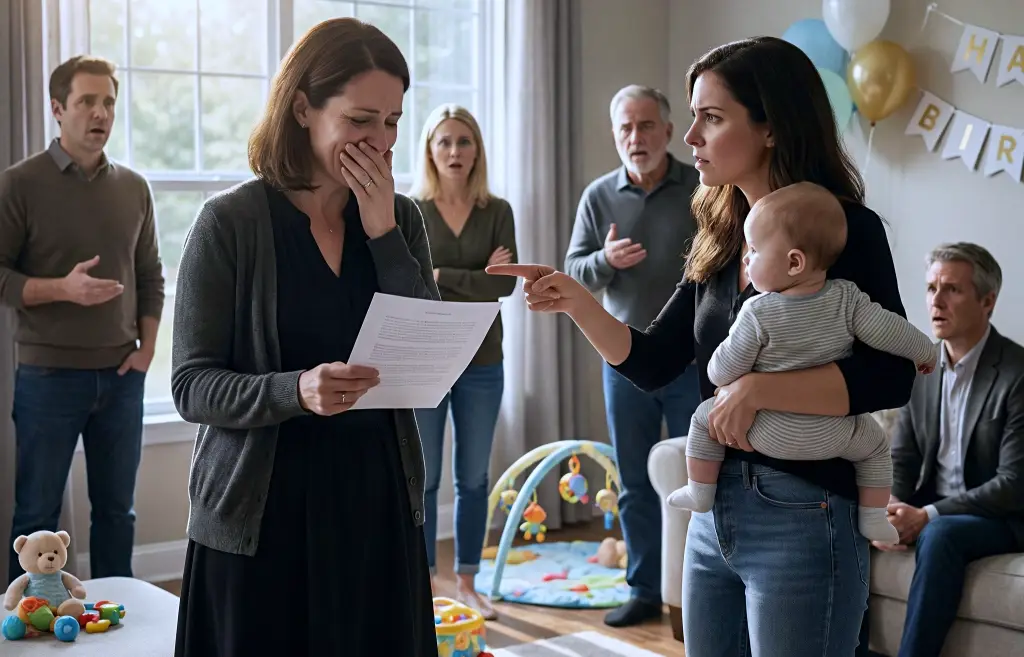
The silence that descended upon the room was absolute, a suffocating blanket that seemed to suck the very air from my lungs. Following the devastating ordeal of my husband’s funeral, I had forced myself to attend my nephew’s first birthday party, only for my sister to drop a bombshell that shattered the fragile composure I was barely maintaining.
“My son is Adam’s child,” she announced, her voice trembling with a mixture of defiance and theatrical performance. “So, regarding the inheritance… I will be taking half of your $800,000 house.”
She did not stop at the verbal assault; she even produced a document she claimed was his will. I stared at her, then at the paper, and finally managed to say, “Oh, I see.” It took every ounce of self-control I possessed to hold back the hysterical laughter bubbling in my chest. My name is Bridget, and at thirty-four years old, being a widow was a nightmare I never expected to navigate.
Three months ago, I lost Adam, my husband of eleven years, to a sudden, catastrophic aneurysm. The grief was still a raw, physical weight. Yet, mere days after laying him to rest, I dragged myself to my nephew Lucas’s birthday, only to listen to Cassandra claim that my late husband was the father of her child and demand half of my estate.
What she did not know—what nobody in that room knew—was why I was fighting the urge to laugh. You will want to hear how I handled what came next.
Adam and I met twelve years ago at a charity auction benefiting pediatric cancer research. I was volunteering, helping to organize the silent auction items. He outbid everyone else for a painting I had been admiring from afar all night.
It was a watercolor of the Boston skyline at sunset. Vibrant oranges and purples bled into the harbor. After winning, he walked straight over to me and handed it over.
“I noticed you looking at this all night,” he said with a smile that made his blue eyes crinkle at the corners. “I think it belongs with you.”
That was Adam: thoughtful, observant, and generous to a fault. I fell hard and fast. We went on our first date the next evening, and it felt like we had known each other our entire lives.
He was a corporate attorney, brilliant but humble. He was the kind of man who remembered the names of waitstaff and asked genuine questions about their lives. Eight months after we met, he proposed on the harbor.
The actual skyline mirrored the painting that had brought us together. We bought our Victorian home in Beacon Hill shortly after our first anniversary. It was a stretch financially at $800,000, but Adam had just made partner at his firm.
I was building a solid reputation as an interior designer. The house needed work, but it had good bones and high ceilings. It also had a small garden out back where I envisioned future children playing.
Those children never came. Not for lack of trying. For years, we charted, planned, and hoped.
Then came the doctors, the tests, and the procedures. Years of fertility treatments drained our savings and our spirits. I still remember the last failed attempt and the quiet drive home from the clinic.
Adam reached across the console to hold my hand. Neither of us spoke because we both knew that was the end of that road. “We can still have a beautiful life,” Adam said that night as we sat on our porch swing.
“You and me, that is enough.” And he meant it. We slowly rebuilt our dreams.
We traveled and poured ourselves into our careers. We renovated the house room by room until it was the showcase home I had always imagined. Adam supported my business when I decided to launch my own interior design firm.
Our life was full, even if it was different than what we had first planned. My younger sister, Cassandra, was always in the periphery of our happiness. Four years younger than me at thirty, she had always been the wild child of the family.
While I was studying design and building a business, she was bouncing between jobs and relationships. Our parents constantly worried about her. This translated to them making excuses for her behavior and bailing her out of financial troubles repeatedly.
Cassandra and I had a complicated relationship from childhood. She was undeniably beautiful, with the kind of effortless charm that drew people to her. But there was always an undercurrent of competition from her side.
If I achieved something, she needed to one-up me. When I started dating Adam, she suddenly became interested in law students. When we bought our house, she complained for months about her apartment, fishing for our parents to help her upgrade.
It was exhausting, but Adam encouraged me to maintain the relationship. “She is your only sister,” he would remind me. “Family is important.”
Two years ago, Cassandra started dating Tyler, a bartender she met while out with friends. He was handsome in a rugged way, with tattoos covering his arms and a motorcycle that our parents disapproved of. Their relationship seemed volatile from the outside, with dramatic breakups and passionate reconciliations.
Then came the pregnancy announcement at Thanksgiving dinner the year before Adam died. It was unexpected, to say the least. I was living up to societal expectations, yet there she was, announcing her pregnancy with theatrical tears.
She made declarations about the miracle of life. I felt the familiar sting of jealousy. After all our struggles and heartbreak, Cassandra had accidentally achieved what we had desperately wanted.
But I pushed those feelings down. I was genuinely happy for her, and I was determined to be the best aunt possible to her child. Lucas was born a healthy baby boy, though small.
I was at the hospital with flowers and a handmade blanket I’d spent months knitting. Cassandra seemed overwhelmed by motherhood from the start. She often called me in tears about Lucas’s fussiness or her exhaustion.
I stepped in as much as I could, sometimes watching Lucas overnight so she could sleep. Adam was less involved with Lucas than I was. In retrospect, I thought it was because of our own struggles with starting a family.
I assumed it might be painful for him to bond with a baby that was not ours. He was always kind when Cassandra brought Lucas over, but he maintained a certain distance. I never questioned it at the time.
Then came that terrible Tuesday morning. Adam complained of a headache before leaving for work. I suggested he stay home, but he had an important client meeting.
“Just a migraine,” he insisted, kissing me goodbye. “I will call you after the meeting.” That call never came.
Instead, I got a call from the hospital. By the time I arrived, he was already gone. Brain aneurysm, they said.
Nothing could have been done. He was thirty-six years old. The next days passed in a blur of arrangements and grief.
Cassandra was strangely absent during most of it. She sent text messages claiming Lucas was sick or she could not find a babysitter. When she did appear at the funeral, she stayed briefly, keeping to herself and leaving before the reception.
I was too numb with grief to think much of it at the time. One week after we laid Adam to rest, Lucas’s first birthday arrived. The last thing I wanted to do was attend a children’s birthday party.