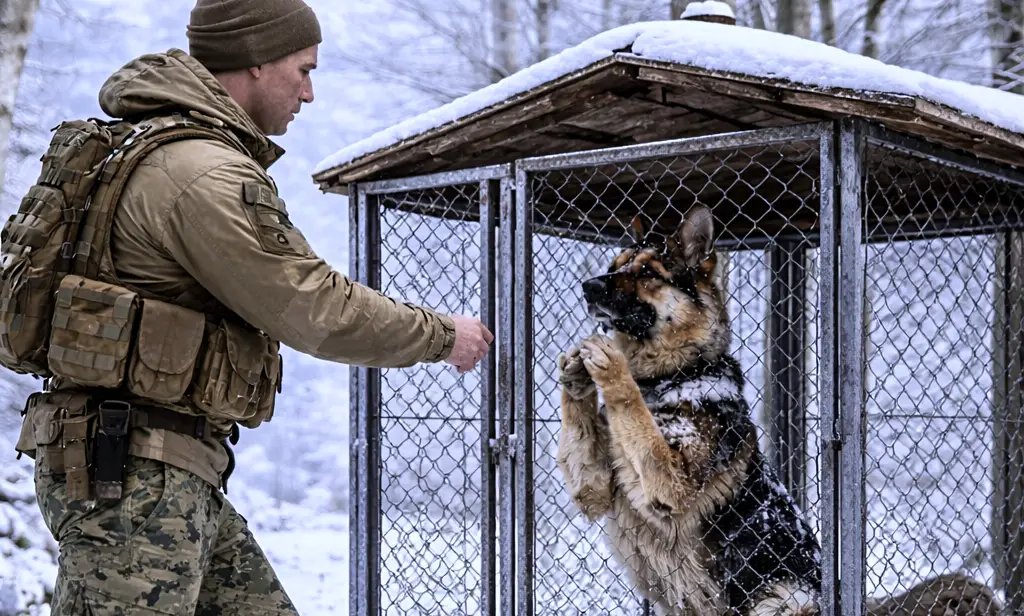
The forest was entombed in white, a vast stillness where the trees stood stripped and skeletal, and life itself seemed paused by the iron grip of winter. In the center of this frozen silence, a German Shepherd remained locked inside a steel cage, exposed to the biting wind. His reserves were nearly depleted, every inhalation a battle against the chill, his body consuming the last of its willpower as he waited for an impossible mercy.
There were no sounds of struggle, no witnesses to the crime, only the slow passage of time assigned to finish what cruelty had started. Then, a Navy SEAL stepped into the clearing, refusing to look away, as if guided by an invisible hand. In that instant, it wasn’t merely a life hanging by a thread, but a buried truth waiting beneath the frost, ready to be unearthed.
The morning light in the far northern reaches of the United States was so distinct it felt sharp enough to cut. An unbroken sheet of snow draped the mountain slopes, capturing the pale sun and reflecting it with the brilliance of shattered glass. The air was pure but aggressive, the sort of cold that slipped into the lungs and took up residence, a stark reminder that survival in these parts was never a promise, only a negotiation.
Cade Merritt navigated the forest service road with deliberate slowness, his hands relaxed yet firm on the steering wheel. He sat with an effortless upright posture, the result of discipline that had settled deep into his marrow. At forty, he moved with the contained energy of a man trained not to project strength, but to be perpetually prepared for its necessity.
Beneath his long-sleeved camouflage shirt, his shoulders were broad, the fabric hugging his torso, while the tactical belt at his waist sat with the familiarity of a second skin. His dark hair featured a clean undercut, maintained with precision despite his isolated lifestyle. His blue-gray eyes remained restless, scanning the tree lines and snowbanks, driven by habits formed long before his tires ever crunched over this mountain gravel.
Cade hadn’t come to the high country for sightseeing. Sheriff Nolan Briggs had phoned him the previous evening, his voice raspy with fatigue, asking Cade to investigate a sector of the forest where locals had reported the irregular rhythm of chainsaws—sounds that didn’t match the schedule of legal logging crews. Nolan was a solid, stocky man in his fifties with graying hair and a pragmatic nature that ran deeper than his badge.
He trusted Cade because Cade didn’t embellish and never spoke more than the situation required. Cade had accepted the request immediately. He lived a quiet existence near the town of Pineville, keeping his distance from local entanglements, yet he had never learned how to turn a deaf ear to the wrong kind of noise in the woods.
As the road wound upward, the dense timber gave way to exposed granite and wind-scoured drifts. Cade slowed the truck instinctively, his gut sensing a discrepancy before his eyes confirmed it. Then, the anomaly appeared.
Just past the edge of the trees, where the mountain flattened into a narrow ridge, stood a construction that was alien to the landscape. It was a metal cage elevated on crude wooden pilings, its iron bars thickened with hoarfrost. The structure was cobbled together with rusted wire and sealed with a corroded padlock.
A slender metal pipe protruded from one corner, leaking a thin ribbon of gray smoke that dissipated uselessly into the vast sky. The arrangement appeared deliberate, meticulous in the worst possible way—as if designed to prolong suffering. Cade killed the engine and stepped out, his boots crunching loudly on the packed snow.
The cold attacked immediately, but his breathing remained rhythmic. He approached with caution, his hand drifting near his belt out of muscle memory, though the only visible enemy was the wind. Inside the enclosure stood a dog, a German Shepherd, full-grown and powerfully built despite its diminished condition.
Snow matted its thick black and tan coat, particularly along the dark saddle of its back. Its ears stood erect but shivered violently, and its amber eyes tracked Cade’s approach with laser focus. The gaze wasn’t feral or pleading; it was the alert stare of a creature that had adopted vigilance as a primary survival tactic.
The animal favored one front leg, placing only a fraction of its weight on it, a subtle limp hinting at an old injury left to heal on its own. The dog did not bark. That silence, loud in the empty clearing, told Cade this was no accidental abandonment.
He stepped closer, cataloging the details: an empty metal bowl frozen to the cage floor, shallow gouges where claws had frantically scraped against the ice, and a faint indentation around the dog’s neck where a collar or tether had once dug in for too long. This wasn’t a case of panic or negligence. This was a methodical act.
Whoever placed the animal here understood exactly what the mountain climate would achieve given time. They hadn’t used a bullet; they hadn’t wanted blood staining the snow. Winter, efficient and silent, had been subcontracted to complete the job.
Cade knelt, bringing himself to eye level with the dog. Close up, he could see the animal’s chest rising in shallow puffs, white vapor escaping, muscles rigid as if held together by sheer stubbornness. The look in the dog’s eyes was devoid of desperation.
It was a watchful, assessing stare, seemingly weighing whether this camouflage-clad human was another cog in the machine of his misery or a disruption to it. Cade extended his hand slowly, palm flat and open.
“Easy,” he murmured, his voice pitching low and steady—the tone reserved for diffusing volatile situations. The dog sampled the air, then took a single, tentative step forward, claws clicking against the metal floor. Snapping the lock took less than sixty seconds.
Cade utilized a compact multi-tool from his belt, his fingers moving with dexterity despite the freezing temperature. When the door creaked open, the dog hesitated, muscles bunching, as if the concept of freedom had become foreign. Then, he stepped out, one deliberate movement at a time, and the true extent of his exhaustion was revealed.
Without a second thought, Cade stripped off his outer jacket and draped it over the dog’s back, feeling the violent tremors coursing through the animal’s frame. He hoisted the dog with controlled strength, struck by the paradoxical weight—heavy with dense muscle, yet light with deprivation.
As Cade turned toward the truck, the dog twisted in his arms, looking back toward the forest. His ears pricked despite the chill, eyes locking onto the dark treeline below the ridge. He wasn’t looking at the cage; he was looking past it, deeper into the woods, as if something unseen still held significance there.
Cade paused, a familiar tightness gripping his chest. He had long ago learned to heed those quiet signals that offered no immediate explanation. He carried the dog to the cab, placed him gently on the seat, and cranked the heater to its maximum setting.
The descent was slow. Cade steered with one hand, the other resting near the dog, feeling the shivers subside incrementally as the warmth penetrated. He noted how the dog processed sound: the distant buffet of wind, the groan of the truck’s suspension. Every noise was registered, analyzed, and filed away.
This was no stray. This was an animal that had worked, trained to link patterns with consequences. About a third of the way down the mountain, an incident occurred that made Cade’s grip on the wheel tighten.
The dog suddenly snapped his head up, emitting a low, restrained growl—not out of aggression, but urgency. His eyes were glued to the rearview mirror and the vacant road behind them. Cade checked the glass.
The road was empty—no headlights, no motion, just snow and sky. Yet the dog remained rigid, breathing accelerating as if reacting to a memory rather than a presence. Cade slowed the vehicle regardless, sweeping the surroundings with his eyes.
The growl tapered off, replaced by a fixed stare ahead, but the tension lingered, heavy with unasked questions. Whatever entity had placed that cage on the mountain, the business was unfinished. By the time Cade reached his cabin near Pineville, the sun had climbed, transforming the snow into a blinding field of light.
He carried the dog inside, settling him near the wood stove, and offered small sips of water, careful not to overwhelm his system. The dog accepted the aid without lowering his guard, eyes tracking Cade, ears swiveling at every ambient noise. Cade observed the scar tissue along the shoulder and a faint burn mark on a scrap of scorched nylon tangled in the fur.
It appeared to be a remnant of an old tactical harness, damaged by heat or flame—a souvenir from a previous life. Cade leaned against the kitchen counter, studying the animal. in a different reality, he might have called animal control and washed his hands of the situation.
But the mountain hadn’t selected someone else. It had chosen this route, this time, and this man. Cade felt the familiar burden of responsibility descend, the same sensation that used to precede missions where the margin for error was non-existent.